Key Highlights
- Circle stock traded near $81.17, with a market cap of about $21.68 billion, while the base DCF model points to a fair value of nearly $49 per share.
- The model suggests CRCL is about 66% overvalued against base fair value, with roughly 40% downside if the stock returns to the DCF-implied level.
- Circle’s valuation depends heavily on USDC circulation, reserve income, Treasury yields, and distribution costs, rather than crypto trading volume.
Circle Internet Group stock is trading well above the level suggested by a base discounted cash flow model, even as the company continues to report strong growth in USDC-linked revenue.
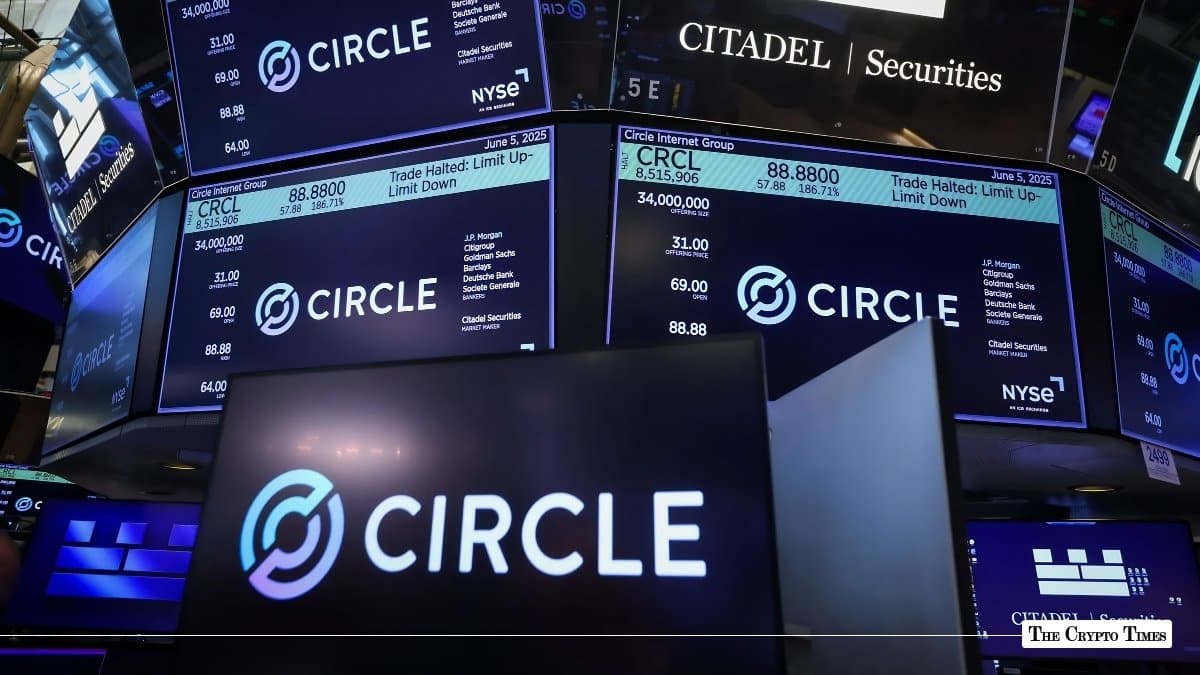
CRCL was recently trading near $81.17, with an intraday range between $78.59 and $81.37. At that price, Circle’s market capitalization stands near $21.68 billion.
However, a base DCF model using normalized free cash flow, a 10.5% discount rate, and 3.5% terminal growth gives Circle an estimated fair value of around $49 per share.
That means the stock is trading roughly 66% above base fair value.
| Metric | Value |
|---|---|
| Current CRCL price | $81.17 |
| Base DCF fair value | ~$49 |
| Overvaluation vs fair value | ~66% |
| Downside to fair value | ~40% |
| Market cap | ~$21.68B |
The difference does not mean the stock must fall immediately. It means the current market price is already assuming that Circle can convert stablecoin growth into much larger long-term cash flow.
What DCF Means for Circle Stock
A discounted cash flow model values a company based on the cash it may generate in the future. Those future cash flows are then discounted back to today because money earned in the future is worth less than money earned now.
In simple terms, DCF asks:
“How much is Circle’s future cash flow worth today?”
The basic idea is:
Where:
| Term | Meaning |
|---|---|
| FCF | Free cash flow |
| r | Discount rate |
| Terminal value | Value of cash flows beyond the forecast period |
| Fair value | Present value of all future cash flows |
For Circle, this model is useful because the company has visible revenue streams from USDC reserves. But it is also risky because Circle’s earnings are sensitive to interest rates, partner payouts, and stablecoin circulation.
Circle’s Q1 Numbers Support Growth, But Costs Matter
Circle’s Q1 showed strong top-line growth, but the cost structure remains important.
The company reported reserve income of $653 million, up 17% year over year, mainly because average USDC in circulation grew 39%. However, the benefit was partly offset by a 66 basis point decline in reserve return rate.
That is the key issue for valuation.
If USDC supply grows but reserve yields fall, Circle’s revenue may not rise at the same speed as circulation. At the same time, distribution, transaction, and other costs remain large because Circle shares economics with partners and distributors.
Circle reported adjusted EBITDA of $151 million in Q1 2026, up 24% year over year, while net income from continuing operations fell 15% to $55 million.
| Q1 2026 Metric | Value |
|---|---|
| USDC circulation | $77.0B |
| USDC onchain volume | $21.5T |
| Total revenue and reserve income | $694M |
| Reserve income | $653M |
| Net income | $55M |
| Adjusted EBITDA | $151M |
The numbers show Circle is scaling, but the valuation already assumes that this scale will translate into much higher free cash flow.
Base DCF Model Puts Circle Near $49
The base model starts with normalized free cash flow of about $450 million. This is below annualized adjusted EBITDA because the model adjusts for taxes, capex, software investment, stock-based compensation dilution, and reinvestment needs.
| Year | Estimated Free Cash Flow |
|---|---|
| 2026 | $450M |
| 2027 | $540M |
| 2028 | $637M |
| 2029 | $733M |
| 2030 | $821M |
| 2031 | $903M |
Using a 10.5% discount rate and 3.5% terminal growth, the model gives Circle an enterprise value of about $10.75 billion. After adding roughly $2.3 billion of liquidity, the equity value comes to about $13.05 billion, or around $49 per share.
Circle reported it had $2.3 billion of total liquidity as of March 31, 2026, including $1.5 billion in cash and cash equivalents and $792.7 million in cash and equivalents segregated for corporate-held stablecoins. Its convertible debt balance was eliminated after the remaining notes converted into Class A common stock in Q1.
| DCF Output | Value |
|---|---|
| PV of forecast cash flows | ~$2.46B |
| PV of terminal value | ~$8.29B |
| Enterprise value | ~$10.75B |
| Add liquidity | ~$2.30B |
| Equity value | ~$13.05B |
| Fair value per share | ~$49 |
How Much Is Circle Stock Overvalued?
Using the current price of $81.17 and base DCF fair value of $49, the overvaluation is calculated as:
So Circle stock appears about 66% overvalued against base fair value.
The downside to fair value is calculated differently:
That means CRCL would need to fall about 40% to return to the base DCF level.
| Valuation Measure | Result |
|---|---|
| Overvaluation vs fair value | ~66% |
| Downside to fair value | ~40% |
Bear, Base, and Bull Case for CRCL
Circle’s valuation changes sharply depending on how fast USDC grows and how much reserve income converts into cash flow.
| Scenario | Assumption | Fair Value |
|---|---|---|
| Bear case | Rates fall, USDC growth slows, costs stay high | ~$21 |
| Base case | USDC grows, but rates normalize lower | ~$49 |
| Bull case | USDC growth stays strong, Arc and payments scale | ~$108 |
The current price near $81 sits between the base and bull case. That means investors are not pricing Circle as a modest-growth financial company. They are pricing it as a high-growth stablecoin infrastructure company.
What the Market Is Pricing In
At the current market cap of about $21.68 billion, Circle’s operating business is valued at nearly $19.4 billion after adjusting for liquidity.
To justify that valuation under the base DCF framework, Circle would need normalized starting free cash flow closer to $800 million, compared with the base model’s $450 million.
That implies the market expects at least one of three things:
- USDC circulation keeps compounding at a high rate.
- Reserve margins stay stronger than expected despite rate cuts.
- Arc, payments, transaction revenue, and enterprise services become meaningful profit centers.
Circle has already shown strong growth. In FY2025, total revenue and reserve income grew 64% to $2.7 billion, while adjusted EBITDA grew 104% to $582 million.
But for the stock to justify its current price, the company needs more than growth. It needs durable free cash flow growth.
The Main Risk Is Interest Rate Compression
Circle’s biggest valuation risk is lower reserve yield.
The company benefits when USDC supply grows, but it also earns income based on the return generated from reserves. If interest rates fall faster than USDC circulation rises, revenue growth can slow.
This is why the market is watching Circle’s non-reserve revenue. The stronger Circle becomes in payments, subscriptions, Arc infrastructure, transaction services, and enterprise integrations, the less dependent the valuation becomes on Treasury yields.
Until then, the stock remains sensitive to the interest-rate cycle.
Price Outlook: CRCL Needs Growth to Defend $81
Circle’s current price near $81 already prices in a strong long-term outlook. The base DCF does not support that level unless normalized free cash flow rises toward $800 million to $1 billion annually.
If the market focuses on near-term reserve income and rate risk, CRCL could face valuation pressure toward the $49 base fair value zone.
If investors continue to price Circle as the leading public stablecoin infrastructure company, the stock can remain above DCF fair value for longer, especially if USDC circulation grows and Arc begins contributing to revenue.
Conclusion
Circle is one of the cleanest public-market stablecoin plays, but the stock is no longer cheap on a DCF basis.
The base valuation points to $49 per share, while CRCL trades near $81. That leaves the stock about 66% overvalued versus base fair value, with nearly 40% downside if it re-rates to the model.
The bull case is still real. USDC is growing, onchain volume is rising, and Circle is building beyond reserve income. But at the current price, the market is already paying for that future.
For CRCL to defend its valuation, Circle must prove that stablecoin growth can become durable free cash flow, not just higher reserve income during a favorable rate cycle.
Also Read: BTC, ETH, BNB, XRP, SOL Slip Ahead of Warsh’s First FOMC