
Key Highlights
- Bitcoin fell below $60,000, triggering a market selloff and wiping out more than $1.21 billion in leveraged crypto positions.
- Rising U.S. inflation data increased concerns that the Federal Reserve may keep interest rates higher for longer.
- Bitcoin faces additional pressure from $6.4 billion in ETF outflows and a $9.33 billion options expiry scheduled for June 27.
Bitcoin (BTC) fell below $60,000 today, sending shockwaves across the cryptocurrency market and triggering about $1.21 billion in liquidations. This decline came after the U.S. inflation data raised concerns that the Federal Reserve may keep interest rates higher for longer.
As the selloff spread, thousands of traders saw their positions automatically closed as prices moved against them.
At the time of this writing, Bitcoin is trading for $59,195, representing a 1.4% drop within the last 24 hours from an intraday low of $58,188 before it recovered slightly back up. Trading activity has increased by 58% to around $49.25 billion in volume. However, this price drop suggests this volume represents traders selling their positions.
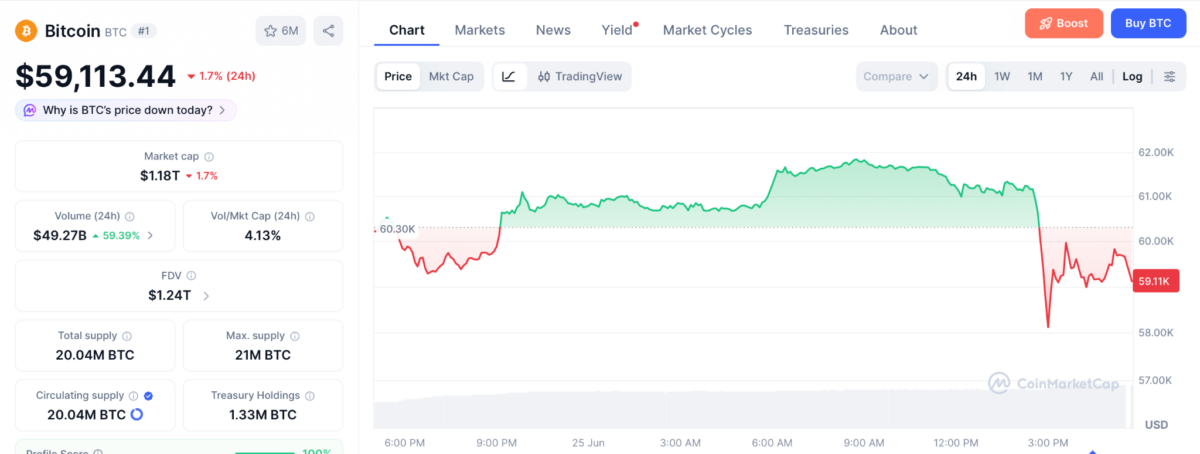
The selloff extended beyond Bitcoin. Ethereum dropped 4.7% to $1,567, while XRP fell 3.7% to $1.03. The broader cryptocurrency market also weakened, with total market capitalization declining 2.2% to $2.13 trillion.
$1.21 billion lost as traders face liquidations
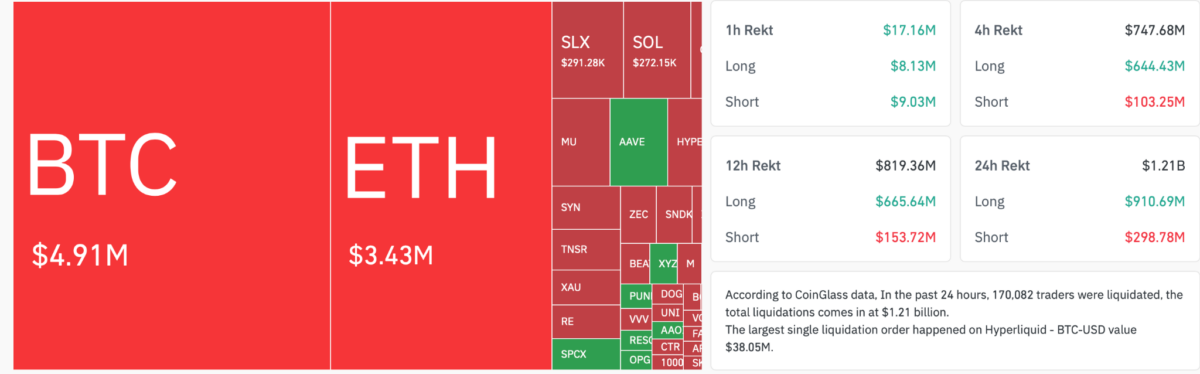
The decline led to a large wave of liquidations across crypto exchanges. More than 170,082 traders were liquidated over the past 24 hours. Liquidation happens when traders use borrowed money to place bigger bets and the market moves too far against them, forcing exchanges to close those positions automatically.
According to data from Coinglass, approximately $1.21 billion worth of positions was wiped out. Around $910 million of that came from bullish positions, compared with about $298 million in losses from short positions. Bitcoin led the liquidation totals, with around $551 million wiped out, followed by Ethereum at $359 million and XRP at $50.5 million.
Inflation data adds pressure to assets
The decline came shortly after the release of the latest U.S. inflation figures. According to the U.S. Bureau of Economic Analysis, the PCE price index rose 4.1% year over year in May, up from 3.8% in April. On a monthly basis, headline PCE increased 0.4%.
Even though these figures were slightly lower than what economists expected, inflation remains more than double the Federal Reserve’s 2% target. This is important because higher inflation can make it harder for the central bank to lower interest rates.
When investors believe rates could stay high for longer, risky assets such as cryptocurrencies often come under pressure.
The report also showed that the U.S. economy remains relatively strong. Personal income increased by 0.7% in May, while consumer spending rose by 0.3%. First-quarter economic growth was also revised higher to 2.1%. While these figures point to economic resilience, they also support the view that the Federal Reserve may not rush to ease monetary policy.
Major Bitcoin options expiry draws attention
At the same time, traders are preparing for one of the largest Bitcoin options expiries of the year.
According to data from Deribit, about $9.33 billion worth of Bitcoin options, representing 157,611 open contracts, are set to expire on June 27. Open interest remains heavily concentrated in call options between $75,000 and $90,000, while Deribit’s max pain level stands at $72,000.
ETF outflows continue to weigh on Bitcoin
Meanwhile, the pressure on Bitcoin has also been growing from another direction. U.S. spot Bitcoin exchange-traded funds have recorded about $6.4 billion in net outflows over the last 30 days, marking the largest monthly withdrawal period since the funds launched.
According to Farside, the fund recorded around $469 million in outflows on June 24. This was led by BlackRock, which took out about $239 million, followed by Fidelity with $120 million.
As money continues to leave these investment products and traders prepare for a major options expiry, the crypto market remains focused on whether Bitcoin can regain strength above the $60,000 level.
Also Read: Strategy’s STRC Hits Record Low, Raising Bitcoin Funding Risks