
Strategy Inc. (Nasdaq: MSTR), the Bitcoin Treasury Company formerly known as MicroStrategy, is seeing its flagship variable-rate perpetual preferred stock, STRC (Stretch), come under intense selling pressure, trading well below its $100 par value and sparking renewed fears of a Terra-Luna-style death spiral.
STRC has plunged to around $75–$80 in recent sessions, hitting fresh lows near the low $70s intraday. The sharp discount has sent the effective yield for new buyers above 15%, while reigniting online debates that overlay STRC’s price action with the final weeks of Terra’s UST and LUNA in 2022.
MSTR’s Bitcoin Treasury Playbook Meets Market Stress
Strategy Inc. (MSTR) common shares plunged 9.35% on Thursday, closing at $85.33 after hitting an intraday low of $85.00. The stock has now reached its lowest level since early 2024, extending losses of more than 50% over the past month amid the ongoing Bitcoin selloff.
At the same time, Strategy’s variable-rate perpetual preferred stock STRC came under even heavier pressure. It closed at $75.69, down 6.37% for the session, after trading as low as $73.62 intraday — a new all-time low. The shares are now trading at a 24–26% discount to their $100 par value, pushing the effective yield for new buyers above 15% based on the current 11.5% dividend rate.
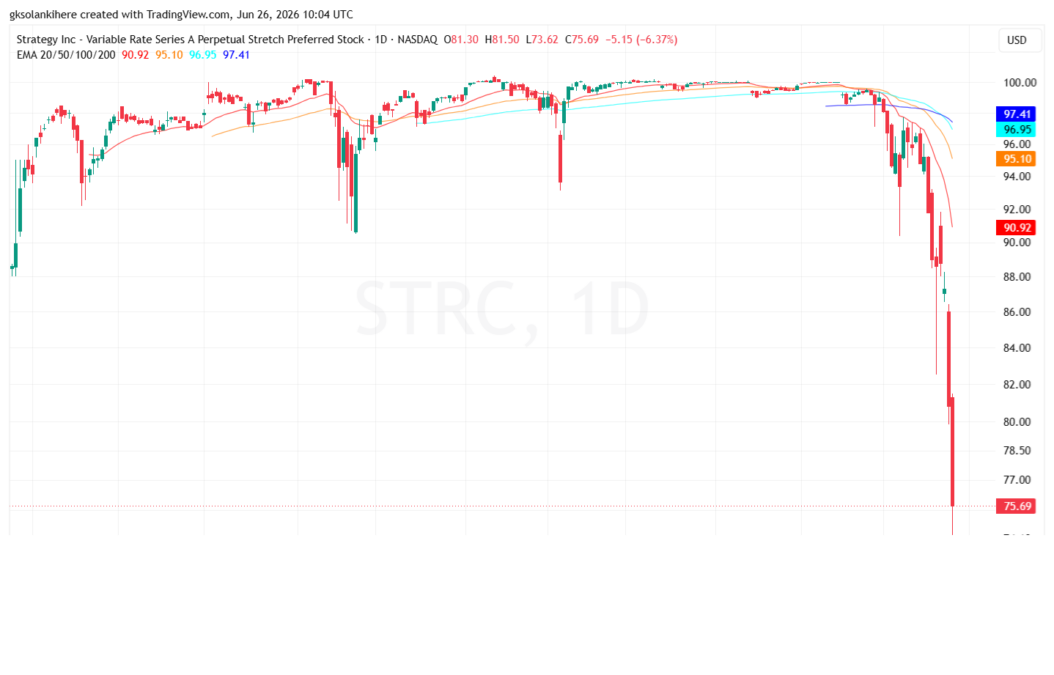
The synchronized decline in both MSTR and STRC reflects broader weakness in Bitcoin, which hovered near $59,800–$60,000 on Thursday. Investors appear increasingly concerned about the sustainability of Strategy’s capital structure as preferred shares trade at deep discounts and dividend coverage comes under scrutiny.
Saylor’s Response
Saylor directly addressed the volatility on X Friday morning: “Volatility tests every capital structure. Strategy remains focused on Bitcoin, disciplined capital allocation, credit quality, and long-term value creation. We appreciate our investors and will continue to execute with transparency and resolve.”
The statement came amid broad weakness in both MSTR common stock and the preferred series. While calm in tone, it underscored the company’s unwavering Bitcoin-first approach even as its innovative capital structure faces its biggest stress test yet.
Why Analysts Reject the Luna Analogy
Despite the online noise, many analysts and researchers argue the comparison is flawed. Unlike Terra’s algorithmic stablecoin, which relied on reflexive minting of LUNA to defend the UST peg and collapsed in a hyperinflationary spiral, STRC is a traditional preferred equity instrument with no peg, no algorithmic arbitrage, and no forced redemption mechanism.
Dividends are discretionary and must be declared by the board from available funds. There is no automatic death spiral trigger. Benchmark and others have called the parallels “fundamentally misguided,” noting that Strategy’s massive Bitcoin holdings provide indirect balance-sheet support, and management retains multiple tools, including rate adjustments, additional preferred issuances, or equity raises, to manage liquidity.
Arkham Intelligence and other on-chain observers emphasized that a lower STRC price does not force Bitcoin sales or liquidation in the way Terra’s design did. “Saylor cannot ‘get liquidated’ if STRC falls,” one analysis noted.
The company itself has branded the approach “bend not break,” relying on the variable rate to absorb shocks rather than shatter under them.
Lingering Risks for MSTR and STRC
Risks remain significant. STRC’s performance is tightly linked to Bitcoin’s trajectory and investor appetite for high-yield exposure to MSTR’s treasury strategy. Prolonged BTC weakness could strain dividend coverage, limit new preferred issuance, and raise questions among common shareholders about value transfer to preferred holders.
Market liquidity for the preferred has also thinned during the selloff, producing wider spreads and sharper moves. Some retail investors who bought near par have taken substantial paper losses, adding to the emotional intensity of the debate.
Outlook
Strategy continues to position STRC and its other preferred series (STRK, STRF, STRD) as core components of a sophisticated Bitcoin acquisition machine. The rebrand from MicroStrategy to Strategy Inc. in 2025 was meant to reflect this singular focus.
Whether the “stretch” mechanism holds will be determined in the coming months. For now, the market is pricing in caution. The discount to par reflects both near-term Bitcoin pressure and skepticism about how effectively the variable dividend can restore equilibrium without further diluting or stressing the broader MSTR capital structure.
The episode highlights the double-edged nature of Saylor’s bold experiment: innovative financing that amplifies Bitcoin upside also magnifies downside volatility. As one market observer noted, volatility is indeed testing every layer of the strategy, from MSTR common equity to the STRC preferred that was supposed to help smooth the ride.
Also read: Why Wall Street is Divided: Michael Saylor’s Scarcity vs. Tom Lee’s Staking Empire