On June 23, 2026, the U.S. Treasury sanctioned additional individuals and entities tied to Cambodia’s Prince Group — expanding what officials describe as the largest action ever taken against a Southeast Asian cybercriminal network. The action followed a U.S. Department of Justice forfeiture earlier this year targeting 127,271 Bitcoin allegedly linked to the network, worth approximately $15 billion at filing and the largest crypto forfeiture in DOJ history.
At the center of the case is Chen Zhi, founder and chairman of Prince Holding Group, a Cambodian conglomerate that publicly presented itself as a real estate, banking, and aviation firm. According to U.S. authorities, behind that corporate facade was a sprawling cyber fraud operation that allegedly used forced-labor scam compounds to defraud Americans through fake crypto investment platforms.
The latest sanctions push three names back into focus: Chen Zhi, Hu Xiaowei, and Qiu Wei Ren. Together, they show how investigators believe the network was built, financed, expanded, and protected across multiple jurisdictions — from BVI shell companies and Singapore family offices to Hong Kong corporate vehicles and a private jet captured at Tokyo’s Haneda Airport.
Key Highlights
- The U.S. DOJ filed the largest forfeiture action in its history, targeting 127,271 Bitcoin (approximately $15 billion at filing) allegedly tied to Chen Zhi’s fraud and laundering network.
- On June 23, 2026, OFAC sanctioned 146 Prince Group transnational criminal organization targets — the largest single action against cybercriminal networks in Southeast Asia. Additional individuals including Hu Xiaowei, Qiu Weiren, Dai An, Fang Zhizhen, Chen Bo, and Brendon Luo were designated.
- Hu Xiaowei, described by U.S. Treasury as a senior figure and alleged “second-in-command” to Chen Zhi, was arrested by Tokyo’s Metropolitan Police in June 2026 in connection with a fraudulent residency notification.
- Singapore Police seized or restricted more than S$500 million (~$600M) in cash, three properties, a yacht, luxury cars, bags, and watches linked to the Prince Group investigation.
- U.S. authorities estimate Americans lost at least $10 billion to Southeast Asia-based scam operations in 2024 — a 66% increase from the previous year. Digital asset investment fraud was among the most lucrative schemes used
Who Is Chen Zhi?
Chen Zhi was born in China’s Fujian province and later became a Cambodian citizen. His rise in Cambodia was fast. Prince Group grew into a major business name, with interests across property, banking, hospitality, and other sectors.
For years, Chen’s public image was that of a businessman and philanthropist. Prince Group’s corporate presence gave the impression of a legitimate regional conglomerate. But U.S. prosecutors and Treasury officials now allege that Chen used this business empire as cover for one of Asia’s largest transnational scam networks.
The U.S. Department of Justice (DOJ) accused Chen Zhi of wire fraud conspiracy and money laundering conspiracy in an indictment unsealed in Brooklyn in October 2025. Prosecutors said Prince Group operated forced-labor scam compounds in Cambodia where trafficked workers were made to run fake crypto investment scams. These scams are commonly called “pig butchering” schemes, where criminals build long-term trust with victims before convincing them to send money or crypto to fake investment platforms.
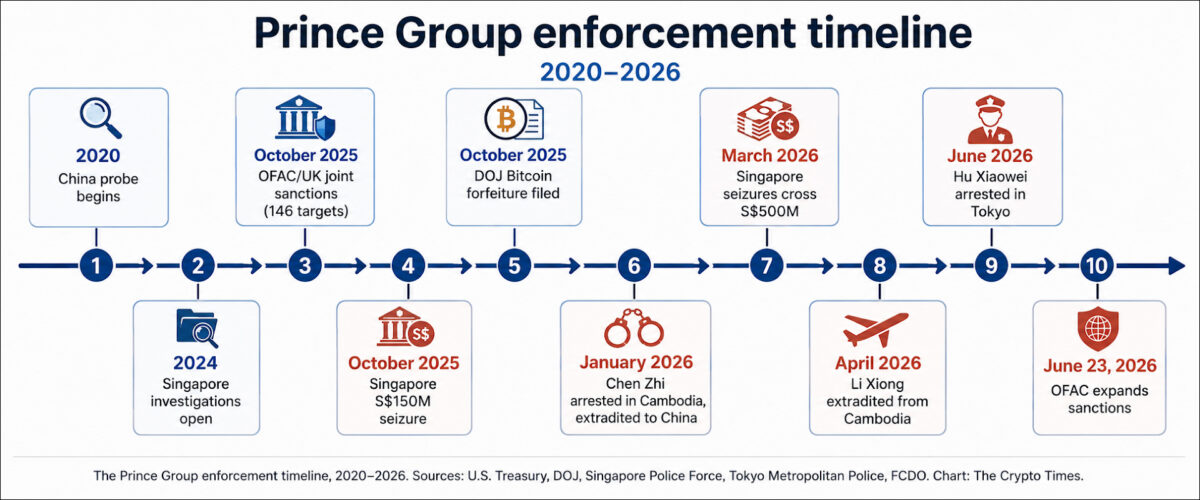
In October 2025, OFAC and the UK’s Foreign, Commonwealth, and Development Office (FCDO) jointly designated 146 Prince Group TCO targets in what Treasury described as “the largest action ever targeting cybercriminal networks in Southeast Asia.” That joint action included 3 Singaporeans and 17 Singapore-registered entities, along with companies registered in Cambodia, Taiwan, Hong Kong, Palau, Laos, the British Virgin Islands, and the Cayman Islands.
Also in October 2025, U.S. authorities also filed what they described as the largest forfeiture action in DOJ history, targeting about 127,271 Bitcoin (BTC) allegedly linked to Chen’s fraud and laundering network. At the time, Bitcoin was valued at roughly $15 billion.
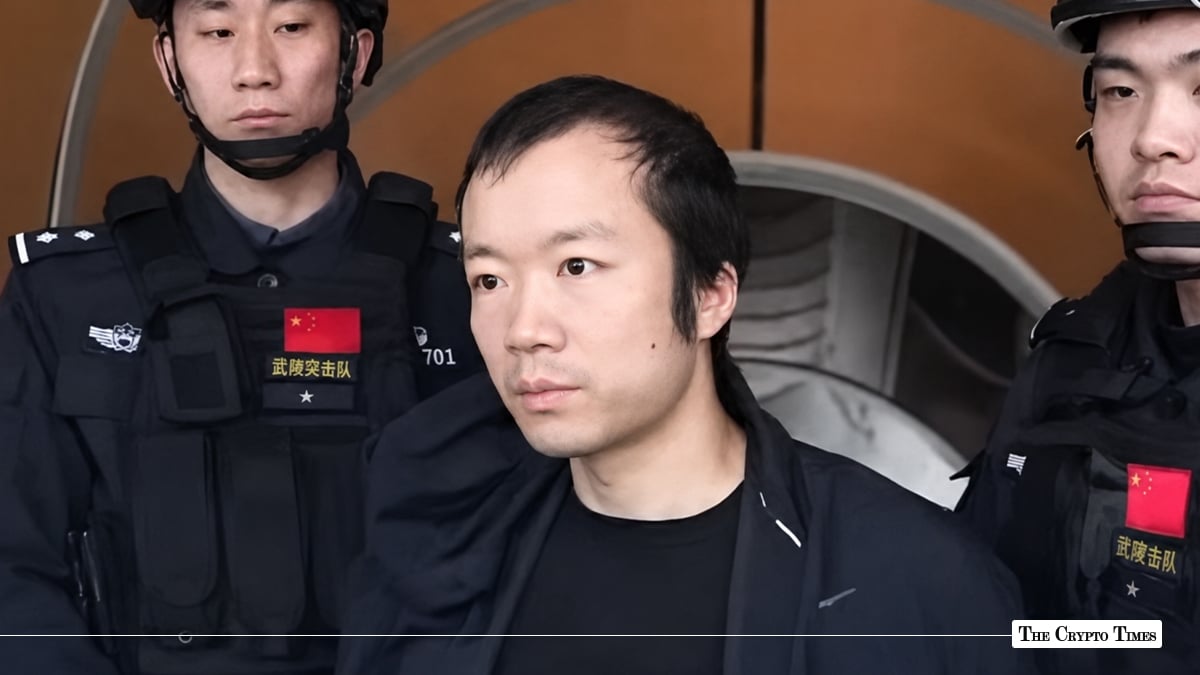
Cambodian authorities arrested Chen Zhi on January 6, 2026, revoked his Cambodian citizenship, and extradited him to China under bilateral cooperation agreements focused on transnational crime. Beijing had been probing Prince Group since 2020. The U.S. criminal charges against him remain allegations unless proven in court, and Prince Group has publicly denied the allegations.
How Prince Group Allegedly Targeted Americans
According to U.S. officials, the scam model was simple but devastating. Victims were usually contacted through social media, messaging apps, dating platforms, or direct text messages. But the scammers deliberately did not immediately ask for money upfront. Instead, they built trust over days, weeks, or even months. In some cases, the relationship looked romantic. In others, the scammer posed as a successful investor, friend, mentor, or business contact.
Once trust was created, victims were directed to what looked like a legitimate crypto trading or investment website. These sites often showed fake profits, fake account balances, and fake trading activity. The goal was to convince victims to deposit more money.

But the platforms were controlled by scammers. When victims tried to withdraw funds, they were told to pay additional taxes, fees, verification charges, or margin requirements. Eventually, the money disappeared.
Treasury Secretary Scott Bessent said in announcing the June 23 sanctions, “Scam centers in Southeast Asia steal billions of dollars from American victims each year.” The official announcement also cited a U.S. government estimate which stated that Americans lost at least $10 billion in 2024 to Southeast Asia-based scam operations, a 66% increase from the previous year. Treasury officials said digital asset investment fraud was one of the most common and lucrative schemes used by these networks.
That is why the Prince Group case matters for crypto readers. This was not just “someone sent Bitcoin to the wrong wallet.” It was an industrialized fraud model built around fake platforms, forced labor, cross-border shell companies, and crypto laundering rails.
The Forced-Labor Side of the Scam
The victims were not only the people who lost money. U.S. officials say many workers inside the scam compounds were also victims.
According to the DOJ, individuals were trafficked into Cambodia and forced to work in scam compounds. These compounds allegedly had dormitories, high walls, barbed wire, and security systems. Workers were allegedly threatened, beaten, and forced to carry out online scams. Amnesty International said it interviewed 73 people released from the compounds and determined that all were victims of human trafficking.
Treasury also said Southeast Asia-based criminal groups often recruit people through fake job offers in technology, customer support, casino work, or online services. Once workers arrive, their passports can be confiscated. They may be trapped through debt bondage, violence, threats, or other forms of coercion.
This is what makes the Prince Group case different from a normal crypto fraud story. It connects fake investment scams with human trafficking, forced labor, money laundering, and offshore corporate structures.
Hu Xiaowei: The Alleged “Second-in-Command”
Hu Xiaowei is now one of the most important names in the Prince Group investigation.
U.S. Treasury officials described Hu Xiaowei as a senior figure in the Prince Group network and said he had been described as a “second-in-command” and “big brother” to Chen Zhi. Hu was previously sanctioned by OFAC in October 2025 under the alias Chen Xiao’er. He is also linked to other names, including Hu Shi and Wu An Ming.
Per the Singapore Police Force and multiple reports, Hu is 44 years old, a Cypriot national, and holds passports issued by Cyprus, St Kitts and Nevis, and Hong Kong. Hong Kong reporting indicates his travel documents have at various points spanned China, Cambodia, Cyprus, and Saint Kitts and Nevis.
According to Treasury, Hu’s role allegedly involved setting up and supervising Prince Group-linked companies outside Cambodia, managing aircraft-related activities, participating in transnational real estate activity, and owning companies ultimately controlled by Chen Zhi.
Specifically, U.S. Treasury said Hu controls three British Virgin Islands companies: Eagle Fortitude Limited, Leisure Focus Limited, and Future King Inc. Through Future King Inc., Hu owns “a large network of companies used to manage funds and properties,” per Treasury. Aviation enthusiasts have linked Hu to private-jet holdings via Hong Kong entities under his control, including a Falcon X8 (registration T7-CLN) photographed at Tokyo’s Haneda Airport in October 2025.
Hu is also tied to a network of offshore and Hong Kong-linked entities. Treasury said some of these firms received funds assessed to have come from cryptocurrency investment scam victims.
Singapore authorities are also investigating Hu Xiaowei and a company linked to him, Future Oasis, as part of their broader Prince Group money laundering probe. Future Oasis is a Singapore-based family office incorporated in 2022, with BVI-registered Future King Inc. as its sole shareholder and Hu as the ultimate owner. Singapore police said assets held across his bank and securities accounts in Singapore had previously been seized in January 2026.
Japan has also entered the picture. In June 2026, Tokyo’s Metropolitan Police Department arrested Hu Xiaowei in connection with a fraudulent change-of-address notification he had filed in April 2026 stating he had moved to Tokyo’s Chuo Ward. The arrest violated Japanese laws against using false electronic official records. Police records show Hu’s movements between London, Tokyo, and Osaka were closely monitored, and surveillance footage in Osaka was instrumental in locating him.
Two Chinese nationals were also arrested in Tokyo for filing the residency change paperwork on Hu’s behalf. Investigators believe Hu is one of the top executives within Prince Group and are now examining the group’s broader Japanese footprint. Corporate records reviewed by the Asahi Shimbun show a company led by Hu was established in Tokyo’s Adachi Ward in April 2023 for trading-related operations, with capital reportedly increasing from ¥8 million to ¥50 million by March 2026.
Qiu Wei Ren: Why His Name Matters
Qiu Wei Ren is another key name in this case.
U.S. Treasury identified Qiu Weiren, also written as Qiu Wei Ren, as one of the individuals linked to the latest sanctions. Per the Singapore Police Force, Qiu is 38 years old and a Chinese national. Treasury said Qiu and Brendon Luo were major investors in a Prince Group scam compound used to facilitate fraud operations.
Singapore police also identified Qiu Wei Ren as part of their investigation into alleged money laundering offences linked to Prince Group and its associates. Authorities said Qiu had left Singapore before police operations began in October 2025 and was not in the country.
According to Singapore-linked reporting, Qiu had served as a director of a now-defunct Singapore management consultancy firm, Fly the Sky International Management, between 2021 and 2025. The firm has S$2 million in start-up capital and five directors holding citizenships from Cambodia, China, Cyprus, and Malaysia.
For the question “Who is Qiu Wei Ren?,” the important point is this: he is not being described as the founder of Prince Group. He is being named by U.S. and Singapore authorities as a figure linked to the wider Prince Group sanctions and money laundering investigation.
Other newly sanctioned figures
The June 23, 2026 OFAC action also designated additional individuals beyond Chen Zhi, Hu Xiaowei, and Qiu Weiren. These include:
- Dai An (formerly Dai Dewen): Described by Treasury as a “high-level leader in the Prince Group TCO” who held an official position in Prince Huan Yu Real Estate Cambodia Group Co. Reportedly, Dai legally changed his name to Dai An in 2017 upon receiving Cambodian citizenship; he was previously a Chinese national. Property records reportedly show that Dai and his wife own a luxury apartment in Singapore’s Leedon Heights, and he serves as a director of a Singapore family office and an investment holding firm.
- Fang Zhizhen: Accused by Treasury of involvement with the Prince Group’s online payment gateways for scams and of laundering money from the TCO’s scam center proceeds.
- Chen Bo: Director of at least six Prince Group TCO companies designated in October 2025; majority owner of Hong Kong-based Cloud Nine No. 4 Leasing Company Limited and Cambodia-based CCU Commercial Bank Plc.
- Brendon Luo: Co-investor with Qiu Weiren in the Prince Group scam compound.
Taken together, the June 23 action illustrates the breadth of the Prince Group’s alleged organisational structure: a founder, his second-in-command, scam-compound investors, real-estate-side executives, online-payment specialists, and corporate-secretary-level facilitators.
Singapore’s Role in the Prince Group Crackdown
Singapore has become a major part of the Prince Group story because investigators say assets and corporate structures linked to the network passed through the city-state.
Singapore Police Force said investigations into Chen Zhi and his associates began in 2024. In October 2025, police mounted enforcement operations against Chen and his associates. At that time, authorities seized or blocked more than S$150 million in assets, including properties, bank accounts, securities accounts, cash, a yacht, cars, and liquor.
By March 2026, Singapore police said the total value of seized or blocked assets linked to the case had crossed S$500 million. The latest reporting now says more than $600 million in cash and assets, including three properties, a yacht, and luxury cars, bags, and watches, have been seized or placed under prohibition of disposal orders since March 2026, linked to the Prince Group probe in Singapore.
Singapore has also arrested three citizens in connection with money laundering investigations related to Prince Group. Authorities have said they are working with foreign law enforcement agencies as the case involves multiple jurisdictions.
This matters because it shows how scam networks can move far beyond the country where the fraud compounds are located. The money can pass through banks, securities accounts, family offices, shell companies, property deals, yachts, cars, and luxury assets.
Where Huione Group Fits In
Huione Group is another major part of the story.
U.S. officials said Huione Group acted as a critical money-moving hub for cyber scams and virtual currency investment fraud. Treasury said Huione was used by Prince Group to transfer and consolidate scam-derived assets.
In October 2025, FinCEN finalized action to cut Huione Group off from the U.S. financial system. U.S. authorities alleged that Huione laundered at least $4 billion in illicit proceeds between August 2021 and January 2025, including funds tied to cyber heists and virtual currency investment scams.
In June 2026, Treasury proposed expanding the Huione-related restrictions to include H-Pay Service PLC and successor entities. That move suggests U.S. authorities believe the network may have tried to continue operating through related or renamed entities.
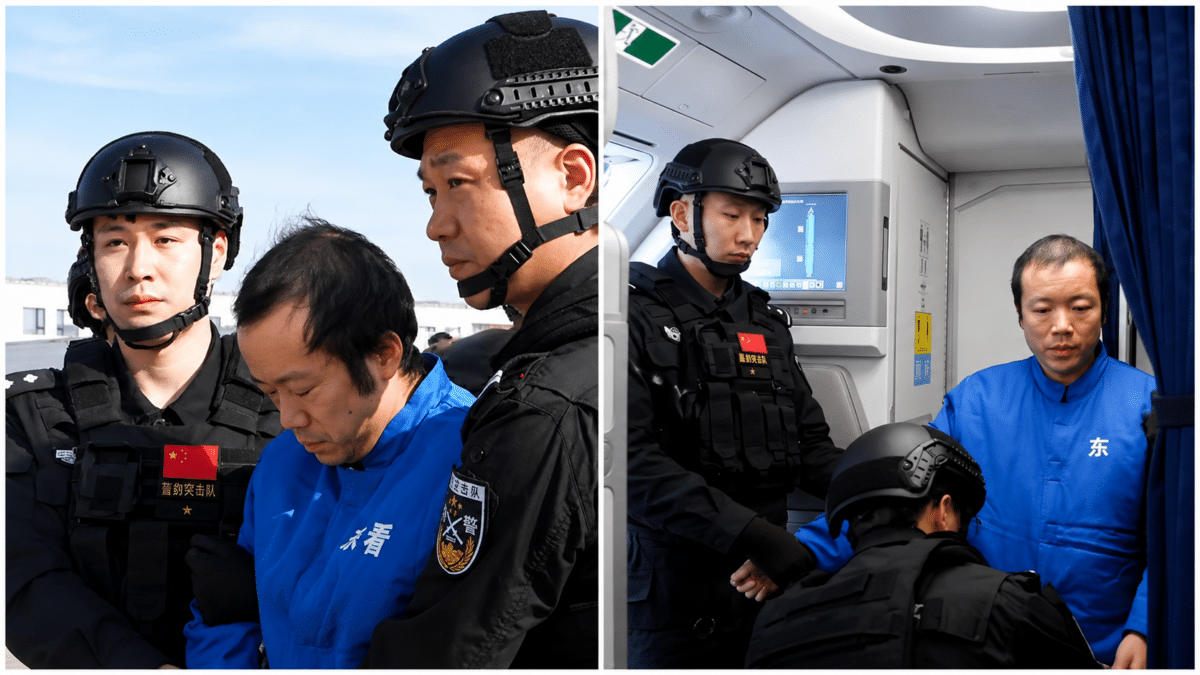
On June 23, in parallel with the OFAC action, the FBI’s New York Office seized infrastructure used by Huione Group to scam Americans. FinCEN credited Australia’s Transaction Reports and Analysis Centre (AUSTRAC) for its contributions, and OFAC said its action was taken in close coordination with Japan’s National Police Agency. The Huione side of the network has also been targeted through extradition: in April 2026, Chinese authorities extradited former Huione Group chairman Li Xiong from Cambodia, identifying him as a core member of the Chen Zhi syndicate.
The reason why Huione is important is because it shows the laundering side of the fraud chain. Scam compounds allegedly generated the stolen funds. Fake investment platforms pulled money from victims. Then laundering networks helped convert, transfer, split, and consolidate those assets.
How the Money Was Allegedly Laundered
The DOJ said Prince Group associates used sophisticated crypto laundering techniques to hide where the money came from. These included methods where large amounts of crypto were split across many wallet addresses and later recombined into fewer wallets. Prosecutors described this as a way to obscure the origin of funds.
Authorities also said criminal proceeds were moved through crypto exchanges, traditional bank accounts, online gambling operations, crypto mining businesses, real estate, luxury purchases, yachts, private jets, watches, and high-end artwork.
This is why crypto fraud investigations increasingly focus on more than just wallet addresses. Investigators now follow the whole pipeline: fake platforms, victim deposits, laundering wallets, exchanges, shell companies, banks, property deals, and luxury assets.
Why This Case Matters for Crypto
The Prince Group case is one of the clearest examples of how crypto can be abused when fraud networks combine technology, psychology, forced labor, and offshore finance.
The scam did not rely on a single hack or a DeFi exploit. It relied on human trust. Victims were emotionally manipulated, shown fake profits, and pushed into sending money to platforms that looked legitimate. Crypto made the transfers fast and global. Shell companies and laundering networks helped move the money afterward.
For regulators, this case strengthens the argument for tougher anti-money laundering controls around crypto platforms, payment processors, OTC desks, and cross-border financial networks.
For investors, it is a reminder that the biggest risk is not always a smart contract bug. Sometimes the risk is a fake trading platform, a fake relationship, and a fake account balance.
The Bigger Picture
The Prince Group crackdown is now a global dragnet.
The U.S. has sanctioned Chen Zhi, Prince Group, Hu Xiaowei, Qiu Wei Ren, Dai An, Fang Zhizhen, Chen Bo, Brendon Luo, and other linked individuals and entities. The DOJ has pursued a historic Bitcoin forfeiture case. Singapore has seized or restricted hundreds of millions of dollars in assets. Japan has arrested a suspected Prince Group-linked executive this month. China has also moved against Chen Zhi and other alleged figures tied to the network, including former Huione Chairman Li Xiong (extradited from Cambodia in April 2026). The UK joined the original October 2025 sanctions package against 146 Prince Group TCO targets; Australia’s AUSTRAC and Japan’s National Police Agency have provided ongoing coordination.
The case shows how modern scam syndicates operate like multinational companies. They use real offices, banks, corporate registrations, lawyers, family offices, real estate, investment firms, and crypto rails. They also exploit workers and victims across borders.
That is why the Prince Group story is not just about one alleged scam kingpin. It is about the infrastructure behind global crypto fraud.
Chen Zhi’s name may be at the center. But the wider network, including figures like Hu Xiaowei and Qiu Wei Ren, and the newly sanctioned individuals, shows how these operations allegedly relied on layers of executives, investors, companies, payment channels, and laundering routes.
As enforcement widens, the biggest question is no longer whether scam networks used crypto. It is how many legitimate-looking businesses, financial accounts, and offshore structures helped them keep the machine running.
Also Read: $150M TXEX-DSJ Empire Exposed: 813 Fake Sites, Human Trafficking Camps, 276 Arrests
Disclaimer:
Some elements of this content may have been enhanced with the help of our artificial intelligence (AI) assistants for purposes such as basic refinement, review, image generation, and translation to deliver high-quality news in a shorter time frame. However, all AI-assisted content is reviewed and approved by our team to ensure accuracy, fairness, and editorial integrity.