Key Highlights
- China arrested Li Xiong, former chairman of Huione Group, for allegedly running a $4 billion global money-laundering network.
- The group reportedly used both legal services and illegal methods, including cryptocurrency, to move money for criminal operations.
- U.S. authorities seized nearly $15 billion in Bitcoin linked to the network and sanctioned related companies.
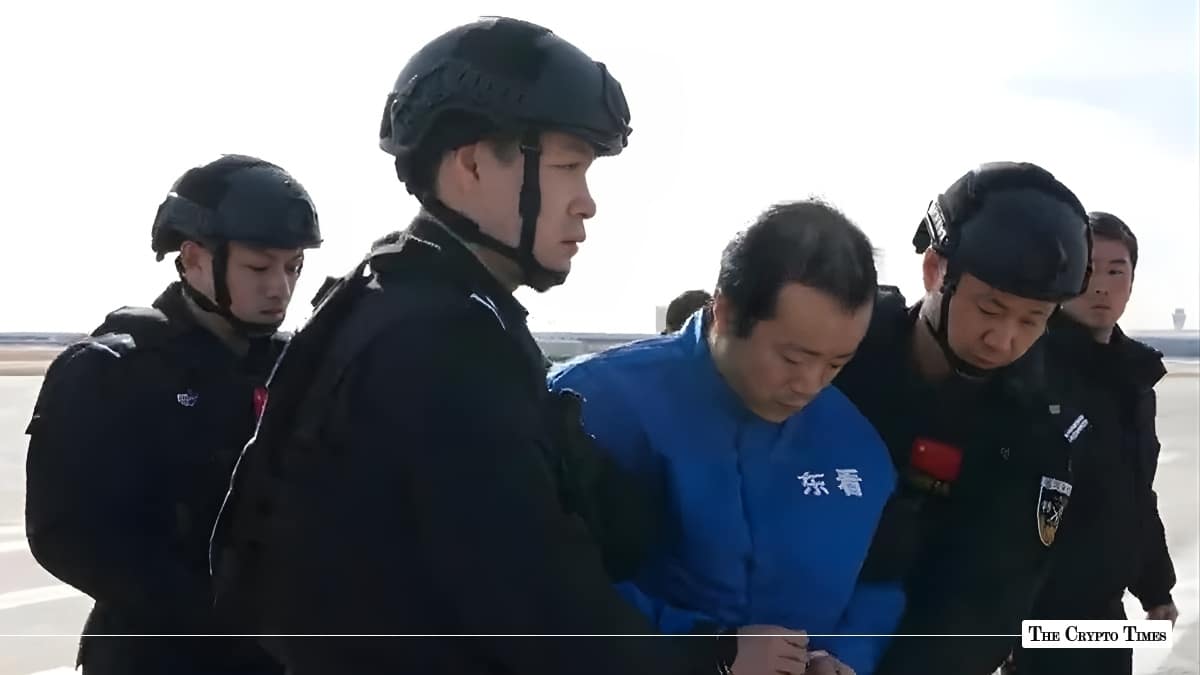
Cambodia has extradited Li Xiong, the former chairman of Huione Pay, to China, widening scrutiny on one of Southeast Asia’s most closely watched alleged laundering pipelines tied to cyber scams and illicit crypto flows. Chinese authorities accuse Li of fraud, unlawful business activity, and concealing criminal proceeds, while Cambodian officials said the extradition followed a joint investigation spanning several months.
According to a Reuters report, Li was identified by Chinese state broadcaster CCTV as a core member of the criminal syndicate linked to Chinese-Cambodian businessman Chen Zhi, who was himself extradited to China in January. The move adds a new enforcement milestone to a broader crackdown on scam compounds and laundering networks operating across Cambodia and the wider region.
Extradition from Cambodia
China’s Ministry of Public Security confirmed that “several key members” of a related criminal group have also been arrested.
Huione Group and its affiliates are believed to have facilitated the movement and laundering of large sums of money across borders. Investigators estimate the network handled at least $4 billion, including funds linked to online scams and hacking operations.
Furthermore, investigations found that Huione was connected to Prince Group, which has been accused by U.S. prosecutors of running investment scams that collected billions of dollars from victims.
The Chairman of Prince Group, Chen Zhi, was also extradited to China earlier this year. U.S. authorities also reported seizing nearly $15 billion in Bitcoin connected to the group’s activities, which is one of the largest seizures recorded.
Wider crackdown on scam networks
Chinese authorities have carried out periodic operations against scam networks in Southeast Asia. These groups often target victims online, promising fake investments or other schemes to collect money.
Many of these operations are based in guarded locations, which makes it difficult for law enforcement to reach the leaders. In some cases, workers involved in the scams are forced to participate against their will.
Some of the earlier efforts to stop these operations often only led to the arrest of lower-level suspects, while the main key suspects continued their activities. But Li Xiong’s arrest shows strong teamwork between China and Cambodia.
“We are willing to continue increasing the intensity of law enforcement cooperation with neighboring countries including Cambodia,” China’s Ministry of Foreign Affairs said in a statement.
Huione’s legal and illegal operations
Huione Group reportedly operated a mix of legitimate and illicit businesses. Its payment services, such as QR-based transactions, were widely used in Cambodia for everyday payments in shops and hotels.
At the same time, other parts of the organization allegedly connected criminal networks with laundering services and enabled the rapid movement of funds across borders, including through cryptocurrency.
Growing crypto-related crimes
The case reflects a broader global effort to dismantle financial networks that support cybercrime and fraud.
In a related development last week, U.S. authorities indicted two Chinese pharmaceutical firms and several individuals for allegedly using cryptocurrency to sell fentanyl precursor chemicals to a Mexican cartel.
These cases highlight how digital assets continue to play a role in cross-border criminal operations, while authorities increase coordination to track and disrupt such networks.
Also Read: Industrialist Arrested in ₹315 Cr Crypto Fraud Case in India