Key Highlights
- XRP and Zcash are not competing for the same use case. XRP is a regulated payments, liquidity, stablecoin, and tokenization asset, while Zcash is a privacy-focused cryptocurrency built around shielded transactions and Bitcoin-like scarcity.
- XRP is much larger and more liquid, with a market cap of roughly $75 billion compared with Zcash’s roughly $8.5 billion market cap as of June 17, 2026.
- Zcash has a stronger scarcity story, with a 21 million max supply, but it carries much higher regulatory and technical-risk pressure after the recent Orchard vulnerability.
- XRP appears better suited for average investors seeking liquidity, institutional adoption, and clearer regulatory positioning.
- Zcash may appeal to high-risk investors who believe financial privacy will become a major crypto investment theme again.
XRP vs Zcash in 2026: The Real Question Is Not Which Coin Is Better
XRP and Zcash are two of the oldest major crypto assets still sitting near the top of the market in 2026. But the reason investors are looking at them today is completely different.
XRP is no longer just a “bank coin” narrative. Its 2026 investment case is tied to the XRP Ledger’s role in payments, stablecoins, tokenized real-world assets, institutional liquidity, and regulatory clarity after years of litigation with the U.S. Securities and Exchange Commission.
Zcash, on the other hand, has returned to the spotlight because privacy is becoming a live crypto theme again. In a world of blockchain analytics, exchange surveillance, AI-powered monitoring, and stricter global crypto rules, ZEC offers something most large-cap crypto assets do not: optional shielded transactions backed by zero-knowledge proofs.
So the real question is not simply, “Is XRP better than Zcash?”
The better question is: Do you want to own regulated financial infrastructure or privacy insurance?
For most investors, XRP looks like the stronger 2026 holding because of its liquidity, institutional alignment, regulatory positioning, and broader market access. Zcash offers more asymmetric upside, but it also comes with greater volatility, exchange-delisting risk, privacy-coin scrutiny, and a fresh protocol-confidence challenge after the Orchard vulnerability.
XRP vs Zcash: Market Snapshot
As of June 17, 2026, XRP remains the much larger asset.
XRP trades near $1.21, with a market cap of about $75.19 billion, ranking it around the fifth-largest crypto asset by market capitalization. Its 24-hour trading volume is around $1.66 billion, and roughly 62.05 billion XRP are in circulation out of a 100 billion max supply.
Zcash trades near $510.73, with a market cap of about $8.53 billion, ranking it around #12. Its 24-hour trading volume is around $847 million, and roughly 16.7 million ZEC are in circulation out of a 21 million max supply.
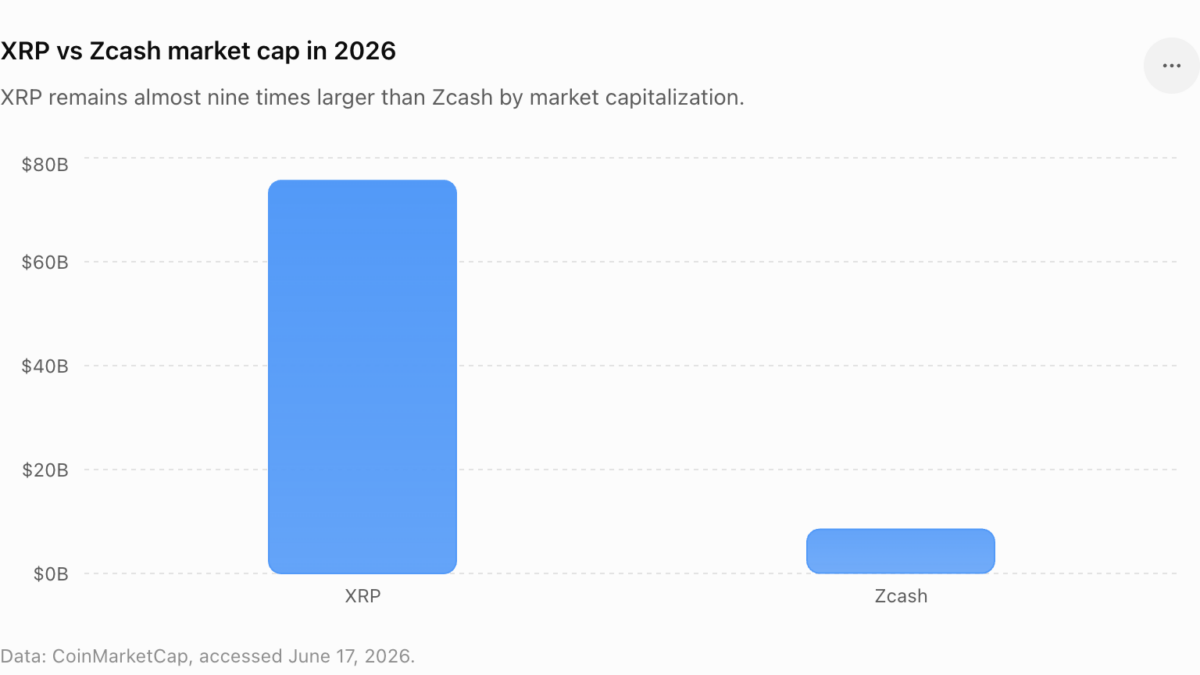
This tells investors something important. XRP is the deeper and more institutionally liquid asset. Zcash is the smaller and more volatile asset with more room for percentage upside if the privacy narrative keeps expanding.
| Metric | XRP | Zcash |
|---|---|---|
| Price | ~$1.21 | ~$510.73 |
| Market cap | ~$75.19B | ~$8.53B |
| Rank | #5 | #12 |
| 24h volume | ~$1.66B | ~$847M |
| Circulating supply | ~62.05B XRP | ~16.7M ZEC |
| Max supply | 100B XRP | 21M ZEC |
| Main thesis | Payments, liquidity, tokenization, stablecoins | Privacy, scarcity, shielded transactions |
| Investor profile | Lower-risk large-cap altcoin investor | High-risk privacy and scarcity investor |
The difference is clear: XRP is already a large-cap institutional crypto asset. Zcash is a smaller, high-beta privacy bet.
What Is XRP?
XRP is the native asset of the XRP Ledger, a public blockchain launched in 2012. XRPL was designed for fast, low-cost settlement and supports payments, issued tokens, decentralized exchange functionality, automated market makers, and real-world asset tokenization.
The XRP Ledger’s biggest advantage is speed and cost. Transactions settle in seconds, and standard transaction costs are extremely low. Unlike gas fees on smart contract chains, XRP transaction fees are destroyed, which protects the network from spam and creates a small burn mechanism.
In 2026, XRP’s strongest narrative is not retail speculation. It is the idea that XRPL can become part of regulated financial infrastructure.
That includes:
- Cross-border payments
- Stablecoin settlement
- Tokenized real-world assets
- Institutional liquidity
- On-chain foreign exchange
- Collateral movement
- Tokenized fund settlement
Ripple’s RLUSD stablecoin has become an important part of this story. RLUSD is issued on both XRP Ledger and Ethereum, backed by cash and cash equivalents, and designed for payments, settlement, trading pairs, and tokenized finance.
That makes XRP’s 2026 thesis different from previous cycles. Earlier XRP rallies were often driven by legal speculation and bank-adoption narratives. The current thesis is more practical: can XRPL become a settlement layer for stablecoins, tokenized funds, and institutional flows?
What Is Zcash?
Zcash is a privacy-focused cryptocurrency launched in 2016. It was originally based on Bitcoin’s codebase, but it added optional privacy through zero-knowledge proofs.
Unlike Bitcoin or XRP, where transactions are transparent by default, Zcash allows users to send shielded transactions that can hide sender, receiver, and transaction amount. It also supports transparent transactions, which means privacy is optional rather than mandatory.
This optional privacy model is important. Zcash is not simply a “hidden money” system. It also allows selective disclosure through viewing keys, which can be useful for audits, compliance, or reporting where needed.
ZEC also has a strong scarcity narrative. Like Bitcoin, it has a 21 million max supply. That gives Zcash a cleaner monetary story than many altcoins, especially when compared with XRP’s 100 billion max supply.
The 2026 Zcash thesis is built around three ideas:
- Financial privacy demand is rising again.
- ZEC has Bitcoin-like scarcity.
- Shielded adoption has become a more important market signal.
But Zcash also has one major problem: privacy coins remain under regulatory pressure. Exchanges and jurisdictions can restrict or delist them more easily than transparent assets. That makes ZEC a more fragile investment, even when its technology is strong.
Technology Comparison: Speed vs Privacy
XRP and Zcash are technically designed for very different worlds.
XRP Ledger is optimized for fast, low-cost transaction settlement. It does not use proof-of-work mining. Instead, it uses a federated consensus model where validators agree on transaction order and ledger state. That makes XRPL much faster and cheaper than proof-of-work networks.
Zcash uses proof-of-work and prioritizes privacy. Its shielded transactions use zk-SNARKs, a form of zero-knowledge proof that allows the network to verify a transaction without revealing sensitive transaction details.
In simple terms:
- XRP is built to move value quickly and cheaply.
- Zcash is built to move value privately.
That difference shapes the investment case.
XRP’s technology is better suited for payments, stablecoins, tokenized assets, and institutional settlement. Zcash’s technology is better suited for users who need transaction privacy and censorship resistance.
For the average investor, XRP’s utility is easier to understand and easier for institutions to adopt. Zcash’s utility may be more powerful in a privacy-focused future, but it is also more controversial.
Tokenomics: XRP Has Scale, Zcash Has Scarcity
Tokenomics is one of the clearest differences between the two assets.
XRP has a maximum supply of 100 billion tokens. A large portion is already circulating, while Ripple’s escrow system remains a long-running point of debate among critics. XRP fees are burned, but the burn rate is tiny compared with total supply, so investors should not treat XRP as a strongly deflationary asset.
Zcash has a 21 million max supply, similar to Bitcoin. Around 16.7 million ZEC are already circulating, meaning roughly 80% of supply is out. That gives ZEC a stronger scarcity profile than XRP.
But scarcity alone does not make an asset better.
XRP has more liquidity, a larger market cap, more exchange depth, and stronger institutional integration. Zcash has cleaner scarcity but a smaller market, higher volatility, and heavier regulatory pressure.
A simple way to frame it:
- XRP has stronger market structure.
- Zcash has stronger scarcity.
Adoption: XRP Has Institutional Momentum, Zcash Has Privacy Momentum
XRP’s 2026 adoption story is stronger on the institutional side.
The XRP Ledger is increasingly positioned around tokenized real-world assets, stablecoins, and settlement infrastructure. XRPL’s official documentation highlights fast settlement, low fees, native compliance tools, on-chain metadata, token issuance, DEX functionality, and institutional-grade tokenization features.
Ripple has also pushed RLUSD as a regulated stablecoin for payments, on/off ramps, trading pairs, and settlement. Recent institutional moves, including RLUSD expansion and payment partnerships, strengthen the argument that Ripple is building around stablecoin infrastructure and not only XRP price speculation.
Zcash’s adoption story is different. It is not about banks or tokenized funds. It is about the return of privacy as an investment theme.
Reports in 2026 show rising interest in privacy tokens, stronger shielded-supply narratives, and renewed institutional curiosity around ZEC. Grayscale has also filed documents related to converting its Zcash Trust into an ETF-style product, though investors must be careful: a filing is not the same as approval.
Zcash adoption should be judged by different metrics than XRP. For Zcash, the important questions are:
- How much ZEC is held in shielded pools?
- Are users actually choosing privacy, or only speculating on the privacy narrative?
- Can exchanges keep supporting ZEC under tighter rules?
- Can Zcash restore full confidence after the Orchard vulnerability?
XRP adoption is easier to measure through liquidity, partnerships, stablecoin volume, tokenized asset activity, and institutional integrations. Zcash adoption is more philosophical and behavioral: are users actually willing to move value into privacy pools?
Regulation: XRP Has More Clarity, Zcash Has More Risk
Regulation is where XRP has a major advantage in 2026.
The Ripple-SEC case, one of the most important crypto legal battles in the U.S., is now largely resolved. Ripple agreed to pay a $125 million fine, while the court’s earlier distinction between institutional sales and public exchange sales helped reduce some of the uncertainty around XRP’s market status.
That does not mean XRP has no regulatory risk. Ripple’s institutional sales history still matters. But compared with where XRP stood during the peak of the SEC case, the legal picture is much clearer now.
Ripple also received conditional approval from the U.S. Office of the Comptroller of the Currency for Ripple National Trust Bank. That matters because it places Ripple deeper inside the regulated financial infrastructure conversation.
Zcash has the opposite problem. Privacy coins face direct scrutiny from regulators and exchanges because they can make transaction monitoring harder. Recent privacy-coin restrictions in the Philippines show that this risk is not theoretical. If more jurisdictions follow, ZEC liquidity and exchange access could be affected.
This is the biggest reason XRP may be better for average investors. XRP’s regulatory path is becoming clearer. Zcash’s regulatory path remains more uncertain.
The Zcash Orchard Vulnerability: Why It Matters for Investors
The biggest 2026 risk for Zcash is not just regulation. It is trust.
In June 2026, Zcash developers released an emergency upgrade after a critical flaw was discovered in the Orchard zero-knowledge proof circuit. The issue could have allowed minting within the Orchard pool if exploited, although the official release said user privacy and the total supply cap were not impacted.
This is extremely important for investors because Zcash’s core value proposition depends on cryptographic trust. If users believe the shielded pool may have been vulnerable, confidence can suffer even if developers respond quickly.
The proposed Ironwood upgrade is meant to help restore confidence by improving supply verification and creating a stronger path after the Orchard issue.
This creates a balanced investment view:
- Bullish view: Zcash found the bug, patched it quickly, and is improving the protocol.
- Bearish view: A privacy asset with a potential counterfeiting-related circuit flaw faces a deeper trust problem than ordinary smart contract bugs.
For ZEC investors, Ironwood is not just a technical upgrade. It is a market-confidence event.
XRP Bull Case for 2026
The XRP bull case has four pillars.
First, XRP has scale. It remains one of the largest crypto assets by market cap and one of the most liquid altcoins globally.
Second, XRP has regulatory momentum. The SEC case no longer dominates the investment thesis the way it did in previous cycles, and Ripple’s conditional OCC approval improves its institutional credibility.
Third, XRPL is becoming more relevant to tokenized finance. Its low fees, fast settlement, native DEX, AMM functionality, and RWA tools make it attractive for payment and tokenization use cases.
Fourth, RLUSD gives the ecosystem a stronger stablecoin layer. If RLUSD keeps growing, XRP Ledger may benefit from more payment, settlement, and liquidity activity.
The key risk is value capture. Even if Ripple, RLUSD, and XRPL adoption grow, investors still need to ask how much of that activity directly benefits XRP holders.
That is the most important question for XRP in 2026: adoption is improving, but will the token capture enough of the value?
Zcash Bull Case for 2026
The Zcash bull case is more asymmetric.
ZEC is smaller than XRP, has a 21 million max supply, and sits directly inside the privacy narrative. If privacy becomes one of the biggest crypto themes of 2026, ZEC could benefit strongly because it is one of the most recognized privacy assets in the market.
Zcash also has optional privacy, which gives it a different profile from fully private-by-default coins. This can be seen as a feature or a weakness. It may make Zcash more flexible for compliance-conscious users, but it also means privacy depends on actual shielded usage.
The strongest ZEC thesis is that crypto markets may start valuing privacy again after years of focusing mainly on ETFs, memecoins, DeFi, and tokenized assets.
In that scenario, Zcash becomes a “privacy hedge” for crypto portfolios.
But it is not a low-risk hedge. It is a high-volatility, high-regulatory-risk asset.
XRP Bear Case
XRP’s biggest weakness is not technology. It is valuation versus value capture.
At more than $75 billion in market cap, XRP already prices in a lot of future adoption. That makes it harder for XRP to deliver explosive percentage gains compared with smaller assets.
There is also the centralization debate. Critics argue that Ripple’s influence, escrow holdings, and institutional orientation make XRP less decentralized than other crypto assets.
Another risk is competition. Stablecoins, CBDCs, bank tokenization networks, Ethereum Layer 2s, Stellar, Solana, and private bank settlement systems all compete in the same broad payments and tokenization market.
XRP may remain important, but investors should not assume that every Ripple partnership automatically increases XRP price.
Zcash Bear Case
Zcash’s bear case is more severe.
The first risk is regulation. Privacy coins can face delistings, restrictions, and compliance pressure. That can reduce liquidity and make it harder for institutions to hold ZEC.
The second risk is adoption. Zcash has strong technology, but it still needs users to choose shielded transactions consistently. Privacy only becomes more powerful when the anonymity set grows.
The third risk is volatility. ZEC can move sharply in both directions because it has lower liquidity than XRP and is more narrative-driven.
The fourth risk is technical trust. The Orchard vulnerability has made protocol confidence a central issue for Zcash investors in 2026.
That does not destroy the ZEC thesis, but it changes it. Zcash is no longer only a privacy story. It is now also a trust-repair story.
XRP vs Zcash: Which Is Better for Different Investors?
Conservative crypto investors
XRP is the better fit. It has deeper liquidity, broader exchange access, stronger regulatory clarity, and more institutional use cases.
High-risk investors
Zcash may be more attractive because of its smaller market cap, scarcity, and privacy upside. But position sizing should be much more careful.
Institutional-style investors
XRP has the edge. It is easier to explain inside a regulated finance, tokenization, payments, and stablecoin framework.
Privacy-focused investors
Zcash has the edge. XRP is transparent by design, while Zcash exists specifically to give users optional financial privacy.
Traders
Zcash may offer more volatility and sharper percentage moves. XRP may offer better liquidity and cleaner market depth.
Long-term holders
XRP is stronger if you believe regulated crypto rails and stablecoins will keep expanding. Zcash is stronger if you believe privacy becomes a scarce and valuable feature in the next phase of crypto.
So, Which Crypto Should You Actually Own in 2026?
For the average investor, XRP has the stronger case in 2026.
It is larger, more liquid, more institutionally connected, and operating with a clearer regulatory path than in previous cycles. Its connection to payments, stablecoins, and tokenized finance gives it a practical role in the market.
Zcash is more interesting for investors looking for asymmetric upside. Its 21 million supply cap, privacy technology, and renewed shielded-transaction narrative make it one of the few major assets with a truly differentiated use case. But that upside comes with serious risk: regulation, delistings, volatility, and the need to restore confidence after the Orchard bug.
The cleanest conclusion is this:
XRP is the better 2026 holding for investors who want regulated utility and institutional adoption. Zcash is the better speculative hedge for investors who believe privacy will become one of crypto’s biggest narratives again.
In portfolio terms, XRP can be treated as a core large-cap altcoin exposure. Zcash should be treated as a smaller, high-risk thematic position.
Final Verdict
XRP and Zcash represent two very different futures for crypto.
XRP is betting that blockchain becomes part of regulated financial infrastructure. Zcash is betting that financial privacy becomes valuable again as surveillance, compliance, and AI-driven monitoring expand.
Both arguments are valid. But they are not equal in risk.
XRP has the better risk-adjusted profile for most readers in 2026. Zcash has the more explosive upside if the privacy trade keeps gaining momentum.
So the answer is not simply XRP or Zcash.
The answer is: XRP for utility, liquidity, and regulation. Zcash for privacy, scarcity, and asymmetric risk.
FAQs
Is XRP better than Zcash in 2026?
XRP may be better for most investors because it has higher liquidity, stronger institutional adoption, and clearer regulatory positioning. Zcash may be better for investors who specifically want privacy-focused upside.
Is Zcash more private than XRP?
Yes. XRP transactions are transparent, while Zcash supports shielded transactions that can hide sender, receiver, and amount.
Does Zcash have a lower supply than XRP?
Yes. Zcash has a 21 million max supply, while XRP has a 100 billion max supply.
Is XRP safer than Zcash?
From a liquidity and regulatory perspective, XRP appears safer. Zcash carries higher regulatory risk because privacy coins can face restrictions or delistings.
Can Zcash outperform XRP?
Yes, Zcash can outperform XRP in percentage terms if the privacy narrative grows and confidence returns after the Orchard issue. But it is also much riskier.
Should investors hold both XRP and Zcash?
Some investors may hold both because they represent different theses. XRP offers exposure to regulated finance and payments, while Zcash offers exposure to privacy and scarcity. However, ZEC should usually be sized more carefully because of higher risk.
Also Read: 7 Altcoins to Buy Now as Crypto Market Searches for Rebound