
Humanity Protocol, a decentralized identity project built around privacy-preserving human verification, is facing one of the most damaging trust crises in its history after a compromised-device and private-key incident triggered a major $H token exploit.
The attack was initially described as a $32 million to $36 million private-key hack. But Humanity’s later post-mortem expanded the scope, saying the incident involved three breach vectors and approximately 447 million $H tokens stolen or unauthorizedly minted across Ethereum and BNB Smart Chain.
The incident matters beyond the price of $H. Humanity Protocol’s core pitch is trust: a system for verifying real humans and identity credentials using privacy tools such as palm biometrics, decentralized identifiers, verifiable credentials, and zero-knowledge proofs. According to Humanity’s own protocol page, the project moved from Proof of Humanity toward a broader Proof of Trust model designed to verify traits such as age, residency, education, employment, or compliance status without exposing underlying private data.
That makes the breach especially damaging. A project built to verify trust is now being judged by the most basic trust question in crypto security: how did enough critical admin keys become exposed to let attackers take over bridge controls?
Key Highlights
- Humanity Protocol said its $H token was hit by a coordinated attack across Ethereum and BNB Smart Chain on June 8–9, 2026.
- The project’s later post-mortem placed the total unique impact at approximately 447 million $H tokens stolen or unauthorizedly minted.
- The attack involved compromised private keys and multisig owners tied to bridge administration systems.
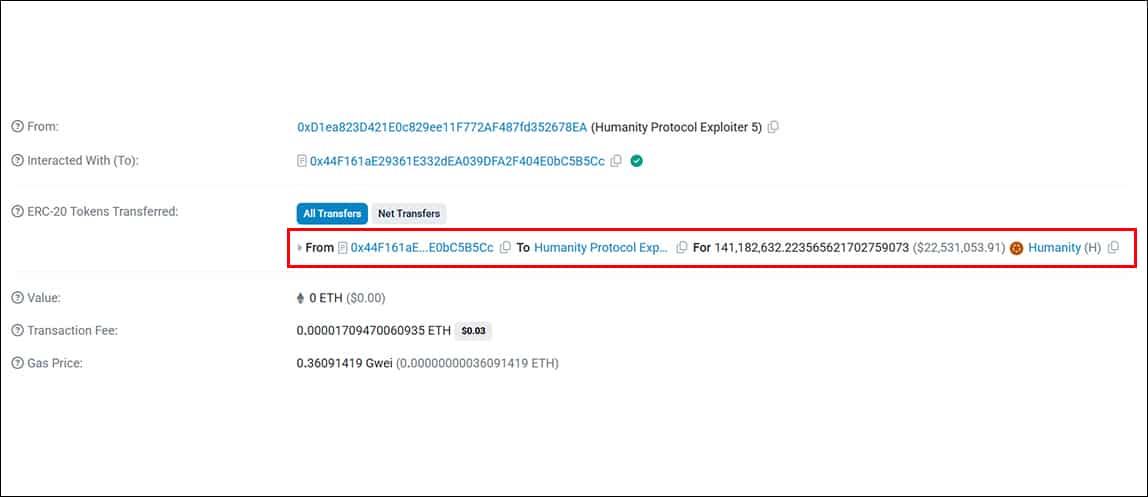
- Around 141 million $H were drained on Ethereum after attackers upgraded a bridge contract to a malicious implementation.
- On BNB Smart Chain, attackers gained ProxyAdmin control and minted unauthorized $H.
- Humanity has launched a public compromised-address tracker and offered a $1M USDT bounty for information leading to recovery.
- The project said recovered funds will be used to buy back $H, but a full compensation or token-remediation framework remains unclear.
What Happened to Humanity Protocol?
Humanity Protocol said the June 8–9 incident began after private keys tied to its administrative systems were compromised.
According to the project’s incident update and later post-mortem, the attacker gained access to multiple Gnosis Safe owner keys that controlled bridge-related ProxyAdmin contracts on Ethereum and BNB Smart Chain. Those controls allowed the attacker to upgrade bridge and token contracts, drain existing $H, and mint unauthorized new $H.
Early reports focused on more than $36 million in stolen value. However, Humanity’s later post-mortem described a larger token-supply impact.
The project identified three main vectors:
| Attack Vector | What Happened | Reported Impact |
|---|---|---|
| Admin hot wallet compromise | An admin hot wallet private key was stolen | Around 6M $H stolen |
| Ethereum bridge takeover | Three of six Gnosis Safe owner keys controlling the Hyperlane bridge ProxyAdmin were compromised | Around 141M $H drained |
| BNB Smart Chain takeover | Three of five Safe owners were compromised, allowing malicious contract changes and unauthorized minting | Around 300M $H minted |
| Total unique impact | Combined stolen and unauthorizedly minted supply | Around 447M $H |
The key issue is not only that funds were stolen. It is that the attacker appears to have gained enough authorized signing power to control critical bridge infrastructure.
That distinction is important because Humanity has described the incident as a key-management and operational-security failure, not a traditional smart-contract exploit. In other words, the attacker did not need to find a bug in the token logic once they had enough privileged keys.
Timeline: How the Humanity Protocol $H Exploit Unfolded
| Date | Event | Why It Matters |
|---|---|---|
| May 30, 2026 | $H surged 31% in a day as trading volume jumped 134%, according to The Crypto Times’ earlier market coverage. | Shows strong pre-exploit market activity before the token collapse. |
| June 1, 2026 | $H rose more than 60% in an altcoin rotation wave and reached a new all-time high near $0.67. | Important context because traders later questioned the timing of the exploit. |
| June 8–9, 2026 | Humanity Protocol’s $H token was hit by a cross-chain exploit involving compromised admin keys. | Start of the core incident. |
| June 9, 2026 | Early reports said the attack involved a private-key compromise and more than $32M–$36M in stolen value. | This became the first major public damage estimate. |
| June 9, 2026 | Humanity said the incident involved compromised keys tied to bridge administration systems. | Confirmed that the issue was admin-key exposure, not a normal smart-contract bug. |
| June 9–10, 2026 | Humanity’s later post-mortem placed the total unique impact near 447M $H. | This updated the story from “$36M hack” to a wider token-supply incident. |
| After post-mortem | Humanity launched a public compromised-address tracker. | Adds transparency and gives exchanges/users a way to monitor attacker-linked wallets. |
| After tracker launch | Humanity offered a $1M USDT bounty and said recovered funds would be used for $H buybacks. | Shows the recovery plan, but compensation and token-remediation details remain unclear. |
On-Chain Breakdown: Three Vectors Behind the 447M $H Impact
| Attack Vector | Chain | Method | Reported Impact | Status / Risk |
|---|---|---|---|---|
| Admin hot wallet compromise | Ethereum / project-controlled wallet | Private key of an admin hot wallet was compromised. | Around 6M $H stolen | Direct treasury/admin-wallet loss. |
| Bridge ProxyAdmin takeover | Ethereum | Attacker used compromised Gnosis Safe owner keys to control the Hyperlane bridge ProxyAdmin, transfer ownership, upgrade the bridge to malicious logic, and drain tokens. | Around 141M $H drained | Shows bridge-upgrade authority was compromised. |
| Unauthorized token minting | BNB Smart Chain | Attacker used compromised Safe owner keys to control ProxyAdmin and deploy malicious contract changes that allowed unauthorized minting. | Around 300M $H minted | Creates token-supply integrity risk. |
| Combined impact | Ethereum + BNB Chain | Stolen tokens plus unauthorized minted supply. | Around 447M $H total unique impact | Requires recovery, tracking, possible burn/migration/blacklist decision. |
The most important detail is that the attacker did not need to exploit a traditional smart-contract bug once they had enough authorized keys. The breach became dangerous because compromised signers were able to control bridge administration, upgrade contracts, drain existing $H, and mint unauthorized supply.
Why the Laptop Breach Matters
A multisig wallet is supposed to reduce single-point-of-failure risk.
Instead of allowing one private key to control a treasury, bridge, or admin contract, a multisig requires several signers to approve sensitive actions. In a secure setup, those keys should be separated across people, devices, hardware wallets, custody systems, or institutional controls.
As reported that Humanity’s exploit happened because a compromised laptop held enough multisig keys to cross approval thresholds on both Ethereum and BNB Smart Chain. The report said the attacker used three of six Ethereum keys and three of five BNB Chain keys to seize bridge controls, deploy malicious code, and drain or mint hundreds of millions of $H tokens.
That is the central failure.
A multisig may look decentralized on-chain, but if multiple keys are generated, backed up, cached, stored, or exposed through the same compromised device, the real-world security model collapses.
This is why the Humanity incident is now being treated as a “keys, not code” failure.
Ethereum Attack: 141M $H Drained Through Malicious Bridge Upgrade
On Ethereum, the attacker reportedly compromised three of six Gnosis Safe owner keys controlling the Hyperlane bridge ProxyAdmin.
With those keys, the attacker transferred ProxyAdmin ownership to an attacker-controlled wallet. They then upgraded the bridge contract to a malicious implementation and drained approximately 141 million $H in a single transaction.
This type of attack is especially dangerous because admin privileges can bypass the normal user-facing assumptions of a protocol. Users may think they are interacting with a safe bridge, but if the contract owner or upgrade authority is compromised, the attacker can replace the logic behind the system.
For bridges, that risk is even higher. Bridges often hold or represent large token balances across networks, and a compromised upgrade path can quickly turn into a system-wide token and liquidity event.
BNB Chain Attack: Unauthorized $H Minting
The BNB Smart Chain side of the attack added a second problem: unauthorized token creation.
Earlier media reports and incident updates cited 200,000,005 $H minted on BNB Chain. Humanity’s later post-mortem expanded the BNB Chain unauthorized minting figure to roughly 300 million $H in separate transactions.
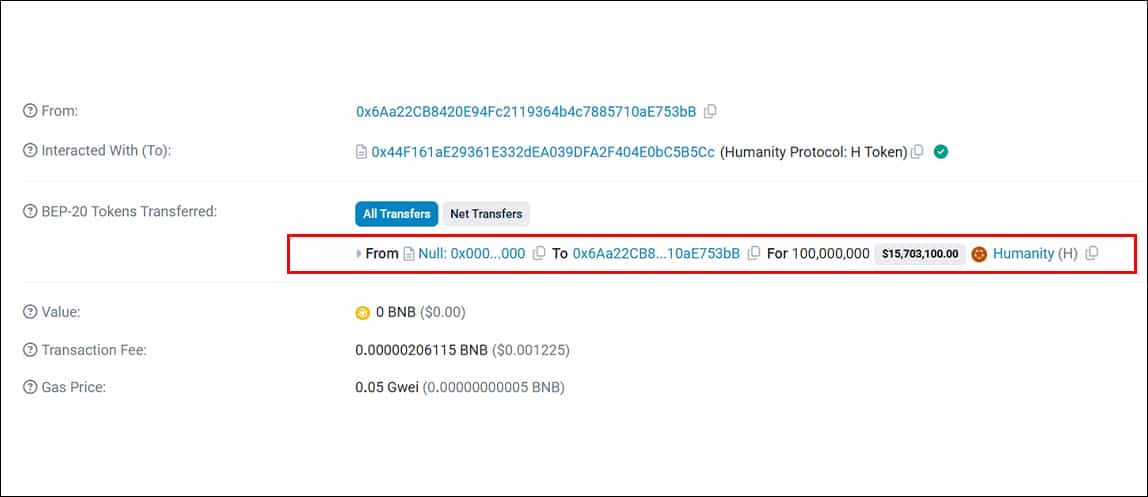
The 200M figure appeared in early incident coverage. The 300M figure came later as part of the broader post-mortem breakdown. The latest total-impact figure combines the admin hot wallet theft, Ethereum bridge drain, and BNB Chain unauthorized minting to reach approximately 447M $H.
This should be viewed not only as a theft but as a supply-integrity event. When attackers can mint unauthorized tokens, the recovery problem becomes more complicated. The project must decide whether to burn, blacklist, migrate, freeze, or otherwise isolate unauthorized supply.
Until that plan is fully clear, $H price recovery alone does not mean the token-supply issue has been solved.
Public Tracker, $1M Bounty, and Buyback Plan
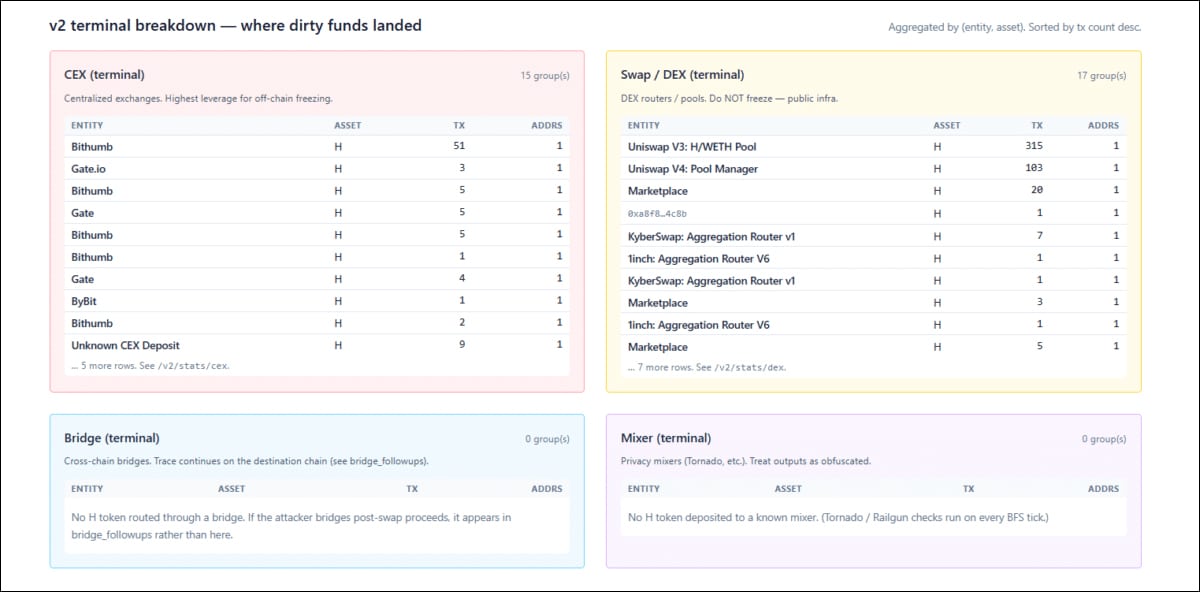
Humanity Protocol has launched a public compromised-address tracker at transparency. humanity.org to help the community, exchanges, DEXes, aggregators, and other ecosystem participants follow attacker-linked addresses and fund movements.
The tracker says it uses on-chain state, token transfer logs, and native traces. It also says every address, balance, amount, and transaction hash displayed on the page should be reproducible on public block explorers. Items still pending internal classification are withheld until resolved.
Humanity has also announced a $1M USDT bounty for information that helps recover funds. The project said recovered funds will be used to buy back $H.
That buyback plan is important for market confidence, but it is not the same as a full user-compensation plan. Humanity has not yet published a complete framework explaining which users qualify for recovery, how unauthorized $H will be treated, or whether token migration will be required.
Were Users Directly Targeted?
Humanity’s post-mortem said users holding $H in personal wallets were not directly targeted. The main losses involved project-controlled treasuries, bridges, and administrative contracts.
However, that does not mean users face no risk.
The project had already warned users to avoid affected bridge and liquidity-pool interactions while containment and recovery work continued. Users who previously interacted with Humanity-related contracts should consider reviewing token approvals and monitoring their wallets for suspicious activity.
Approval revocation does not recover stolen funds, but it can reduce future exposure if risky smart-contract permissions remain active.
Users should also be cautious of phishing campaigns. Major crypto exploits often lead to fake refund pages, fake claim links, Telegram impersonators, fake bounty forms, and malicious “recovery” messages.
What Users Should Do Now
Users should take the following precautions:
- Avoid affected Humanity bridge and liquidity-pool interactions until the team issues a clear all-safe update.
- Review and revoke unnecessary $H-related token approvals.
- Do not click refund, recovery, or claim links shared through DMs or unofficial channels.
- Monitor wallet activity on Ethereum and BNB Smart Chain.
- Save transaction hashes, screenshots, wallet addresses, and timestamps if affected.
- Use Humanity’s public tracker and verified project channels for updates.
- Wait for a clear recovery or compensation framework before assuming losses will be reimbursed.
Why ZachXBT and Traders Questioned the Incident
The Humanity exploit triggered immediate debate across Crypto Twitter because of the timing.
Before the breach, $H had rallied sharply. The Crypto Times reported on May 30 that $H rose about 31% in 24 hours as trading volume jumped 134%. On June 1, The Crypto Times reported that $H surged around 61% in a broader altcoin rotation, reaching a new all-time high near $0.67.
Days later, the token collapsed after the private-key exploit.
On-chain investigator ZachXBT publicly questioned the incident and described it as “possibly staged,” pointing to market-maker activity, token concentration, and the way $H was sold. Other analysts also raised questions around pre-funded attacker wallets, cross-chain coordination, and whether the attacker may have held useful access before the public exploit.
These claims remain unproven.
The most responsible interpretation is that the public evidence currently supports a private-key and bridge-admin compromise. However, the timing of the pre-exploit rally, the large scheduled unlocks, market-maker questions, and the attacker’s coordinated execution deserve further investigation.
CoinDesk later reported that ZachXBT separated the key compromise from suspicious market-making activity, while still raising questions about $H trading before the breach and the project’s upcoming unlock schedule.
What Remains Unclear
Several critical questions remain unanswered:
| Question | Why It Matters |
|---|---|
| How was the employee or admin device compromised? | Determines whether this was malware, leaked backups, phishing, insider access, or setup error. |
| When did the attacker first gain access? | A long dwell time would suggest a patient or coordinated compromise. |
| Why were enough signer keys reachable from one environment? | This is the core multisig-security failure. |
| Does the attacker still control any BNB Chain ProxyAdmin or mint authority? | Future minting risk depends on this. |
| What happens to unauthorized $H supply? | Token integrity depends on burn, blacklist, migration, or another remediation path. |
| Will affected users be compensated? | Recovery confidence depends on a clear framework. |
| Were market-maker agreements or unlock schedules relevant to the timing? | Market transparency remains a major concern. |
| Will Humanity publish independent forensic findings? | External verification is needed to rebuild trust. |
Why This Matters Beyond $H Price
Humanity Protocol’s whitepaper frames the project as a trust infrastructure for the digital economy. The protocol is designed to verify human authenticity and identity credentials without forcing users to expose private information.
That mission made the exploit more damaging than a normal token crash.
For a decentralized identity project, security is not a secondary feature. It is part of the product. Users, developers, exchanges, and partners are not only asking whether $H can recover in price. They are asking whether Humanity can safely manage the infrastructure that supports its identity network.
The exploit shows that advanced cryptography does not replace basic operational security.
A protocol can use zero-knowledge proofs, decentralized identifiers, verifiable credentials, and privacy-preserving biometrics but still fail if private keys, admin controls, contract upgrade paths, and bridge permissions are not properly protected.
What Humanity Must Do Next
For Humanity Protocol to rebuild trust, the project needs more than general updates.
It needs a clear technical, financial, and governance response.
The most important next steps are:
- Publish a full independent forensic report.
- Confirm whether all attacker-controlled admin and mint authorities have been revoked.
- Explain how multiple multisig keys became exposed.
- Identify whether keys were stored, backed up, exported, cached, or generated on a compromised device.
- Publish a complete list of affected contracts, wallets, bridge addresses, and attacker-linked wallets.
- Clarify how unauthorized BNB Chain $H will be treated.
- Announce whether there will be token migration, burn, blacklist, or supply adjustment.
- Define a compensation framework for affected users.
- Disclose whether any funds have been frozen by exchanges.
- Clarify market-maker relationships and unlock-related concerns.
- Add hardware-secured signers, MPC, custody separation, and timelocked upgrades.
- Create public monitoring for ProxyAdmin ownership changes, bridge upgrades, and abnormal mint events.
Without these steps, the story may continue to damage the project even after the immediate exploit is contained.
Can $H Recover?
A $H recovery depends on four separate outcomes.
First, Humanity must prove the attacker no longer controls any critical admin, bridge, or minting function.
Second, the project must show whether stolen or unauthorizedly minted tokens can be isolated, frozen, recovered, bought back, burned, or migrated.
Third, exchanges and liquidity venues need clarity on which tokens are legitimate and which addresses are compromised.
Fourth, the community needs a compensation and remediation plan that is specific enough to evaluate.
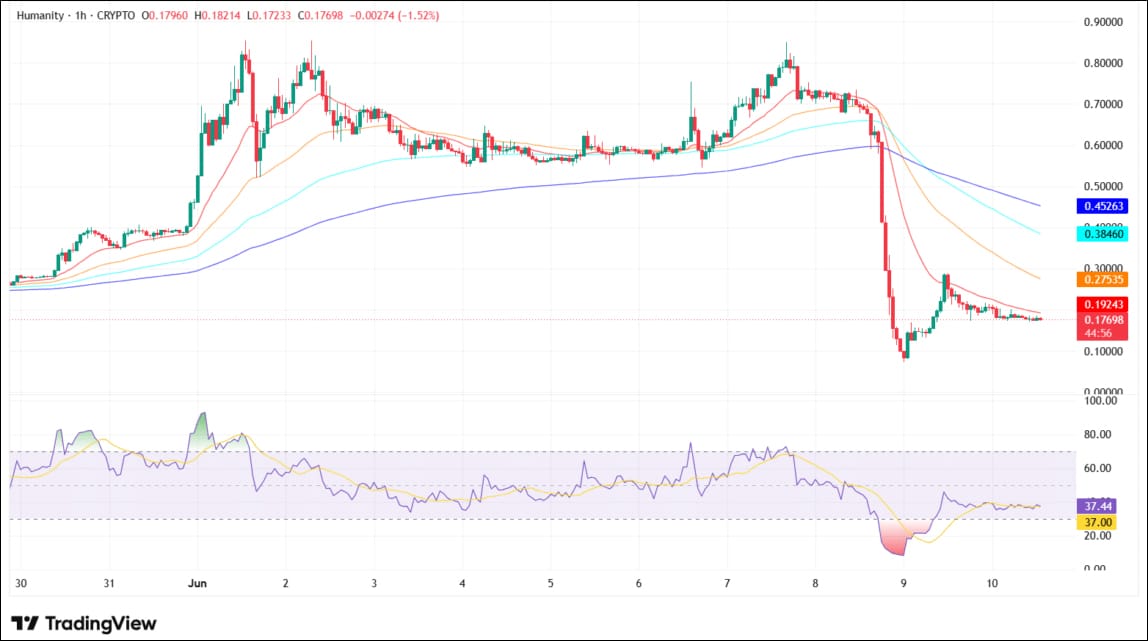
A token price bounce may happen before these questions are answered, but that would be a market reaction, not proof of full recovery.
The deeper issue is supply trust. Once unauthorized tokens are minted, the market must know whether the supply can be repaired.
Final Takeaway
The Humanity Protocol exploit is not just a story about one laptop or one token crash.
It is a warning about how quickly a crypto project’s security model can fail when multisig keys are not truly separated in practice.
Humanity’s public mission is to build digital trust. But the June 8–9 exploit exposed a gap between cryptographic ambition and operational security. The project may have privacy-preserving identity technology, but attackers appear to have gained enough authorized keys to take over bridge controls and trigger a 447M $H token-impact event.
The recovery now depends on transparency.
Humanity has taken some important steps: a public compromised-address tracker, a bounty program, and a promise to use recovered funds for $H buybacks. But the market still needs answers on root cause, attacker control, unauthorized supply, compensation, market-maker transparency, and long-term security changes.
Until those answers are public, users should avoid affected infrastructure, revoke unnecessary approvals, follow verified updates, and treat any $H recovery narrative with caution.