
When crypto is stolen, most people hear the same response: “the blockchain is irreversible — your money is gone for good.”
But that’s a half-truth. A transaction is indeed irreversible.
However, the fate of stolen assets is determined not by that fact, but by how quickly and professionally you respond.
Two Asset Types — Two Recovery Strategies
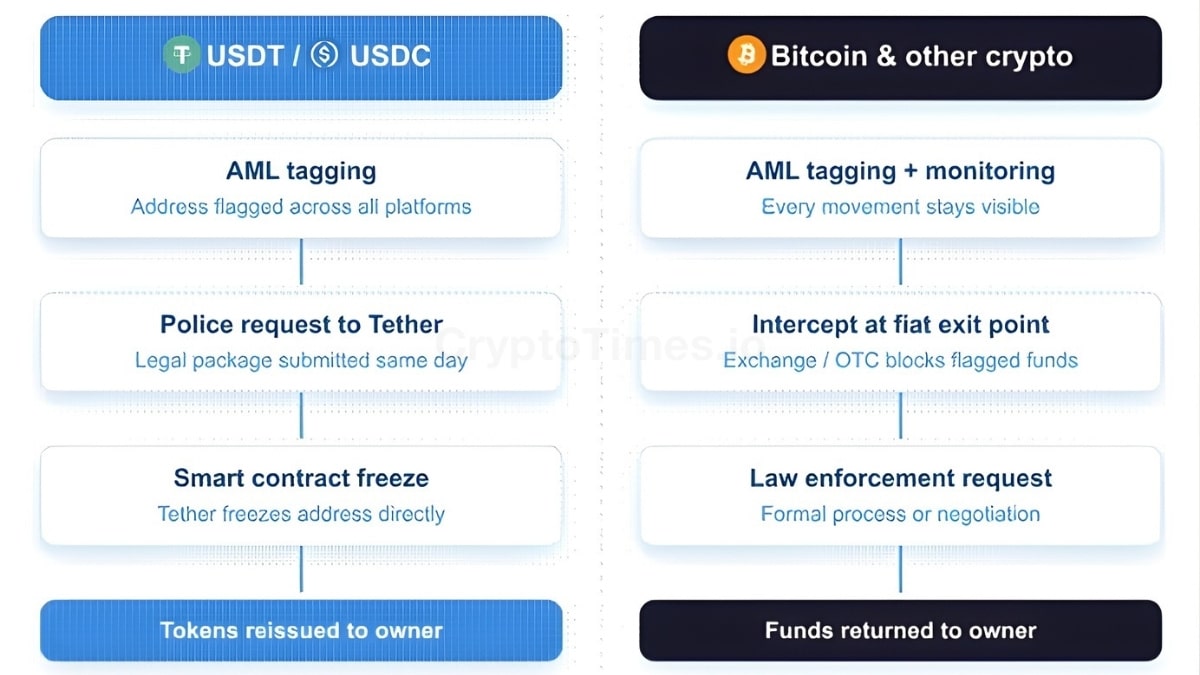
There is a fundamental distinction in crypto asset recovery between centralized stablecoins — such as USDT and USDC — and everything else. Bitcoin is simply the most prominent example of the second category, but the same mechanics apply to the vast majority of crypto assets.
USDT and USDC are issued by centralized entities — Tether and Circle, respectively. These issuers have the technical capability to freeze any address at the smart contract level and subsequently reissue tokens to the rightful owner. This is a unique instrument that no decentralized network possesses.
Bitcoin and most other crypto assets are decentralized. There is no issuer, no “freeze” button. But that does not mean recovery is impossible, it simply requires a different approach.
Recovering USDT: Freezing Through the Issuer
When USDT is stolen, we can work on two tracks simultaneously.
- Technical: Immediate AML tagging of the attacker’s addresses across all major analytics systems. The address is flagged as “stolen assets” — a signal propagated throughout the connected infrastructure.
- Legal: Preparation of a complete documentation package for law enforcement — it is through an official police request that Tether initiates a freeze at the smart contract level. After the freeze, the process of reissuing tokens to the rightful owner begins. It is important to note: Tether charges a recovery fee of approximately 10% of the amount or a minimum of $1,000, whichever is greater. This fee is deducted from the recovered funds, not paid upfront.
In this kind of cases, speed is critical: the window for freezing is open only until the attacker converts USDT into another asset or cashes out into fiat.
Recovering Bitcoin: The Interception Strategy
With Bitcoin and other decentralized assets, the mechanics are fundamentally different — but no less effective when the response is timely.
“With Bitcoin, we don’t stop the transaction — we make it impossible for the attacker to cash out. Tagged coins become toxic to the entire regulated infrastructure.”
Our work operates on three levels:
- Tagging and monitoring: The attacker’s addresses are immediately flagged in analytics systems. Every movement of the coins becomes visible. Tags do not expire, a marked Bitcoin address remains “toxic” indefinitely.
- Interception at the fiat exit point: Sooner or later, the attacker needs to cash out. To do so, they need regulated infrastructure: an exchange, an Over-The-Counter (OTC) desk, or a KYC-compliant exchanger. The moment tagged coins touch any of these points, an alert fires and the assets are blocked.
- Legal pressure and recovery: Once assets are blocked at an exchange, law enforcement requests or direct legal engagement with the platform follow. This is the channel through which funds are ultimately returned to the owner. In parallel, we work to de-anonymize the attacker — through IP addresses, device fingerprints, and behavioral patterns. When there is no way out, negotiation also becomes a viable tool.
When Recovery Is Realistic — and When It’s Not
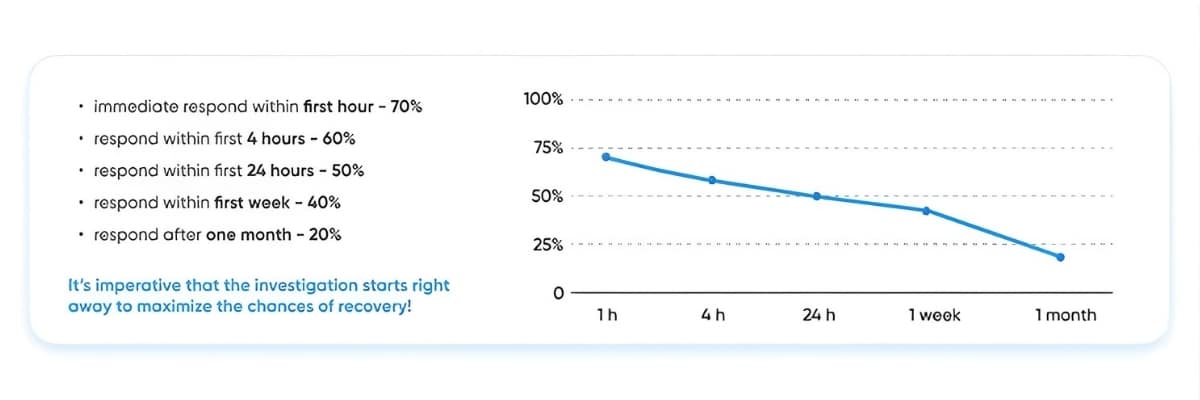
This is the question I’m asked most often — and I answer it honestly, even when the answer is uncomfortable.
Prospects are strong when:
- You acted within the first hours after the theft.
- The attacker has not yet run the assets through mixers and bridges.
- The theft occurred through a traceable scheme with a clear transaction trail.
Prospects are poor when:
- Several days have passed and the assets have already moved through multiple mixers.
- The attacker used professional obfuscation tools.
- Funds were withdrawn through unregulated P2P channels without KYC.
In the latter scenario, we tell the client plainly. A professional never promises 100% recovery — they explain the realistic odds and propose what is actually achievable.
Also Read: How to Identify Fake USDT in 60 Seconds (Step-by-Step Guide)
A Case from Practice: When Speed Was Everything
In one of our investigations, a client discovered their crypto assets were stolen several hours after the theft occurred. By then, the funds had already been moved to new addresses and were in transit through the chain. The situation looked critical.
We acted immediately on two fronts: AML tagging of the attacker’s addresses and preparation of a legal package for the issuer. It was speed—not technology alone—that proved decisive. The assets were frozen before the attacker could convert them into fiat.
This scenario plays out again and again. Those who respond quickly have a chance. Those who spend days attempting to contact exchange support on their own lose the window of opportunity.
First Steps After Discovering a Theft
- Record the transaction hash and gather evidence — wallet addresses, screenshots, any correspondence. This forms the foundation of the investigation.
- Do not make any further transactions from the compromised wallet — any additional transaction complicates the analysis.
- Tag the attacker’s addresses — exchanges and services receive a notification that the address is linked to illegal activity. Any withdrawal attempt triggers an asset freeze.
- Contact qualified specialists immediately. Reaching out to exchange support on your own, without a prepared evidence package, typically results in template responses and the loss of critical time. A detailed action protocol is available here.
One more warning: be cautious of anyone who approaches you unsolicited offering help. Recovery scams — secondary fraud disguised as assistance — inflict double harm on victims.
Conclusion
Stolen cryptocurrency is not a death sentence. But recovery demands the right instrument for the right asset — and above all, the right timing. Stablecoins are frozen through the issuer. Bitcoin and other assets are intercepted at the fiat exit point.
In both cases, the window of opportunity is open only until the attacker has had a chance to spend the money.
The blockchain is irreversible. But the ecosystem around it is manageable.
Disclaimer:
Some elements of this content may have been enhanced with the help of our artificial intelligence (AI) assistants for purposes such as basic refinement, review, image generation, and translation to deliver high-quality news in a shorter time frame. However, all AI-assisted content is reviewed and approved by our team to ensure accuracy, fairness, and editorial integrity.