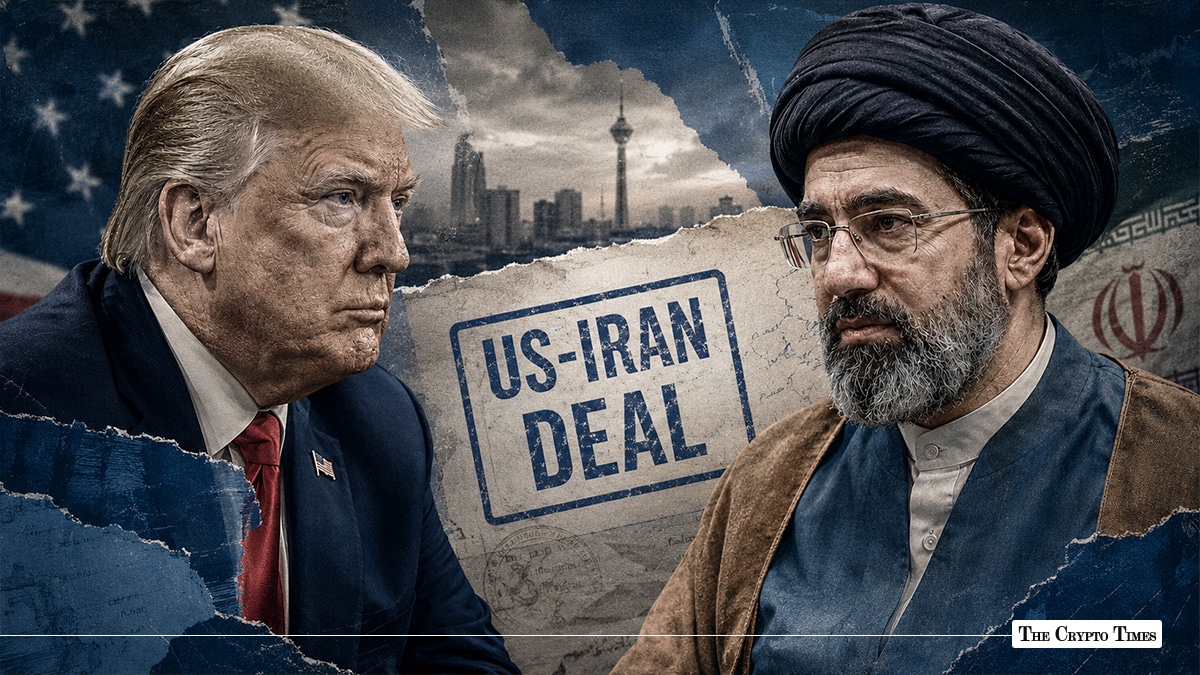
The first crypto headline from the U.S.-Iran framework was predictable: Bitcoin bounced, oil cooled, and traders rushed to price in lower geopolitical risk. But the bigger story is not Bitcoin’s move above the mid-$60,000 range. It is what the deal could do to the financial plumbing of the Middle East.
The U.S.-Iran memorandum of understanding (MoU), announced by President Donald Trump on June 14, 2026 and scheduled to be formally signed in Switzerland, following a two-week ceasefire framework reached on April 8, 2026, is expected to gradually reopen the Strait of Hormuz and create a path toward conditional sanctions relief if Tehran cooperates on nuclear and regional security commitments. The MoU establishes a 60-day window for final negotiations on the unresolved nuclear file, remaining sanctions, and UN Security Council / IAEA Board of Governors resolutions regarding Iran.
That does not instantly normalize Iran’s crypto economy. In fact, it may do the opposite.
The deal could harden the divide between two very different crypto systems in the region: Iran’s sanctioned, state-linked stablecoin rails on one side, and the UAE-led regulated tokenization corridor on the other.
That is why the real crypto winners from the Iran framework may not be in Tehran. They may be in Dubai, Abu Dhabi, Manama, and Riyadh.
Key Highlights
- The U.S.-Iran framework may lower the Gulf war-risk premium, but it does not automatically normalize Iranian crypto.
- OFAC’s sanctions on Nobitex, Wallex, Bitpin, and Ramzinex make Iran-linked crypto flows a compliance risk for regional platforms.
- Dubai may be better positioned to benefit through regulated tokenized real estate, stablecoin settlement, and RWA infrastructure.
- Dubai Land Department’s tokenization pilot has already moved into secondary-market resale activity.
- The key opportunity is not Tehran crypto adoption, but compliant GCC tokenization.
Iran’s Crypto Economy Is Too Risky To Normalize Overnight
For years, crypto has played two roles in Iran. For ordinary Iranians, Bitcoin and stablecoins have been a survival tool against inflation, currency collapse, blackouts, and banking restrictions. For state-linked actors, however, digital assets became part of a parallel finance system used to move value outside the reach of the traditional dollar network.
That distinction matters now. Iran’s crypto ecosystem reached more than $7.78 billion in 2025, according to Chainalysis. Addresses linked to the Islamic Revolutionary Guard Corps and proxy networks accounted for around half of the value received by Iranian crypto services in Q4 2025, with more than $3 billion in transfers across the year.
This is why any “Iran goes legit” thesis is too simple.
A diplomatic framework can reduce war risk. It cannot instantly erase years of sanctions exposure, exchange-level risk, IRGC-linked flows, and stablecoin monitoring alerts. Even if oil sales resume more freely and limited sanctions relief begins, global institutions will still treat Iranian crypto rails as a high-risk zone.
The Nobitex Crackdown Changed the Map
On June 2, the U.S. Treasury’s Office of Foreign Assets Control sanctioned Nobitex, Iran’s largest crypto exchange, along with Wallex, Bitpin, and Ramzinex. Treasury said Nobitex processed more than half of all Iranian digital asset inflows in 2025 and supported transactions tied to sanctions evasion, terrorist financing, and IRGC-linked activity.
The action was the third distinct enforcement layer in five months under “Operation Economic Fury,” the broader Treasury campaign launched by Defense Secretary Pete Hegseth in April 2026 to disrupt Iran’s ability to finance its war effort. OFAC designated the exchanges under both Executive Order 13224 (counterterrorism) and Executive Order 13902 (Iran financial sector), combining counterterrorism authority with Iran-specific financial sector blocking and triggering secondary sanctions exposure for foreign financial institutions that continue to process transactions for these entities.
Four individual executives were also designated alongside the exchanges: Amir Hossein Rad, Nobitex Chairman, Co-Founder, and former CEO; Seyed Ali Khoee, Nobitex’s current CEO; Ali Aghamir and Mohammad Aghamir, Nobitex co-founders and members of the Kharrazi family, part of Supreme Leader Khamenei’s inner circle.
The scale of the designated infrastructure is also significant. At its peak, Nobitex processed approximately 70% of Iran’s entire digital asset activity and served roughly 11 million users. Wallex received about 12% of Iranian digital asset inflows in 2025; Bitpin received about 10%; Ramzinex, founded in Tehran in 2018, has processed more than $2.45 billion in lifetime transactions. Per TRM Labs analysis, the four exchanges together accounted for approximately $7.7 billion, roughly 78%, of Iran’s $9.9 billion in attributed 2025 crypto volume. Elliptic’s analysis shows the four sanctioned exchanges have sent or received cryptoasset transactions totaling at least $40 billion across their lifetimes.
That action matters because it turns Iran exposure into a regional compliance problem.
A Dubai-based exchange, a Bahrain fintech, a Saudi trade-finance platform, or a tokenized real estate issuer cannot simply benefit from “regional crypto growth” if the flows are contaminated by Iranian exchange risk. Any serious RWA platform will now need much stricter wallet screening, counterparty checks, issuer disclosures, custody controls, and sanctions monitoring.
In other words, the Iran deal may reduce military risk, but it increases the importance of compliance infrastructure. That is where the UAE has an advantage.
The Freezability Paradox
The most important lesson from the Iran crypto crackdown is not that stablecoins are dangerous. It is that stablecoins are enforceable.
On April 23, 2026, Tether coordinated with OFAC and U.S. law enforcement to freeze approximately $344.2 million in USDT across two Tron blockchain wallets attributed to the Central Bank of Iran, the largest single stablecoin freeze on public record.
The two wallets (TNiq9AXBp9EjUqhDhrwrfvAA8U3GUQZH81 holding ~$213 million, and TTiDLWE6fZK8okMJv6ijg42yrH6W2pjSr9 holding ~$131 million) had accumulated approximately $370 million across nearly 1,000 transactions starting in March 2021. OFAC linked the two wallets to Iran’s Bank Markazi with specific connections to the IRGC-Qods Force and Hezbollah.
Treasury Secretary Scott Bessent framed the action in an April 24 X post, “We will follow the money that Tehran is desperately attempting to move outside of the country and target all financial lifelines tied to the regime.” That creates a paradox.
Iran and other sanctioned actors used stablecoins because they were fast, liquid, dollar-linked, and easier to move than bank wires. But those same features make stablecoins visible, traceable, and, in many cases, freezeable.
For regulators and institutions, that is not a weakness. It is the feature that makes tokenized finance investable.
A bank, asset manager, property issuer, or sovereign fund does not want a fully uncontrolled RWA market. It wants a market where tokens can settle quickly, ownership can be verified, bad actors can be screened out, and issuers can respond to court orders or sanctions events.
The same enforcement logic that trapped Iranian-linked stablecoin reserves could become the reason institutional investors trust regulated Gulf tokenization.
Why Dubai Is Positioned To Win
Dubai has spent the last few years building exactly the kind of infrastructure that post-deal capital will need.
VARA has created a clearer licensing path for virtual asset issuers, including Asset-Referenced Virtual Assets, or ARVAs. These rules are especially relevant for tokenized real estate, commodities, and other real-world assets because they require disclosures, licensing, and regulatory oversight instead of relying on vague offshore structures.
Dubai’s real estate tokenization push is already live. The Dubai Land Department moved its Real Estate Tokenisation Project into Phase II in February 2026, enabling secondary-market resale activity for approximately 7.8 million real estate tokens under a controlled pilot framework. The Phase II rollout operates through two VARA-licensed platforms, PRYPCO Mint and Ctrl Alt, with minimum investments starting around AED 2,000. The longer-term ambition is far larger: tokenized real estate could represent a meaningful share of Dubai’s property market by 2033.
The Phase II launch followed nine months of pilot phase results since May 2025: properties sold out in under two minutes, attracting investors from over 50 nationalities, and facilitating over AED 18.5 million ($5 million) in tokenised property investments during the pilot. The broader regulatory consortium includes VARA (licensing), the Dubai Future Foundation (Real Estate Sandbox), and the Central Bank of the UAE (payment flows, settlement arrangements, AML/CFT supervision), all coordinating under the Real Estate Evolution Space (REES) Initiative first launched in March 2025.
This gives Dubai a working model that Iran does not have: real assets, legal title infrastructure, regulated platforms, bank settlement, and government participation.
At the same time, the UAE is strengthening its stablecoin rails. Circle has secured regulatory approvals in Abu Dhabi’s ADGM, while USDC and EURC have been recognized within DIFC’s crypto token framework. DMCC FinX is also connecting commodities, trade finance, tokenized assets, and Web3 infrastructure across one of Dubai’s largest business districts.
That combination is powerful: regulated money, regulated asset issuance, regulated custody, and real-world trade corridors.
The Peace Dividend Routes Through the GCC
The Iran framework lowers one major barrier for Middle East RWAs: the war-risk premium.
A tokenized Dubai apartment, Gulf logistics asset, energy project, or trade-finance instrument is still tied to a physical region. When the Strait of Hormuz is closed or threatened, investors demand a higher risk premium. When the strait reopens and oil disruption risk falls, the discount can narrow.
That does not mean capital will suddenly flow into Iranian crypto. It means capital may become more comfortable with Gulf assets that are near the conflict zone but outside the sanctions perimeter. This is the key distinction.
The peace dividend is regional, but the compliance dividend is selective. It favors jurisdictions that can prove legal enforceability, clean banking access, licensed custody, and sanctions controls. Today, that points more clearly to the UAE and broader GCC than to Tehran.
What Could Accelerate
The first likely growth area is tokenized real estate. Dubai already has a functioning pilot and international investor demand. Lower geopolitical risk could make tokenized property exposure easier to market to global investors.
The second is tokenized trade finance. The Middle East sits at the center of energy, commodities, shipping, and re-export flows. If Hormuz traffic normalizes, tokenized invoices, warehouse receipts, commodity claims, and short-term trade instruments could become attractive use cases.
The third is energy and infrastructure. A more stable regional environment could open the door for tokenized exposure to power, logistics, ports, renewable energy, and reconstruction-linked projects. These products would not need to touch Iranian crypto rails directly. They could be issued from regulated Gulf jurisdictions and sold to screened investors.
The fourth is regulated stablecoin settlement. If institutions want faster regional settlement without taking Iranian counterparty risk, UAE-based stablecoin and payment frameworks could become a bridge between traditional finance and on-chain capital markets.
What Could Complicate It
The risks are still serious. First, the Iran framework is not a final peace settlement. Sanctions relief is conditional, the nuclear file remains unresolved, and any breakdown could bring back the war-risk premium quickly. The 60-day final negotiations window is precisely where the unresolved sanctions and nuclear questions are meant to be settled, and where the framework is the most vulnerable.
Second, Iranian crypto exposure will remain a compliance hazard. Wallets linked to Nobitex, Wallex, Bitpin, Ramzinex, the Central Bank of Iran, or IRGC-linked networks could create serious counterparty risk for exchanges, stablecoin issuers, brokers, custodians, and RWA platforms. OFAC clarified earlier in 2026 that Iranian digital asset exchanges are considered blocked financial institutions regardless of whether they appear on the SDN list, meaning the compliance perimeter is broader than just the four explicitly designated exchanges.
Third, tokenization does not automatically create liquidity. Many RWA products look strong on issuance numbers but remain thinly traded, highly gated, or dependent on a small group of investors.
Fourth, legal rights matter more than token design. If a token represents a property, commodity, bond, or infrastructure claim, investors need to know who holds the asset, what court has jurisdiction, how redemption works, what happens in insolvency, and whether transfer of the token actually transfers enforceable rights.
That is why the next phase of Middle East crypto will not be won by the loudest token launch. It will instead be won by the platforms with the cleanest legal structure.
What To Watch Next
The next six to 12 months will show whether this thesis is real.
Watch stablecoin flows into and out of regional exchanges. Watch whether Iranian-linked wallets migrate to smaller platforms after OFAC’s Nobitex action. Watch whether UAE-licensed platforms announce new tokenized property, commodity, energy, or trade-finance products. Watch whether any sanctions-relief mechanism touches on-chain settlement.
Most importantly, watch where institutional capital chooses to enter.
If it goes through Dubai, Abu Dhabi, Bahrain, or Saudi Arabia, the Iran deal will have done something bigger than move Bitcoin for a few days. It will have accelerated the split between shadow crypto and compliant tokenization in the Middle East.
Bottom Line
The Iran deal is not a clean green light for Iranian crypto adoption. Rather, it is a stress test for the entire region.
Crypto’s first role in the conflict was survival and sanctions evasion. Its next role may be regulated settlement, tokenized ownership, and institutional capital formation.
That transition will not happen evenly. Tehran remains trapped under a compliance cloud. Dubai is building the legal and financial infrastructure to absorb the peace dividend.
The price story may fade in days. The tokenization story could define the next phase of Middle East crypto.