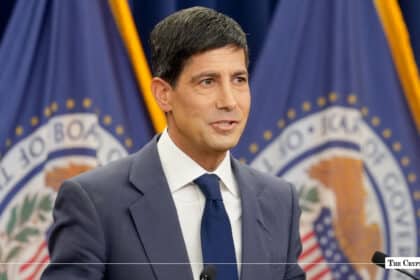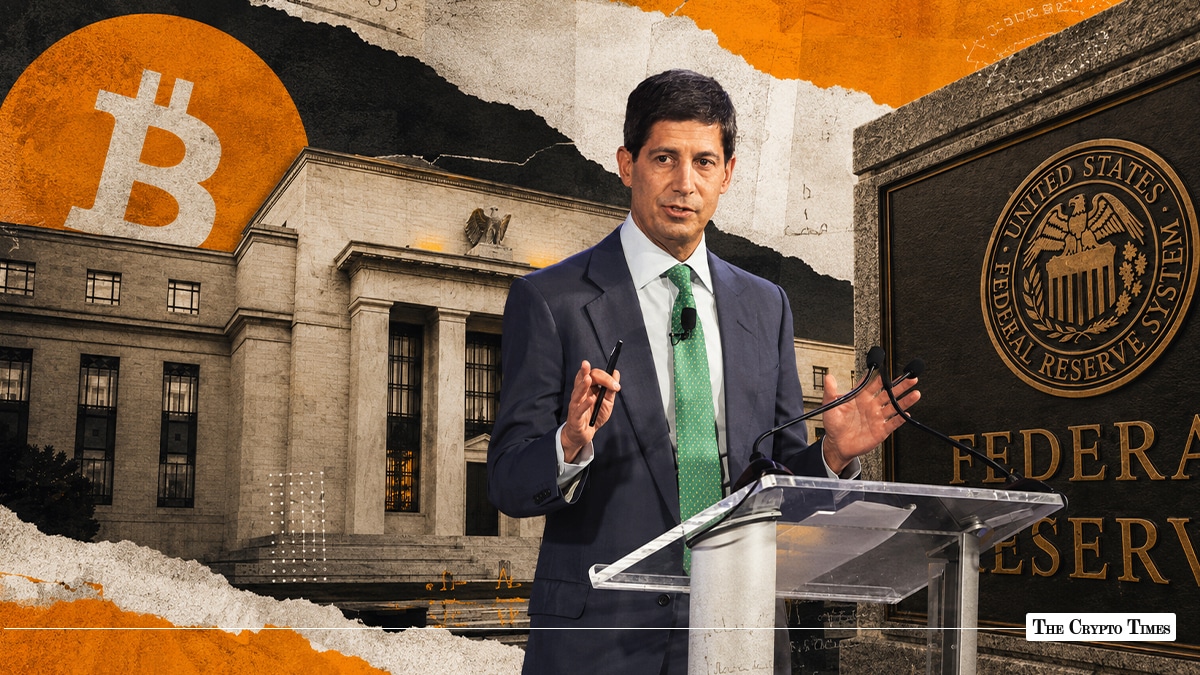
Kevin Warsh takes the chair at his first Federal Open Market Committee (FOMC) meeting on June 16–17, and the digital asset market is watching less for what the Fed does than for who the new chairman turns out to be.
Sworn in on May 22 after the most divisive confirmation vote in Fed history, a 54–45 Senate split, Warsh inherits a central bank navigating inflation near a multi-year high of around 3.8–4.2%, an energy shock from the ongoing war with Iran, and a president who hand-picked him expecting rate cuts. The rate decision itself is close to a foregone conclusion. The bigger question for crypto is whether the most crypto-literate chair in the institution’s history arrives as a tailwind or a headwind.
Warsh Walks Into a Macro Storm
The backdrop is unforgiving.
U.S. inflation has climbed back toward 4%, a multi-year high, driven by the energy shock from the US-Israel war with Iran and the effective closure of the Strait of Hormuz; which the International Energy Agency has called the largest oil-supply disruption in market history. Gasoline has pushed above $4 a gallon, and the Organisation for Economic Co-operation and Development (OECD) and other forecasters project headline U.S. inflation at 4.2% for 2026, partly due to the war. Against that, the FOMC has held the federal funds rate at 3.50%–3.75% for three straight meetings, and markets expect a fourth hold on June 17.
That sets up the meeting’s real subplot: the independence test. President Donald Trump nominated Warsh while openly demanding lower rates, then used the swearing-in to insist, “I want Kevin to be totally independent.” Warsh, for his part, has told lawmakers he will never predetermine a rate decision at the White House’s request. With elevated inflation arguing for caution and the administration pushing the other way, his first press conference will be parsed for any sign of which master the new chair answers to. As The Crypto Times has detailed in mapping the Warsh transition, the direction of travel matters more than any single decision.
The ‘Fed Chair Transition Curse’
For Bitcoin holders, the historical pattern is uncomfortable. Every recent Fed leadership change has coincided with a deep crypto drawdown within roughly the first year.
| Fed Transition | Policy Shift | Crypto Catalyst | Max BTC Drawdown |
|---|---|---|---|
| 2014 (Yellen) | Fed begins tapering QE | Mt. Gox collapse | ~83% |
| 2018 (Powell, 1st term) | Aggressive quantitative tightening | ICO bubble bursts | ~84% |
| 2022 (Powell, 2nd term) | Rapid-fire rate hikes | Terra/Luna and FTX collapses | ~77% |
The logic offered for the “curse” is part psychology, part leverage. New chairs tend to talk hawkish early to establish inflation-fighting credibility, and facing an unfamiliar decision-maker, institutional investors instinctively de-risk out of high-beta assets like crypto. Tighter policy then exposes the most over-leveraged players in the system.
It is worth being clear-eyed, though: three data points is not a law. Each of those crypto crashes had its own internal trigger, an exchange implosion, an ICO mania unwinding, an algorithmic stablecoin and a fraudulent exchange failing, that would likely have detonated regardless of who chaired the Fed.
The pattern is a suggestive correlation and a useful frame for risk, not a mechanical prophecy. What it does capture accurately is that monetary regime changes inject uncertainty, and uncertainty is what crypto prices least well.
The Warsh Paradox: Hawkish Macro, Friendly Posture
What makes this transition genuinely novel is the contradiction at its center. Warsh is simultaneously the most crypto-sympathetic chair the Fed has had and one of its most committed hawks.
The bearish case is the death of easy money.
Warsh resigned from the Fed Board in 2011 over his opposition to quantitative easing, has called the central bank’s 2021–22 low-rate stance a “fatal policy error,” and wants to accelerate the runoff of the Fed’s roughly $6.7 trillion balance sheet (data as of mid-June 2026). Crypto’s biggest runs were fueled by cheap liquidity; a chair determined to drain it could keep institutional risk capital on the sidelines. Bloomberg’s chief U.S. economist, Anna Wong, put it bluntly—if Trump wanted someone easy on inflation, “he got the wrong guy.”
The bullish case is legitimacy.
Warsh does not view digital assets with his predecessors’ skepticism. At a Hoover Institution event, he described Bitcoin as “a very good policeman for policy,” a signal of confidence in the Fed’s inflation management, and has called it a generational alternative to gold. At his April confirmation hearing he said digital assets are “already part of the fabric of our financial services industry.”
As The Crypto Times has reported, he opposes a government-issued central bank digital currency and favors private-sector stablecoins, positions that align with the framework in the CLARITY Act and could accelerate its path to the President’s desk. That regulatory green light is what pension funds and insurers have wanted before allocating to the space. Notably, while Warsh has disclosed crypto-related exposure, he has signed an ethics agreement requiring him to divest most private holdings, so his personal stake is not the tell some assume.
The AI Productivity Wildcard
The most intriguing variable is a unique framework Warsh floated during his confirmation hearings: the theory that productivity gains from artificial intelligence could expand the economy’s supply capacity. In theory, this would allow the Fed to lower rates without reigniting inflation.
If he introduces this ‘AI productivity’ framing into the FOMC statement or press conference, it could open a policy path toward easier monetary conditions despite elevated inflation. This narrative shift could act as major rocket fuel for risk assets, specifically benefiting Bitcoin and AI-related utility tokens.
The idea is not fringe: the OECD itself flags stronger-than-expected AI productivity as a genuine upside to an otherwise grim global outlook. Whether Warsh is willing to lean on it this early, with inflation near 4%, is the open question.
What to Watch on June 17
Given that a rate hold is near-certain, the real signal lives in the tone. Warsh has criticized the Fed’s heavy reliance on forward guidance and the dot plot. He has also floated a “reform-oriented” Fed with messier, more debate-driven meetings, even hinting at cutting the total number of annual meetings and press conferences.
Expect less precise forward signaling and a more data-dependent posture. The Summary of Economic Projections and any shift in the median rate path will be scrutinized for his fingerprints, as will any sudden language updates regarding the balance-sheet runoff.
For crypto specifically, one on-chain tell is worth monitoring during the press conference: the Coinbase Premium. Coinbase Premium tracks the price gap between U.S.-regulated Coinbase and offshore venues. If U.S. institutional appetite wavers under a hawkish Warsh tone, that premium tends to flip negative well before a broader sell-off becomes obvious to retail spot markets.
The bottom line is that Warsh’s debut is a communication event, not an immediate policy pivot. In the near term, macro liquidity signals will handily outweigh his personal affinity for Bitcoin. A hawkish, balance-sheet-shrinking message risks echoing the transition pattern that has bruised every recent cycle. Conversely, a dovish surprise, especially one dressed in AI-productivity logic, could hand crypto a decisive tailwind at an otherwise fragile structural moment. Whether the rate moves or not on June 17, the tone Warsh sets could define crypto’s summer.
Also Read: Warsh, Warren, and Bitcoin’s $80K Wall: Three Forces Shaping Crypto’s Summer