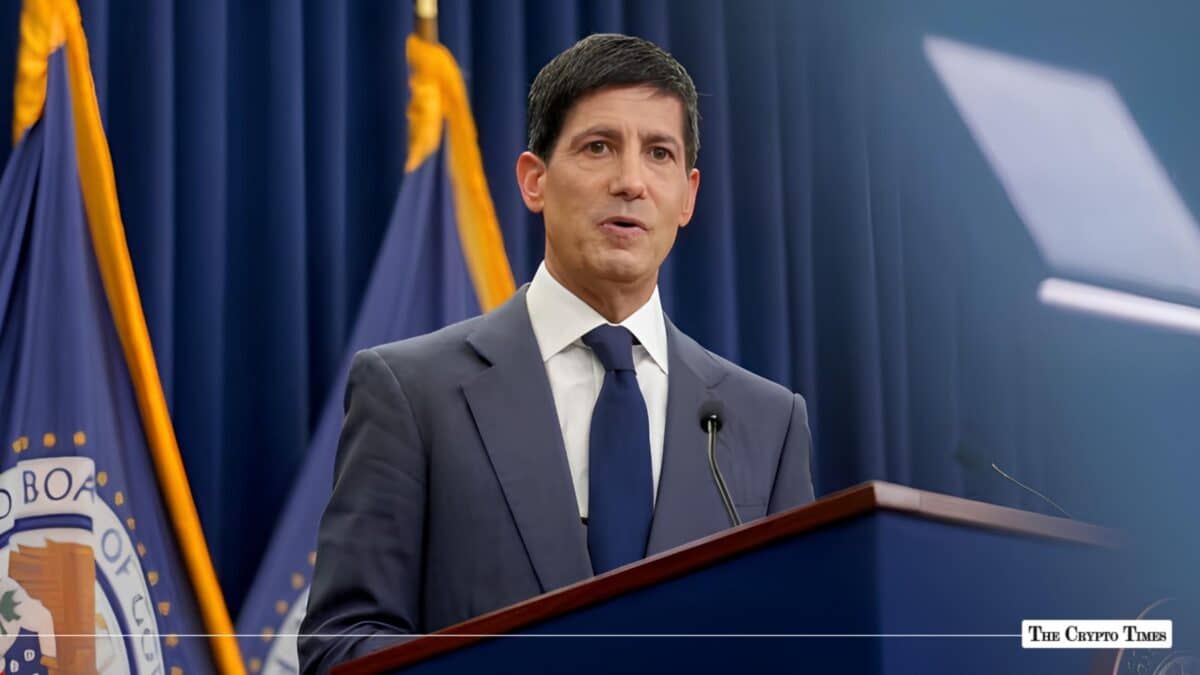
When President Donald Trump named Kevin Warsh to chair the Federal Reserve, much of the crypto industry cheered. Months later, with Bitcoin pinned near $62,000 and rate cuts off the table, Warsh has become the clearest example of a hard truth for the market: the Fed chair crypto wanted is also the one weighing on its price.
The Fed Chair Crypto Wanted
Warsh arrived with a reputation that read as friendly to digital assets. He has described Bitcoin as a “generational alternative to gold,” remarking that “if Bitcoin never existed, gold would be rallying even more,” and has said that for investors under 40, “Bitcoin is your new gold.”
He has called the asset “a good policeman for policy,” a market signal that flags when monetary policy drifts off course, and, unusually for a central banker, has held personal stakes in crypto ventures, including the stablecoin project Basis and asset manager Bitwise.
Just as important was his monetary philosophy. Warsh is a sound-money hawk, a critic of the Fed’s balance sheet expansion, and a champion of central bank discipline, instincts that rhyme with Bitcoin’s anti-debasement ethos. Against Jerome Powell, who largely dismissed crypto, Warsh looked like an ally at the top of the financial system, and the market treated his appointment as a structural win.
The Inflation Vow Changes the Math
Then he opened his mouth. At his first press conference, Warsh came across as a committed inflation hawk, stating repeatedly that “price stability” would be his priority and slashing the FOMC statement to a terse vow to control prices. Investors took him at his word, lifting bets on tightening, dumping short-dated Treasuries, and trimming risk.
The Fed held rates at 3.50%–3.75% and crushed the rate-cut hopes the market had leaned on, pushing expected easing into 2027 as inflation runs above 4% on the back of the Iran-war energy shock.
That is the crux of the paradox. Crypto, as a non-yielding risk asset, rallies on falling rates and a softer dollar, the very tailwind Warsh has now removed. Worse for bulls, markets believe he means it, which is why the no-cut repricing has stuck and Bitcoin has drifted to the lows. The same credibility that makes Warsh effective as an inflation-fighter is what makes him a reliable headwind for crypto prices.
He Was Never Quite the Ally the Market Imagined
The “pro-Bitcoin” label also flattened a more skeptical record. In a 2022 essay, Warsh argued that most private cryptocurrencies were “scams or worthless” and that the term “cryptocurrency” is itself misleading, these are “software, not money,” in his framing.
He has praised Bitcoin as a potential store of value, like gold, while rejecting it as a medium of exchange because of its volatility. His views on a digital dollar are nuanced too: he has argued for a wholesale, interbank digital dollar as a counter to China’s e-yuan; a different animal from the retail CBDC the Trump administration has moved to ban.
In other words, Warsh was never a crypto evangelist. He is a sound-money technocrat whose respect for Bitcoin as “digital gold” coexists with deep skepticism of the broader crypto complex, a distinction that got lost in the celebration of his appointment.
The Silver Lining for Bulls
There is a constructive reading, and it is not trivial. A credible, disciplined Fed that re-anchors inflation expectations could, over time, validate the exact debasement-hedge thesis that underpins Bitcoin’s “digital gold” case, and reduce the policy uncertainty crypto markets have battled for years.
Some analysts argue that hawkish Fed leadership ultimately strengthens Bitcoin’s role as a hedge against centralized monetary control. Warsh’s own framing of Bitcoin as a “policeman for policy” fits that view: a Fed that behaves is not the enemy of sound-money assets, even if a Fed that won’t cut is unfriendly to their price today.
The tension, then, is between the cycle and the structure. Cyclically, Warsh’s inflation vow is a clear drag, higher-for-longer rates and a firmer dollar leave little oxygen for risk assets, and the price action shows it.
Structurally, a restrained, rules-based Fed is closer to what Bitcoiners say they want than the easy-money regime that preceded it. For now, the rates are winning, and crypto’s chosen Fed chair is its biggest obstacle. Whether Warsh’s discipline eventually vindicates Bitcoin’s thesis or simply keeps a lid on it is the question the market will spend the rest of 2026 answering.