
The intense redemption pressure that hammered U.S. spot Bitcoin ETFs throughout May and early June 2026 appears to be easing. According to precise data from SoSoValue, weekly net outflows for Bitcoin ETFs have shrunk dramatically from multi-billion-dollar figures to more manageable hundreds of millions.
This softening comes as Bitcoin trades in a relatively narrow range around $63,000, reflecting cautious investor sentiment amid macroeconomic uncertainty and post-rally profit-taking.
While not yet signaling a full reversal to consistent inflows, the trend offers a glimmer of stabilization for the $2.27 trillion crypto market.
Total net assets in Bitcoin ETFs stand at approximately $78.32 billion, holding about 674,900 BTC and representing roughly 6.19% of Bitcoin’s market capitalization. Cumulative inflows since launch remain a robust $53.40 billion, underscoring the long-term institutional commitment despite recent volatility.
The May Exodus: From Inflows to Record Outflows
The shift began in mid-May. For the week ending May 15, 2026, Bitcoin spot ETFs recorded a $1.00 billion net outflow. This marked the start of a painful streak. The following week (ending May 22) saw outflows widen to $1.26 billion, followed by $1.42 billion for the week of May 29.
By early June, the pressure peaked with a staggering $1.72 billion outflow for the week ending June 5.
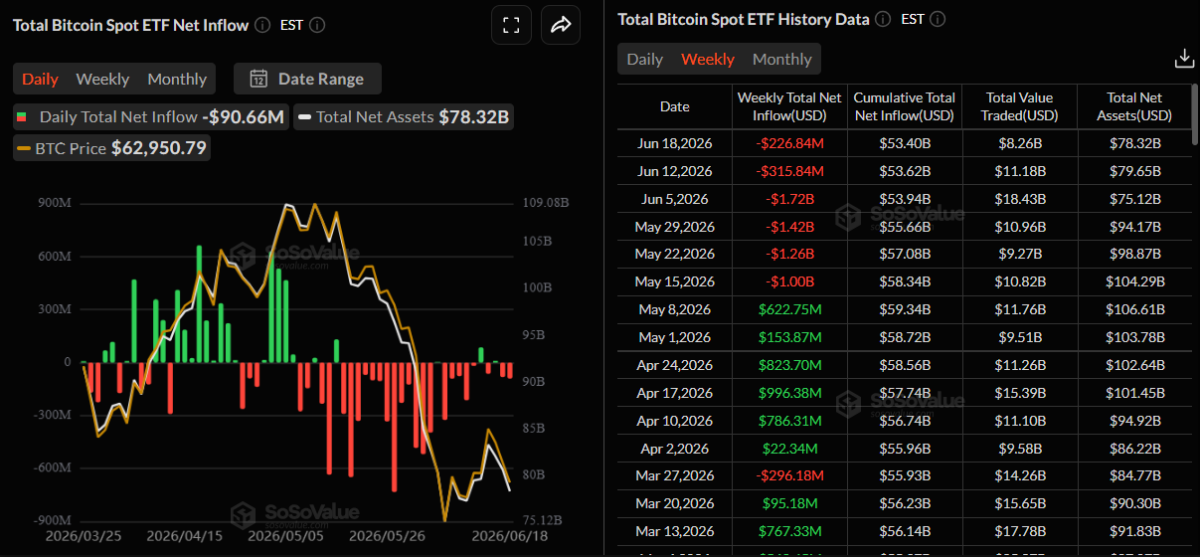
These figures aligned with broader reports of a record 13-day outflow streak from mid-May to early June, totaling roughly $4.4 billion. BlackRock’s iShares Bitcoin Trust (IBIT) bore much of the brunt, with single-day redemptions occasionally exceeding $400 million. Assets under management across the complex dropped sharply from peaks above $104 billion to around $75–78 billion by early June.
Analysts attributed the sell-off to several factors: Bitcoin’s failure to break decisively above key resistance levels after its 2025 highs, lingering concerns over delayed Federal Reserve rate cuts, and broader risk-off sentiment in traditional markets. Grayscale’s GBTC continued to face structural outflows due to its higher fees, while even dominant players like IBIT experienced net selling pressure.
Signs of Softening: June’s Moderating Trend
The trajectory has improved noticeably in recent weeks. For the week ending June 12, outflows narrowed to $315.84 million. By the week ending June 18, they stood at $226.84 million, a significant reduction in intensity.
This represents an approximate 75–87% decline in weekly redemption volume from the early June peak. Daily flows have also become more mixed, with occasional small positive days interrupting the negative run. On June 18 specifically, the complex saw a $90.66 million net outflow, led primarily by IBIT, while other funds remained relatively flat.
Ethereum spot ETFs followed a similar pattern, though on a smaller scale, with cumulative inflows at $11.18 billion and recent daily flows in the low tens of millions negative. Meanwhile, newer spot products tracking Solana and XRP have attracted steadier inflows, with each exceeding $1 billion cumulatively since launch, highlighting some rotation toward alternative assets.
Market Context: Range-Bound Bitcoin Amid Uncertainty
Bitcoin has hovered near $62,950–$63,400 in recent sessions, down more than 50% from its all-time highs in late 2025 but showing resilience above key support levels around $60,000. The market remains range-bound, with traders split on the next move.
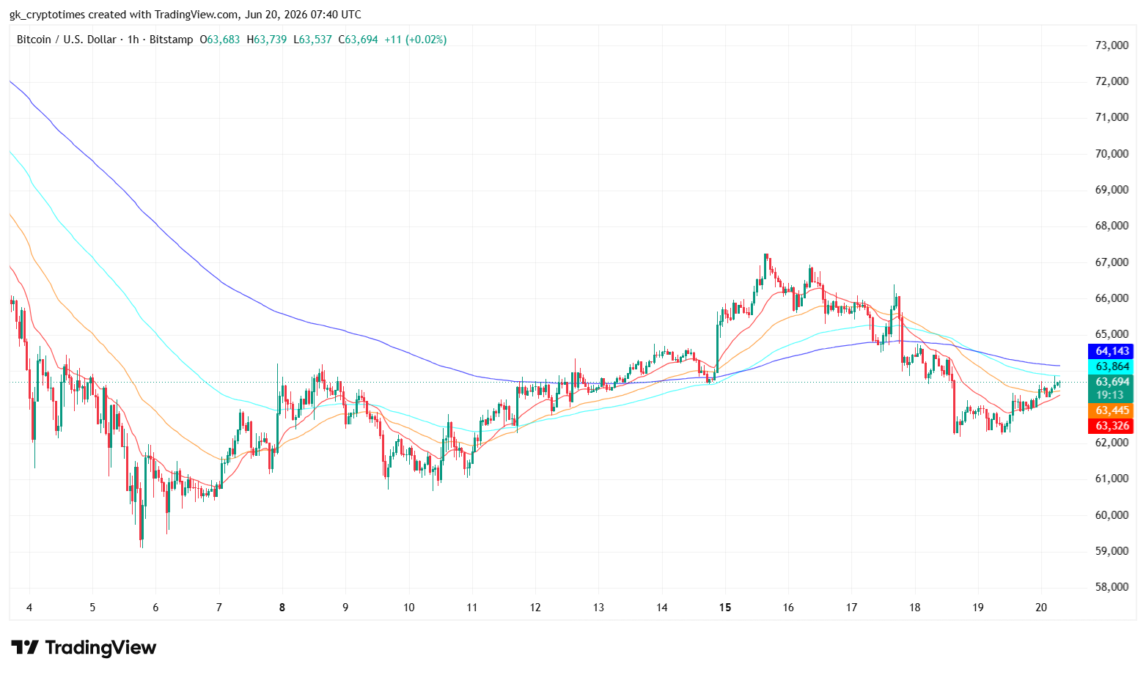
Total crypto market capitalization sits at approximately $2.27 trillion, up modestly in the past day but still reflecting subdued momentum. Ethereum trades near $1,700, while altcoins show mixed performance. Macro headwinds, including sticky inflation data and geopolitical tensions, have kept institutional risk appetite in check, preventing a strong rebound despite the easing ETF pressure.
Implications for Investors and the Industry
The softening of outflows carries several potential implications. First, it may indicate that the most aggressive profit-taking and risk reduction has already occurred. With cumulative inflows still overwhelmingly positive, many view the recent redemptions as cyclical rather than structural. Institutional allocators appear to be repositioning rather than abandoning the asset class.
Second, reduced selling pressure could provide breathing room for Bitcoin to stabilize and potentially test higher resistance levels, such as $65,000–$70,000. A sustained period of neutral-to-positive flows would likely reinforce bullish technical setups. Conversely, any resurgence in heavy outflows could test lower supports near $55,000–$60,000.
For the ETF issuers, the data underscores the importance of competitive fee structures and product innovation. BlackRock and Fidelity continue to dominate assets, but Grayscale’s ongoing challenges highlight the need for adaptation. Broader industry developments, such as Franklin Templeton’s recent filing for Bitcoin dividend-reinvestment ETFs, signal continued innovation aimed at bridging traditional finance with crypto.
Retail and smaller institutional investors have opportunities in this environment. Rotation into Solana and XRP ETFs suggests diversification strategies are gaining traction. Meanwhile, the overall resilience of cumulative inflows, despite a 27%+ drawdown in Bitcoin from recent peaks, demonstrates maturing market infrastructure.
Expert Perspectives and Forward Outlook
Market observers remain divided. Some analysts see the current range-bound action and moderating outflows as a healthy consolidation phase, akin to previous cycles that preceded strong recoveries. Others caution that without clear macroeconomic catalysts, such as actual rate cuts or positive regulatory developments, the market could linger in limbo.
“Institutions have taken profits and de-risked, but the structural bid remains intact,” noted one crypto strategist. “The key will be whether flows turn consistently positive as we approach the third quarter.”
Looking ahead, the coming weeks will be critical. Traders will watch ETF flow data closely alongside Bitcoin’s ability to hold above $60,000 and reclaim $65,000. Broader factors, including Federal Reserve policy signals, corporate adoption news, and on-chain activity, will influence sentiment.
The softening of spot crypto ETF outflows since mid-May represents a meaningful shift from the heavy redemption pressure that defined the early summer period. While markets remain range-bound and sentiment guarded, the dramatic reduction in weekly losses, from over $1.7 billion to under $230 million, suggests exhaustion of aggressive selling.
With cumulative inflows exceeding $53 billion and Bitcoin holdings in ETFs still substantial, the foundation built over the past two years appears resilient. Whether this leads to renewed inflows and a breakout rally or merely a temporary pause will depend on evolving macro conditions and investor conviction.
Also read: Bankers Press Senate on Stablecoin Yield Ahead of CLARITY Act Vote