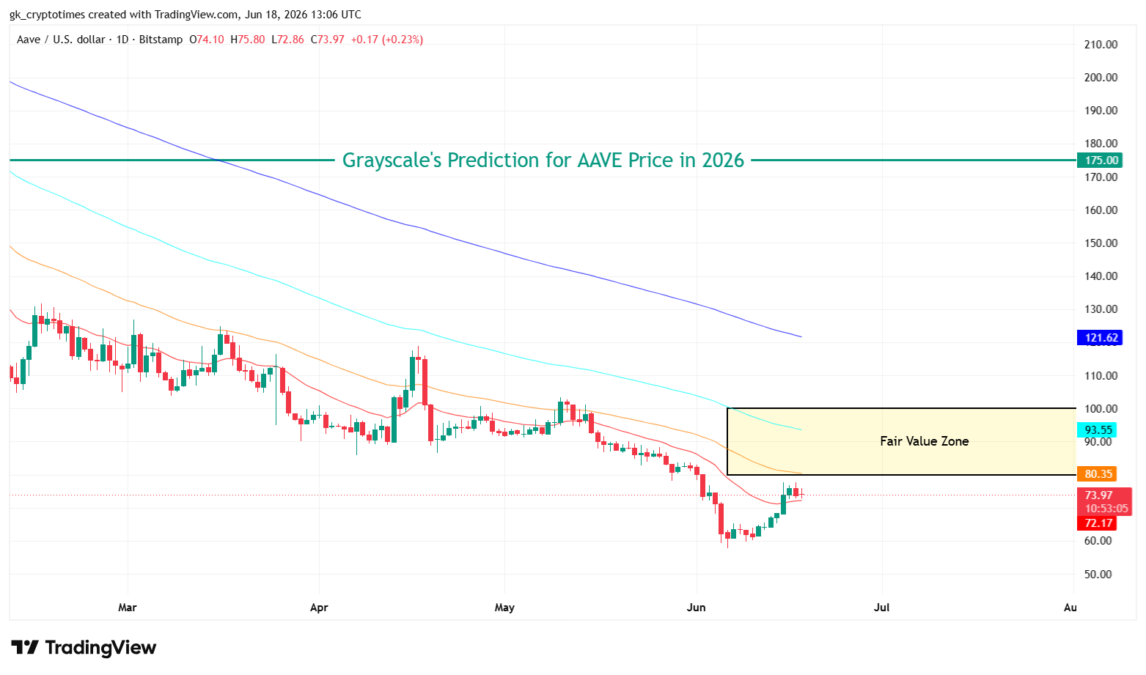
Asset manager Grayscale Research has identified decentralized lending protocol Aave as highly undervalued in its latest report, estimating a current fair value of $80 to $100 per AAVE token based on projected cash flows and traditional financial multiples.
The analysis, published June 16, comes as the AAVE token trades near $74–$75. Grayscale projects the protocol could generate approximately $60 million in revenue in 2026 and outlines a base-case scenario in which the token could surge by staggering 133% and reach about $175 within one year under favorable regulatory and adoption conditions.
The report marks a continued push by Grayscale to apply conventional valuation tools—such as discounted cash flow models and earnings multiples—to decentralized finance (DeFi) protocols that produce measurable revenues, moving beyond speculative narratives that have long dominated crypto markets.
DeFi’s Revenue Milestone and Shift Toward Fundamentals
DeFi protocols have collectively generated nearly $25 billion in cumulative fees since the beginning of 2023, according to Grayscale. This real economic activity has enabled analysts to evaluate certain tokens more like equities than commodities.
Bitcoin and similar assets are often valued on scarcity and adoption as digital gold, but protocols like Aave function as operational businesses with revenue streams, margins, and capital allocation mechanisms. Aave, the largest on-chain lending platform, earns primarily from the spread between deposit and borrowing rates, along with fees from liquidations, flash loans, and its native GHO stablecoin.
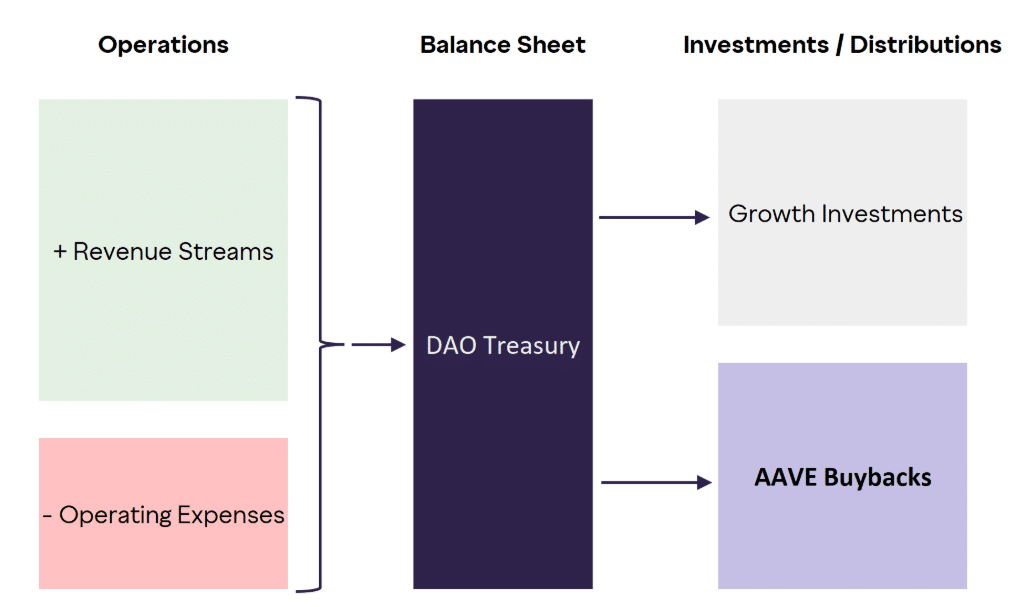
Despite recent challenges—including contributor departures, deposit outflows, and the indirect effects of market exploits—Aave maintains a leading position with over $13 billion in total value locked (TVL), trillions in lifetime deposits, and roughly 200,000 monthly active users. The protocol currently operates at approximately 50% margins.
Grayscale’s Valuation Methodology
Grayscale applied discounted cash flow analysis and comparable multiples from the fintech and banking sectors to Aave’s projected financials. With expected 2026 revenue of around $60 million and typical fintech multiples of 20x to 25x earnings, the firm arrives at a fair market capitalization of $1.2 billion to $1.5 billion.
Divided across roughly 15 million circulating tokens, this implies a per-token value of $80 to $100—representing potential upside of roughly 7 to 33% from prevailing prices near $75.
At current levels, Aave’s trailing and forward price-to-earnings ratios sit in the mid-to-high teens, comparable to large banks (around 14x) and below many fintech peers (around 22x). The S&P 500 trades near 24x trailing earnings.
Grayscale notes that Aave’s transparent on-chain financials, governance processes, and diversified revenue provide a stronger foundation for such analysis than many earlier-stage crypto projects.
Key Growth Drivers Highlighted
The report identifies several product and market catalysts that could support higher valuations:
- GHO Stablecoin: Aave’s native, overcollateralized stablecoin already contributes meaningfully to revenue by capturing internal borrowing spreads. Its supply stands around $283 million.
- Horizon and Institutional Markets: A dedicated venue for tokenized real-world assets (RWAs) as collateral, aimed at bridging traditional finance with DeFi.
- V4 Architecture: An upgrade designed to improve capital efficiency through a hub-and-spoke liquidity model and easier deployment of new markets.
- Umbrella Safety Module and Aave App: Enhancements to risk management and a more accessible user interface intended to broaden retail adoption.
Broader tailwinds include continued expansion of the stablecoin market and tokenized asset sector. Potential regulatory clarity—such as through proposed legislation like the CLARITY Act—could accelerate institutional participation in on-chain credit markets.
Scenario Analysis and Price Targets
Grayscale presents multiple scenarios for AAVE’s potential performance over the next year, primarily varying assumptions around regulatory progress and adoption of tokenized assets and stablecoins.
A base case for AAVE sits at approximately $175 per token, implying more than 133% upside from current levels. While more optimistic assumptions around earnings growth (25–35% annually) could support significantly higher valuations in bull scenarios, though Grayscale cautions these remain speculative.
The firm emphasizes downside resilience stemming from Aave’s market leadership, substantial treasury reserves (which have exceeded $360 million at peaks), and governance mechanisms that increasingly align protocol performance with token holder returns, including potential buybacks and staking incentives (though buybacks are currently paused for review).
“Aave’s revenue has increasingly been anchored by stablecoin activity rather than volatile crypto assets, providing a more durable earnings base as the protocol scales,” Grayscale Analysts mentioned in the report. “With stablecoin adoption and RWA tokenization representing significant structural tailwinds, Aave is well positioned to grow its loan book independent of broader crypto market cycles.”
Risks and Challenges
Analysts and investors should weigh several risks. As a decentralized autonomous organization (DAO), Aave operates outside traditional corporate structures, creating regulatory uncertainty around governance, liability, and token classification.
Smart contract vulnerabilities, while historically well-managed by Aave, remain inherent to the sector. Intense competition from newer lending protocols, potential liquidity fragmentation across chains, and broader crypto market volatility could pressure performance. Recent TVL drawdowns and governance shifts add near-term uncertainty.
Grayscale stresses that all projections depend on assumptions regarding market growth, regulatory developments, and successful execution of upgrades. Cryptocurrency investments carry substantial risk of loss.
Implications for Crypto Investment Landscape
Grayscale’s focus on cash-flow-generating protocols reflects a maturing approach to digital asset investing. By highlighting Aave alongside other DeFi projects with strong economics—such as Uniswap, Hyperliquid, Sky, and Maple—the report underscores a shift from hype-driven narratives toward sustainable business models.
For institutional and retail investors, the analysis provides a framework for evaluating DeFi opportunities using familiar financial tools. Should regulatory clarity improve and tokenized assets gain traction, established protocols like Aave could capture a larger share of the growing on-chain finance market, currently representing tens of billions in deposits and loans.
Disclaimer: This article is for informational and educational purposes only and does not constitute financial, investment, legal, tax, or any other professional advice. Grayscale’s projections, price targets, and valuations are forward-looking estimates based on assumptions that may not occur, and actual results may differ materially due to market volatility, regulatory changes, competition, and other risks. Cryptocurrency investments, including AAVE, carry a high degree of risk—you could lose all of your invested capital. Past performance is not indicative of future results. Always conduct your own thorough research (DYOR), consult a qualified financial advisor, and invest only what you can afford to lose.
Also read: 80% of Brazil’s Illicit Crypto Flows Through Just 5 Addresses