Crypto Times Logo Black
Google News Follow Banner
  • News
    • Market
    • Bitcoin
    • Ethereum
    • Altcoins
    • Regulations & Policies
    • DeFi News
    • Blockchain News
    • Industry
  • Exclusive
    ExclusiveShow More
    Telegram Ban India Crypto, TON & Durov's Attack on Reliance
    Telegram Ban in India: Crypto, TON & Durov’s Attack on Reliance
    Hormuz Peace Dividend How the US-Iran Deal Fuels Dubai RWAs & Not Tehran
    Hormuz Peace Dividend: How the US-Iran Deal Fuels Dubai RWAs & Not Tehran
    Kevin Warsh's First FOMC What It Means for Bitcoin and Crypto
    Bitcoin and the ‘Fed Chair Curse’: What Kevin Warsh’s First FOMC Means for Crypto
    Crypto Tax Overhaul What Congress’s New Framework Means for 60M Americans
    Crypto Tax Overhaul: What Congress’s New Framework Means for 60M Americans
    One Laptop, $36 Million, and a Token Collapse Inside the Humanity Protocol Exploit
    Humanity Protocol $36M Exploit: 447M $H Hit After Laptop Breach and Multisig Failure
  • Opinion
    OpinionShow More
    The Arthur Hayes Paradox Macro Prophet or Market Opportunist
    The Arthur Hayes Paradox: Macro Prophet or Market Opportunist?
    RBI Denies Gold Sale Amid Oil Crisis: Could It Speed Up India's Digital Rupee Push?
    RBI Denies Gold Sale Amid Oil Crisis: Could It Speed Up India’s Digital Rupee Push?
    The CLARITY Act War Starts Jamie Dimon Vs Armstrong
    The CLARITY Act War Starts: Jamie Dimon Vs Armstrong
    Is Crypto Dying, or Is Pump.fun Turning It Into an Attention Casino
    Is Crypto Dying, or Is Pump.fun Turning It Into an Attention Casino?
    CoinSwitch on TMKOC India Saw a ₹100 Crypto Pitch, But Not the Risks Behind It_
    CoinSwitch on TMKOC: India Saw a ₹100 Crypto Pitch, But Not the Risks Behind It
  • Learn
    • Explained
    • How To
    • Insights
  • Videos
  • More
    • About Us
    • Our Authors
    • Contact Us
    • Editorial Policy
The Crypto TimesThe Crypto Times
  • All News
  • Market
  • Bitcoin
  • Ethereum
  • Altcoins
  • Regulations & Policies
  • Blockchain
  • DeFi
  • Industry
  • Exclusive
  • Opinion
Search
  • News
    • Market
    • Bitcoin
    • Ethereum
    • Altcoins
    • Regulations & Policies
    • Blockchain
    • DeFi
    • Industry
    • Exclusive
    • Opinion
  • Learn
    • Explained
    • How To
    • Insights
  • Quick Links
    • About Us
    • Our Authors
    • Contact Us
    • Editorial Policy
    • AI Policy
    • Sponsored & Advertorial Policy
  • Podcasts
Follow US
© 2026 By Crypto Times. All Rights Reserved.
Market News

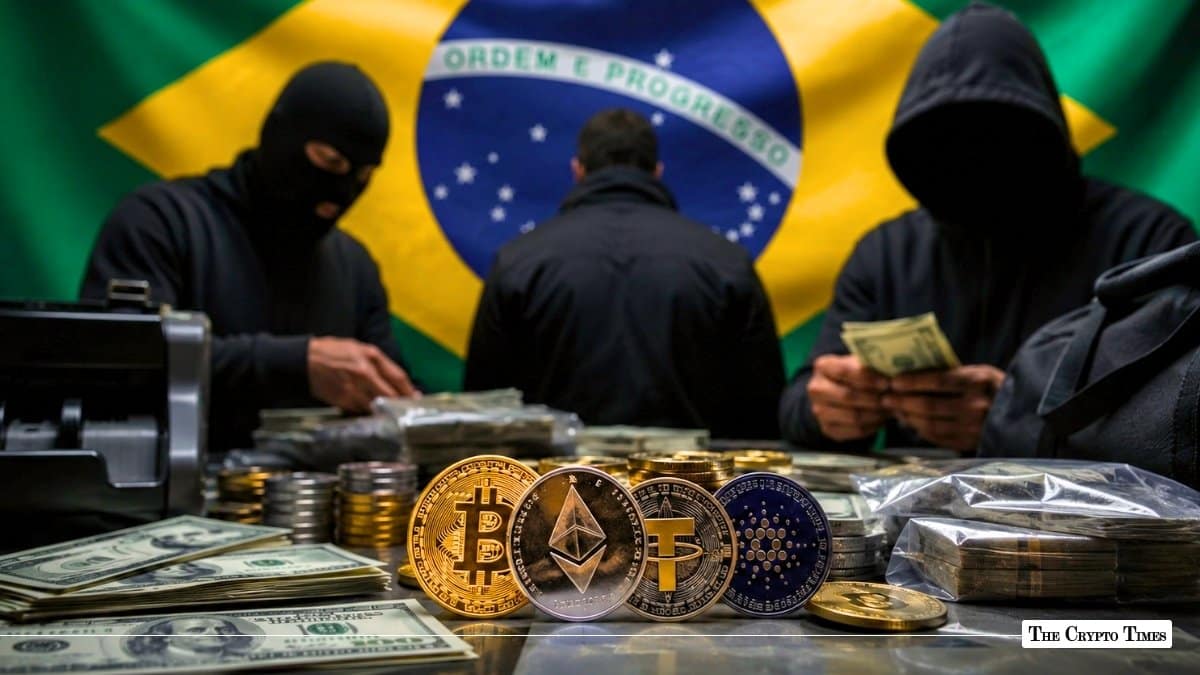
Chainalysis: 80% of Brazil’s Illicit Crypto Flows Through Just 5 Addresses

Just 5 addresses received 80% of illicit crypto flowing into Brazilian exchanges, despite 550-950 exposed addresses per quarter.

Written By:
Dishita Malvania

Last updated: 1 hour ago
Published 1 hour ago
Share
Chainalysis 80% of Brazil's Illicit Crypto Flows Through Just 5 Addresses
Show AI Summary
Chainalysis data reveals Brazilian exchanges received $318 billion in on-chain crypto value between 2024 and 2025.
Cartel-related money laundering dominates illicit inflows to Brazilian exchanges, leveraging key cocaine trafficking routes.
Chinese-language money laundering networks account for 20% of global on-chain illicit laundering, offering services to various actors.

The same criminal networks that define the global crypto laundering landscape have found significant footholds inside Latin America’s largest cryptocurrency market, according to a new analysis from Chainalysis published today.

The blockchain analytics firm’s data shows that drug cartel money laundering, Chinese-language money laundering networks, and Russian sanctions evasion have become the three dominant categories of illicit crypto activity flowing into Brazilian exchanges between 2023 and 2025.

Brazil received an estimated $318 billion in on-chain cryptocurrency value between July 2024 and June 2025, roughly one-third of all crypto value received across Latin America, according to the Chainalysis 2025 Geography of Cryptocurrency Report. That scale has made it an attractive target for the same threat actors operating across global markets.

Cartels lead, CMLNs follow, Russia grows

Cartel-related money laundering emerged as the single largest identified category of illicit inflows to Brazilian exchanges, according to the Chainalysis analysis. The firm noted that Brazil sits along key South American cocaine trafficking routes and that Brazilian organized crime groups, including Primeiro Comando da Capital (PCC) and Comando Vermelho, have been documented using cryptocurrency as part of their financial operations. Both groups are now designated as Foreign Terrorist Organizations in the United States.

Chinese-language money laundering networks appeared consistently across the 2023 to 2025 period in the data. These professionalized operations provide laundering-as-a-service to drug trafficking organizations, fraud operations, and increasingly, nation-state actors. 

🇧🇷 Brazil received ~$318B in crypto this past year—1/3 of LatAm’s total value. But growth attracts more than legitimate users.

Our latest research reveals:
– Cartel money laundering is the largest identified category of illicit inflows.
– Russian sanctions evaders are… pic.twitter.com/sEozjcnl3y

— Chainalysis (@chainalysis) June 18, 2026

Chainalysis estimates that CMLNs now account for approximately 20% of the total on-chain illicit laundering ecosystem globally, a share that has grown consistently since 2021. Their presence in Brazil is consistent with a broader pattern across Latin America, where these networks have established operations in countries with active trade corridors and large informal economies.

Russia-linked flows, including entities subject to international sanctions, became a more visible component of illicit inflows, particularly in 2024 and 2025. Chainalysis pointed to the A7A5 swap service and other sanctioned services as part of this exposure. Globally, state-driven sanctions evasion reached approximately $104 billion in 2025, a 694% year-on-year surge, as nation-states increasingly turn to crypto to bypass international financial restrictions.

The firm also flagged the emergence of “guarantee services” in its Brazilian data for 2025. These are criminal escrow-type services associated with fraud and organized crime, and their appearance suggests that the local market is being integrated into broader criminal service ecosystems tied to Southeast Asian operations.

Also Read: Crypto’s Use in Suspected Human Trafficking Surges 85% YoY: Chainalysis

Five addresses, 80% of the problem

One of the more striking findings from the analysis involves how concentrated the illicit exposure actually is. Chainalysis found that while the number of distinct deposit addresses exposed to illicit inflows at Brazilian exchanges ranged from roughly 550 to 950 per quarter between 2023 and early 2026, the top five most exposed deposit addresses per quarter consistently accounted for between 75% and 90% of total illicit volume received.

As of March 2026, approximately 80% of illicit volumes went to just five distinct addresses. Chainalysis described this concentration as “operationally significant,” noting that while criminal actors are spreading flows across many entry points to avoid detection, a meaningful share of illicit volume remains traceable to a small number of high-risk addresses.

The firm said this data shows real opportunities for intervention and helps compliance teams zero in on the worst actors rather than chasing a broadly distributed problem.

$154 billion globally, stablecoins dominate

The Brazil-specific findings come as part of a broader picture. Total value received by illicit cryptocurrency addresses reached $154 billion globally in 2025, up from $59 billion in 2024 and $11 billion in 2020. Chainalysis said this growth reflects not just rising crypto adoption but a fundamental shift in how criminal enterprises operate on-chain.

Stablecoins now account for the overwhelming majority of illicit crypto value, preferred by criminal actors for their price stability and settlement utility. This mirrors stablecoins’ dominance more broadly in the cryptocurrency ecosystem. In Brazil specifically, officials have previously estimated that around 90% of the country’s crypto transaction volume involves stablecoins.

The regulatory clock is ticking

These illicit flow patterns are arriving at a critical juncture for Brazil’s crypto regulatory framework. In November 2025, the Banco Central do Brasil published Resolutions 519, 520, and 521, operationalizing the 2022 Virtual Assets Law. 

The regime took effect on February 2, 2026, and introduced a licensing pathway for crypto service providers (SPSAVs) that covers domestic brokers, custodians, intermediaries, and overseas firms serving Brazilian clients.

The framework also mandates AML/CFT obligations, including the FATF Travel Rule, and classifies cross-border stablecoin transfers as foreign exchange activity under Resolution 521. Reporting obligations went live on May 4, 2026, with the SPSAV licensing deadline for existing firms set for October 29.

In March 2026, Brazil passed Law No. 15.358, giving authorities expanded powers to freeze, seize, and repurpose digital assets linked to organized crime.

Chainalysis described the October deadline as “a near-term opportunity to demonstrate with on-chain evidence that targeted intervention can outpace the global threat actors that have arrived in the market.” 

The firm noted that the concentration of illicit volume among a small number of deposit addresses is exactly the kind of signal that its Reactor, Data Solutions, and KYT (Know Your Transaction) tools are built to surface, and that these signals are already visible in Brazilian exchange data today.

The firm emphasized that its data reflects the global nature of crypto crime and is not a verdict on any individual exchange’s compliance posture. Criminal networks operating across borders route funds through whichever on-ramps and off-ramps offer access, and Brazil’s large, growing market makes it an attractive target regardless.

Also Read: G7 Declares North Korean Crypto Heists a Top Global Security Threat

Disclaimer: The information researched and reported by The Crypto Times is for informational purposes only and is not a substitute for professional financial advice. Investing in crypto assets involves significant risk due to market volatility. Always Do Your Own Research (DYOR) and consult with a qualified Financial Advisor before making any investment decisions.

Follow The Crypto Times on Google News to Stay Updated!      Google News
Google News Banner

TAGGED:BrazilCryptocurrency
Share This Article
Whatsapp Whatsapp LinkedIn Telegram Copy Link
Dishita Malvania - Senior crypto journalist at The Crypto Times
By Dishita Malvania
Follow:
Dishita Malvania is a Crypto Journalist with 3 years of experience covering the evolving landscape of blockchain, Web3, AI, finance, and B2B tech. With a background in Computer Science and Digital Media, she blends technical knowledge with sharp editorial insight. Dishita reports on key developments in the crypto world—including Litecoin, WazirX, Solana, Cardano, and broader blockchain trends—alongside interviews with notable figures in the space. Her work has been referenced by top digital media outlets like Entrepreneur.com, The Independent, The Verge, and Metro.co, especially on trending topics like Elon Musk, memecoins, Trump, and notable rug pulls.

Latest News

Malta Pushes to Define What Actually Counts as 'Decentralized' Under MiCA
Malta Pushes to Define What Actually Counts as ‘Decentralized’ Under MiCA
Inside Grayscale's Bold Prediction for Aave: How AAVE Price Could Reach $175 in 2026
Inside Grayscale’s Bold Prediction for Aave: How AAVE Price Could Reach $175 in 2026
Oman's Mandatory Bitcoin Mining Pool Trades Miner Freedom for State Control
Oman’s Mandatory Bitcoin Mining Pool Trades Miner Freedom for State Control
G7 Declares North Korean Crypto Heists a Top Global Security Threat


Coinbase CEO Illinois Crypto Tax Punishes Blockchain & Will Kill Tech Jobs
Coinbase CEO: Illinois Crypto Tax Punishes Blockchain & Will Kill Tech Jobs

Find Us on Socials

You may also like

Capital B Secures €105B Financing Authorization for Bitcoin Strategy

Capital B Secures €105B Financing Authorization for Bitcoin Strategy

India's FIU Seeks Data on OTC Crypto Deals Above ₹9.4 Lakh

India’s FIU Seeks Data on OTC Crypto Deals Above ₹9.4 Lakh

Binance Users Added Ether More Than Twice as Fast as Bitcoin in May

Binance Users Added Ether More Than Twice as Fast as Bitcoin in May 2026

Italy’s Conio Secures MiCA License Ahead of EU’s July 1 Deadline 

Italy’s Conio Secures MiCA License Ahead of EU’s July 1 Deadline 

The Crypto Times Logo PNG

Providing real-time, accurate Crypto reporting. Your trusted source for Crypto News and Research.

Stay Updated

All News
Exclusive
Opinions
Learn
Videos

Company

About Us
Our Authors
Editorial Policy
AI Policy
Advertorial Policy

Get In Touch

Contact Us
Career

Find Us on Socials

X-twitter Linkedin Telegram Youtube Instagram

© 2026 The Crypto Times | A BITROCK TECHNOLOGIES L.L.C. Company.

DMCA.com Protection Status
  • Terms and Conditions
  • Disclaimer
  • Privacy Policy
  • Cookie policy
Do Not Sell or Share My Personal Information