Key Highlights
- Aster introduced a new tokenomics model linking 99% of daily platform fees to automatic $ASTER buybacks via a TWAP mechanism.
- Purchased tokens are distributed to veASTER stakers alongside existing loyalty rewards, increasing staking incentives.
- The protocol will conduct bi-weekly burns from reserve allocations, targeting a reduced total supply of 3 billion $ASTER.
Aster, the decentralized trading platform, has rolled out a tokenomics upgrade effective June 17, designed to align platform activity directly with token holder value.
According to the official announcement, the changes introduce automatic buybacks funded by protocol revenue, enhanced staking rewards for veASTER holders, and a structured burn mechanism aimed at reducing the total supply to 3 billion $ASTER tokens.
Buyback and burn mechanisms
Under the new model, 99% of Aster’s daily platform fees will automatically be used to purchase $ASTER on the open market through a time-weighted average price (TWAP) mechanism. The purchased tokens will be sent to a public buyback wallet and distributed to veASTER stakers each epoch in addition to the existing base loyalty reward of 300,000 $ASTER.
The protocol has also introduced a burn mechanism. For every $ASTER purchased through platform fees, an equivalent amount will be burned from the protocol’s reserves, beginning with the team allocation.
Burn events will take place every two weeks and continue until the total token supply is reduced to the target of 3 billion $ASTER.
Permissionless spot listings add another revenue stream. Each new listing incurs a 50,000 USDT fee, which is converted into $ASTER buybacks the following week. Staking rewards from these fees activate two weeks after listing, further incentivizing ecosystem expansion.
What’s breakdown of token allocation
The initial $ASTER supply has been allocated across several categories to support ecosystem growth, community participation, and long-term development.
- Airdrop (53.5% – 4.28 billion $ASTER): The largest share supports traders, community builders, and ecosystem participants. Roughly 8.8% (704 million tokens) unlocked at TGE for Aster Spectra and Aster Gems reward recipients. Unclaimed tokens revert to future community distributions. The remainder vests gradually over 80 months, subject to governance adjustments.
- Ecosystem & Community (30% – 2.4 billion $ASTER): Funds APX holder migration, grants, marketing, liquidity, and staking rewards. APX-to-ASTER swaps feature a time-decaying conversion rate. After four months of linear vesting (October 2025–January 2026), this bucket transitioned to a staking emission model, currently dedicated to rewards.
- Treasury (7% – 560 million $ASTER): Fully locked post-TGE and accessible only through governance for strategic initiatives and operations.
- Team & Advisors (5% – 400 million $ASTER): Subject to a 12-month cliff followed by 40 months of linear vesting at 10 million tokens monthly, ensuring long-term alignment.
- Liquidity & Listings (4.5% – 360 million $ASTER): Fully unlocked at TGE to support exchange liquidity and bootstrapping.
Token reacts to the upgrade
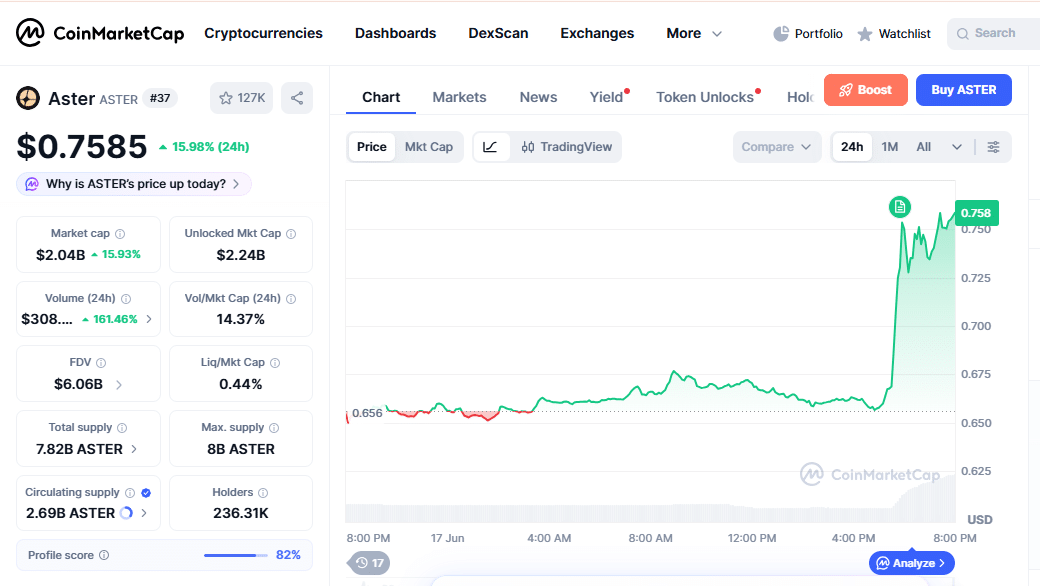
At the time of writing, $ASTER was trading at $0.75, up 15.98% over the past 24 hours and 24.53% over the past seven days, according to CoinMarketCap. Market capitalization stands at $2.03 billion, with a 24-hour trading volume of $302 million.
The token is reacting positively to today’s major tokenomics upgrade announcement. Circulating supply remains relatively low compared to total, which amplifies the impact of buybacks and burns. The token shows good liquidity across exchanges, though volatility is typical for the sector.
Users advised to conduct their own research
The tokenomics upgrade introduces a mechanism that channels 99% of platform fees into automatic $ASTER buybacks, with matched burns from reserves targeting a reduction of total supply to 3 billion tokens. This shifts part of the incentive structure from emissions toward revenue-backed rewards for veAster stakers.
How effective these changes will be in influencing token value, participation, or long-term supply dynamics remains to be seen and will depend on actual platform usage, execution of buybacks and burns, governance decisions, and broader market conditions.
As with similar DeFi mechanisms, outcomes are uncertain and subject to various risks inherent in the sector. Users interested in the protocol should conduct their own research regarding the upgrade details, staking mechanics, and token unlocks before making any decisions.
Also Read: BTC, ETH, BNB, XRP, SOL Slip Ahead of Warsh’s First FOMC