
Bitcoin has spent the better part of two months trading in a relatively tight band in the low-to-mid $60,000 range, a period of quiet consolidation that stands in sharp contrast to the dramatic swings that defined much of the past year.
As of early August 5, 2026, the leading cryptocurrency is hovering near $64,000, roughly 49% below its October 2025 all-time high of $126,198—as per CoinMarketCap data. The sideways action follows a steep correction earlier in the year that briefly tested levels near $58,000 to $60,000, leaving market participants debating whether this prolonged base-building phase marks the early stages of a recovery or simply a pause before further downside.
Aggregated data from multiple exchanges by Coinglass shows Bitcoin oscillating mostly between $62,000 and $66,000 in recent weeks, with sessions in late July and early August frequently closing above $63,000. Trading volumes have been mixed, and volatility has remained subdued compared with earlier in the cycle.
Spot Bitcoin exchange-traded funds (ETFs) have provided intermittent support through net inflows totaling $172.43 million in July 2026, including notable contributions from BlackRock’s IBIT—as per SoSoValue data.
At the same time, capital rotation toward artificial-intelligence-related equities and a backdrop of elevated interest rates and a relatively strong U.S. dollar have limited upside momentum. Corporate activity has also drawn attention, with some treasury holders adjusting positions even as longer-term believers continue to accumulate.
Two Months of Quiet Range-Bound Trading
The current consolidation began in earnest after Bitcoin’s mid-year slide, which erased a substantial portion of the gains accumulated during the previous bull phase. From the October 2025 peak, the drawdown has been significant yet still shallower than the 75 to 85% peak-to-trough declines that characterized earlier bear markets.
Bitcoin price has repeatedly found buyers near the low $60,000s, turning that zone into a temporary floor while resistance has clustered around the mid-to-upper $60,000s.
This two-month grind has allowed positions to transfer and leverage to reset without the kind of cascading liquidations that often accompany sharper declines. Short squeezes have occasionally lifted price, yet sustained buying pressure has so far been insufficient to push Bitcoin decisively above key resistance. The result is a market that feels neither euphoric nor panicked—simply waiting for a clearer catalyst.
Near-Term Scenarios and August Outlook
Looking ahead to the remainder of August and the coming weeks, analysts largely expect the range-bound pattern to persist, though the precise boundaries remain contested. One widely cited on-chain assessment from analyst Axel Adler Jr. places the most probable trading band between roughly $57,700 and $67,000, with a base-case probability around 55% that Bitcoin closes the month somewhere between $60,000 and $64,000. In this view, support near recent lows and the on-chain cost area should continue to attract buyers, while resistance near prior supply zones and moving averages limits upside.
A more constructive scenario, assigned roughly 15% probability in the same framework, envisions a daily close above $67,000 accompanied by stronger ETF inflows, softer Treasury yields, and a weaker dollar. That combination could open a path toward $71,000 to $74,000 and potentially higher levels in the $75,000 to $80,000 region.
Conversely, a bearish outcome carrying about 30% probability would see a break below $57,700, exposing the realized price near $52,800 and raising the risk of a deeper test of support.
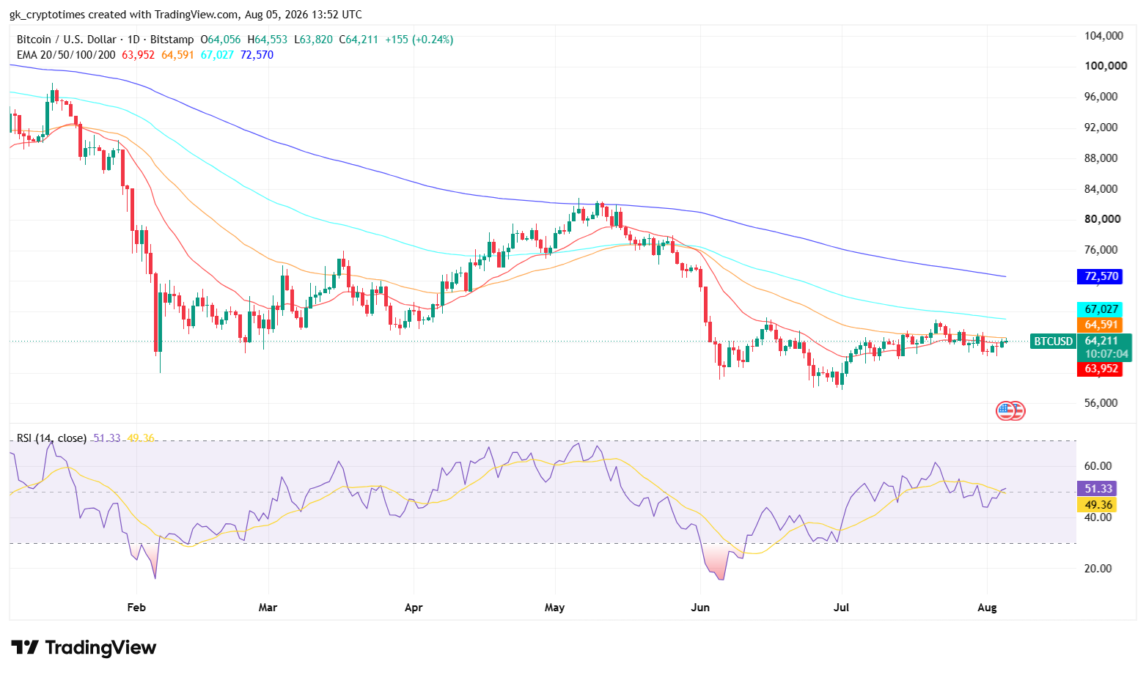
Seasonal tendencies have historically leaned soft in August, and the current macro environment—still characterized by restrictive monetary policy and competition for capital from AI themes—reinforces a cautious tone. Regulatory developments, including any progress on market-structure legislation before congressional recesses, could serve as near-term catalysts in either direction.
According to analysts, key technical levels to watch include the $60,000 to $61,000 psychological and structural floor, the $58,000 prior monthly low area, and upside hurdles clustered between $65,000 and $68,000.
The Broader Cycle Path and What Lies Beyond
Zooming out to the remainder of 2026, opinion splits more sharply between those who believe the low $60,000s already represent, or closely approximate, the cycle bottom and those who anticipate one more leg lower.
Under optimistic assumptions the structural demand from ETFs and corporate treasuries reasserts itself, some institutional forecasts continue to float targets of $100,000 or higher by year-end, though such projections appear ambitious from current levels.
A more cautious camp points to historical cycle patterns, liquidity heatmaps, and Bitcoin’s position below major longer-term moving averages. These analysts see a final bottom more likely forming in the $45,000 to $55,000 zone during the third or fourth quarter of 2026—painful enough to reset positioning yet still milder than previous bear-market troughs.
Deeper stress scenarios extend toward the low $40,000s if macro conditions deteriorate further or if forced selling intensifies. On-chain cost bases clustered in the low-to-mid $50,000s are frequently cited as the line separating a normal correction from more severe capitulation.
Ultimately, the trajectory will hinge on a handful of variables: the Federal Reserve’s path on rates, the sustainability of ETF flows, any shift in capital away from AI equities back toward crypto, and broader risk appetite. Bitcoin’s two-month stay in the low $60,000s has built a foundation of sorts, but the market remains in a corrective phase relative to its cycle peak.
Whether that foundation holds or gives way to lower levels will determine if 2026 ends as a year of base-building or prolonged recovery. For now, the world’s largest cryptocurrency continues to trade with the quiet tension of a coiled spring, waiting for the next decisive move.
Also read: Coldcard Hack Stirs Dormant Bitcoin, Retail Transfers Hit FTX-Era Highs