
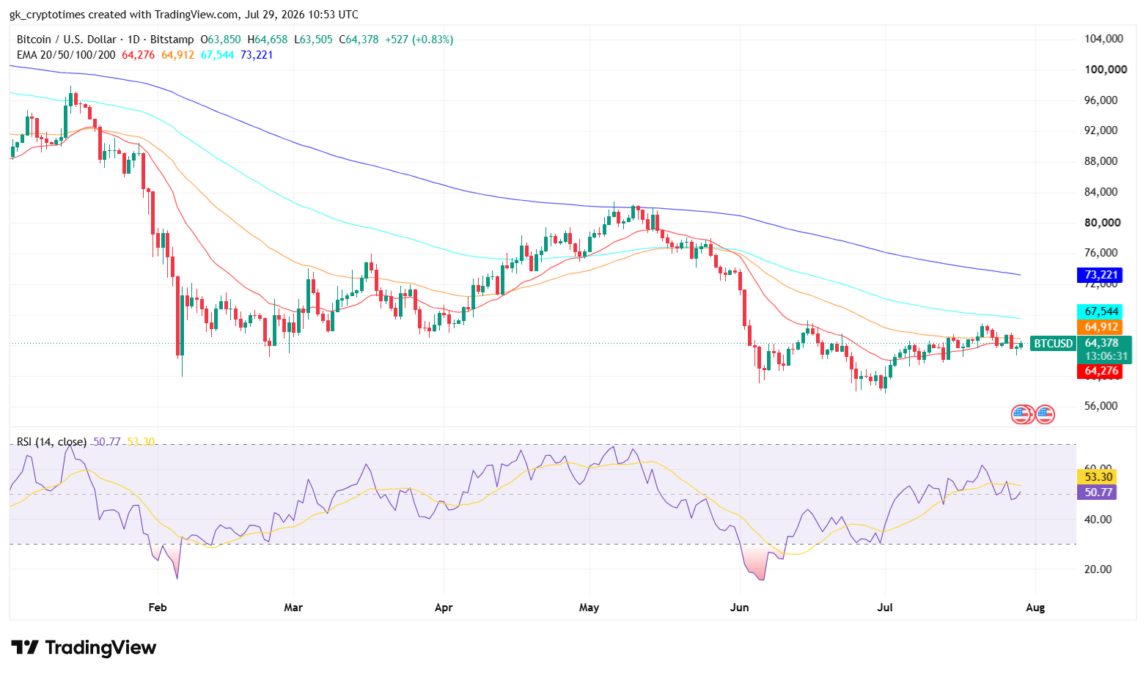
Bitcoin will most certainly begin August 2026 trading in the $63,800–$65,500 range after clawing back from June’s steep losses. The cryptocurrency recovered from late-June levels near $58,000–$60,000 and posted solid gains through much of July, yet the calendar is about to turn against the bulls.
August has long ranked among Bitcoin’s weaker months, and the market must now decide whether recent relief is the start of something more durable or simply a pause before further pressure.
As of late July 2026, Bitcoin stabilized near $64,000 after a turbulent first half of the year. June delivered one of the harshest monthly declines of 2026 so far, with losses exceeding 20%. July reversed much of that damage, producing a rebound that tracked historical patterns for the month.
Spot prices spent much of the second half of July oscillating between roughly $61,000 and $66,900, with key support forming near the $60,000–$61,000 zone and resistance clustering around $66,000–$67,000.
Notably, institutional demand has been inconsistent. U.S. spot Bitcoin ETFs suffered record outflows of $4.51 billion in June. While July brought intermittent inflows that briefly lifted confidence, it was only for net flows to turn negative again in the final trading days of the month.
Aggregate year-to-date flows remain deeply negative, and assets under management (AUM) across the complex sit well below their earlier 2026 peaks. Without a sustained return of capital, any price advance faces an uphill battle.
Macro conditions add another layer of uncertainty. Traders continue to monitor Federal Reserve policy signals and any movement on U.S. crypto legislation. These factors, combined with still-cautious institutional positioning, leave Bitcoin in a fragile recovery phase rather than a confirmed uptrend.
August’s Historical Track Record
Seasonality offers little encouragement. Across data spanning 2013 onward, August has closed higher in only a minority of years. Average monthly returns typically land at +1.12% while the median return is more clearly negative at –7.49%. Data from Coinglass shows that consecutive red Augusts from 2022 through 2025 have reinforced the perception of seasonal weakness.
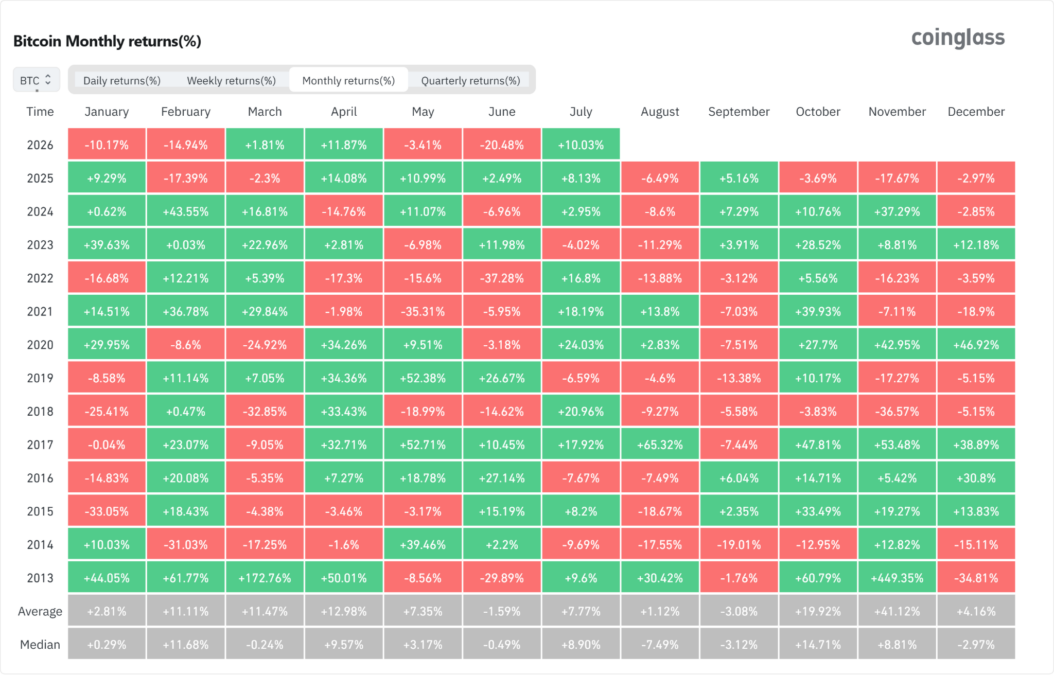
While strong outliers exist, particularly in certain post-halving years, the broader pattern shows August frequently fails to sustain momentum built in July. Q3 as a whole has historically delivered only modest returns compared with the explosive average gains often seen in Q4.
Technical Levels That Matter
Bitcoin’s price action in recent weeks has left clear markers. Support near $60,000–$61,000 has held through several tests and aligns with important longer-term moving averages in some analyses.
A decisive break below that zone would open the door to the mid-$50,000s and potentially lower realized-price support areas. On the upside, a multi-day close above $66,000–$67,000 would signal renewed strength and could target the low-$70,000s range.
Some chart patterns observed in late July, including potential exhaustion signals and range-bound structures, suggest the market remains in consolidation. Weak volume on any attempted breakout would raise the probability of failure.
Conversely, expanding volume alongside improving ETF flows would give bulls a stronger case. The immediate technical setup is therefore binary: hold the July recovery zone and the path of least resistance stays sideways-to-higher; lose it and downside risk expands quickly.
Analyst Views and the $100K Question
Institutional forecasts for 2026 remain divergent. Standard Chartered’s Geoffrey Kendrick has maintained a $100,000 year-end target, framing the current weakness as a potential buying opportunity if ETF pressure eases.
Bernstein continues to hold a more aggressive $150,000 year-end call, describing the 2026 drawdown as relatively mild by historical standards. Other desks have turned more cautious; Citi has reduced its 12-month target significantly, citing persistent outflows and slower regulatory progress.
Shorter-term model-based projections for August itself are more restrained. Various algorithmic forecasts cluster around modest gains or mild declines, with average price targets in the mid-to-high $60,000s appearing frequently. Machine-learning aggregates and statistical models generally do not expect a straight-line rally from current levels to six figures within a single month.
For Bitcoin to reach $100,000, the pathway remains a second-half or year-end scenario that would require roughly a 55–60% advance from present prices, an outcome far outside typical August performance.
The consensus, such as it exists, points to consolidation rather than a decisive breakout or collapse in the immediate weeks ahead. Bullish year-end targets depend on a second-half improvement in flows, macro conditions, and market structure that has yet to fully materialize.
Catalysts That Could Tip the Balance
Three factors will likely dominate price action through August. First, ETF flows remain the clearest real-time gauge of institutional appetite. A shift back to consistent net inflows would provide the fundamental fuel needed for higher prices. Continued redemptions would reinforce the recent pattern of weak demand.
Second, monetary policy and broader risk sentiment matter. Any surprise in Fed communication or shifts in interest-rate expectations can move crypto markets rapidly. Softening policy signals would support risk assets; a hawkish tone would likely pressure Bitcoin.
Third, regulatory developments in the United States continue to influence institutional forecasts. Delays or setbacks on crypto-related legislation have already contributed to more conservative bank targets. Positive progress could improve sentiment; further gridlock would keep caution elevated.
These catalysts interact with the technical picture. Improving flows and a constructive macro tone would make resistance levels easier to overcome. The opposite combination would increase the odds that seasonality asserts itself.
Read: Bitcoin Price Approaches Potential Cycle Low as Rare Oversold Signals Align
Scenario Framework for August
Bullish Case: For a bullish outcome, Bitcoin holds above $61,000, ETF outflows reverse, and price reclaims the upper end of the recent range. Under those conditions a push toward the high-$60,000s or low-$70,000s becomes realistic. Stronger momentum could even open a path toward $75,000–$80,000 if volume expands meaningfully.
Base Case: The base case envisions continued range trading between the high-$50,000s and mid-$60,000s. This outcome would fit both the modest historical returns of Q3 and the current mixed flow picture. Price would spend the month rebuilding rather than trending.
Bearish Case: A bearish resolution would see support near $60,000–$61,000 give way on volume. That would expose the mid-$50,000s and potentially deeper levels, bringing “crash” narratives back into focus. While some technical measured moves project even lower targets, such outcomes typically require a clear catalyst that is not yet visible.
The Bottom Line
August 2026 arrives with Bitcoin in a better position than it occupied at the end of June, yet the seasonal, flow, and technical backdrop remains cautious. History shows that July rebounds often fade in August, and recent multi-year performance has done little to break that pattern. Institutional capital has not returned in force, and key resistance levels still need to be cleared with conviction.
A weekly close above recent highs accompanied by improving ETF demand would strengthen the case for continuation. Failure to defend the recovery zone would shift attention back to downside risk.
Looking beyond the next four weeks, several major institutions still see a path to $100,000 or higher by year-end, provided the second half of 2026 delivers the flow and macro improvements that have so far proved elusive.
For now, the August outlook is best described as a test. Seasonality leans negative, technical structure is mixed, and fundamental demand remains inconsistent. Bitcoin can still rise, but the data does not make that the default expectation. The month is more likely to decide whether the July bounce was exhaustion selling or the early stages of a more durable recovery.
This analysis is for informational purposes only and does not constitute financial advice. Cryptocurrency markets are highly volatile. Conduct your own research and consult a qualified advisor before making investment decisions.
Also read: US Graham Russia Sanctions Bill Advances 86-12, Targets Crypto Evasion