Key Highlights
- Standard Chartered still expects Bitcoin to reach $100,000 by the end of 2026, even after the recent market drop.
- The sell-off was driven by massive ETF outflows and heavy liquidations of about $800 million that triggered panic selling.
- The bank believes selling pressure is fading and the market may be near a bottom, with long-term recovery still possible.
Wall Street giant Standard Chartered has held firm on its prediction that Bitcoin could still reach $100,000 by the end of 2026, even after a sharp market correction pushed prices lower and triggered widespread selling across the crypto market.
Geoffrey Kendrick, the bank’s global head of digital assets research, said in a statement that the recent wave of selling may end soon, even though Bitcoin has gone through a painful fall driven by big institutional actions and heavy withdrawals from investment funds.
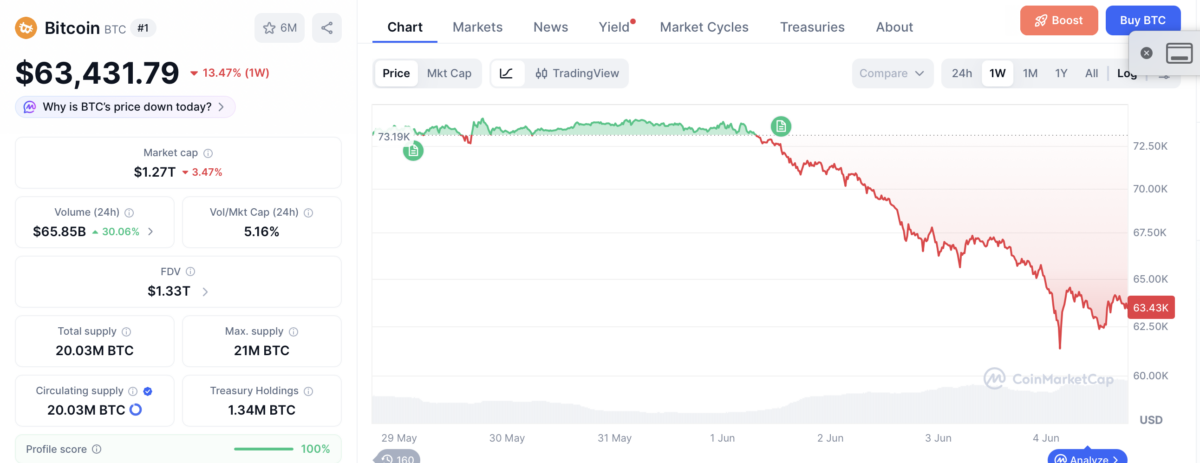
At the time of this writing, Bitcoin is trading around $63,424. The cryptocurrency has lost more than 12% within a single week, briefly touching near $61,000 before recovering.
Strategy sale sparks market reaction
Part of the recent market weakness followed a disclosure by Strategy Inc., the largest corporate holder of Bitcoin, that it had sold a small portion of its Bitcoin holdings for the first time since 2022.
Kendrick explained the mood clearly in his statement, saying, “This week has been painful in crypto. There is really no other way of putting it,” pointing to the speed and intensity of the downturn.
Although the sale from Strategy Inc. was very small compared to its total holdings, only about 0.004%, it still had a big effect on market confidence. This is because Strategy has been seen as one of the strongest believers in Bitcoin. So when such a major holder sells, even a tiny amount, traders start to worry that stronger hands might also step back.
$1.4 billion ETF outflows and $803 million in liquidations
At the same time, spot Bitcoin exchange-traded funds saw withdrawals of about $1.4 billion in just a single week, according to data from SosoValue, marking one of the strongest withdrawal periods on record.
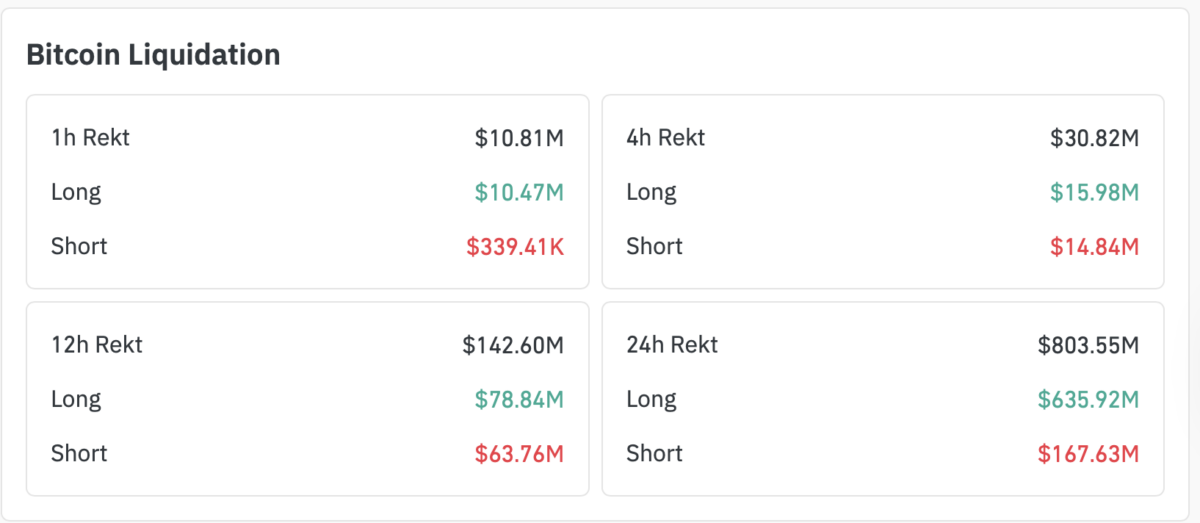
On top of that, traders were forced to close positions worth around $803 million. According to Coinglass, about $636 million from that total came from traders who had bet on the price going up, while $167 million was from short position traders.
These combined pressures pushed Bitcoin down more than 27% year-to-date, while the stock market, measured by the S&P 500, has gone up more than 10% in the same period.
Market under pressure but not broken
Despite the recent decline, Kendrick argued the worst part of the fall may already be behind the market. He said that in the future, people may look back and see this moment as a strong buying opportunity. “When we look back at the end of 2026 with bitcoin at $100K we will say this was the buying zone we all wanted,” he said. His view is that fear is high now, but selling pressure is slowing down.
He added that further downside is possible if Bitcoin falls below $60,000, but believes most bullish positions have already been cleared from the market.
Why Standard Chartered still hopes for recovery
Standard Chartered pointed out a few reasons behind its view. One is the historical pattern of Strategy Inc., which has a history of buying back Bitcoin after selling in past cycles. It is believed that this could happen again.
Another is the stability of ETF holdings, which still account for roughly 674,000 BTC, only slightly below recent highs. Also, the level of forced liquidations is not as extreme as in earlier crashes, which suggests the market is not completely broken.
Overall, Bitcoin is still far below its peak from October last year, having lost more than half its value over time. Even with positive signals from U.S. crypto-friendly policies, the price has struggled to recover.
Still, Standard Chartered is not changing its long-term view. The bank believes this is more of a reset phase than a collapse. In its eyes, the panic may be fading, and what comes next could be a slow recovery and possible growth again toward the $100,000 mark.