
Key Highlights
- XRP dropped to around $1.17, falling nearly 10% in a week as the whole crypto market also weakened.
- Over $25 million in XRP leveraged positions were liquidated, with most being long trades, adding extra selling pressure.
- ETF flows turned negative despite $1.42 billion total inflows since launch.
Ripple’s XRP dropped sharply to around $1.17 on Thursday after losing over 4% in a single day and nearly 10% over the week. The fall came alongside a broader market downturn, with the total cryptocurrency market cap falling 6.6% to $2.17 trillion.
Bitcoin also dropped approximately 7.3% during the same period, highlighting that the weakness was not limited to XRP but reflected a wider market pullback.
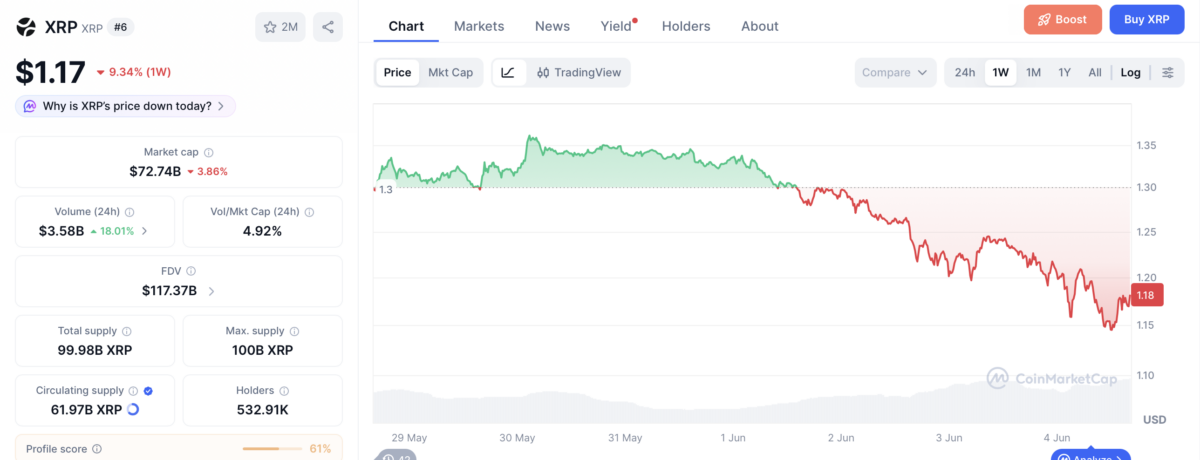
The cryptocurrency recorded a market activity of over 16% within 24 hours, pushing the volume to around $3.59 billion. However, the price drop suggests these activities are just traders selling their positions.
$25 million liquidated in 24 hours
The selling pressure became worse when leveraged trading positions were forced to close. According to data from Coinglass, more than $25 million worth of XRP positions were liquidated in the past 24 hours, and about 96% of those were long positions. $1.25 million from that total was from short-position traders.
This means traders were actively betting on the price going up. When the price moved against them, their positions were automatically closed. This created extra selling in the market and made the drop even faster.
Whale sell-off adds extra pressure
At the same time, large holders, often called whales, added more pressure. According to a recent post from Crypto Analyst Ali Charts, around 60 million XRP were sold or moved by whale wallets over the past week.
When large amounts like this enter the market, it increases supply and makes it harder for prices to recover.
ETF flows turn negative after strong inflows
Exchange-traded fund flows also turned negative after previously strong demand. Data from SosoValue shows that U.S. spot XRP ETFs recorded about $5.34 million in net outflows in a single day after a strong inflow period earlier in the year.
Bitwise saw the largest single-day withdrawal of around $4.06 million, while Grayscale also posted smaller outflows.
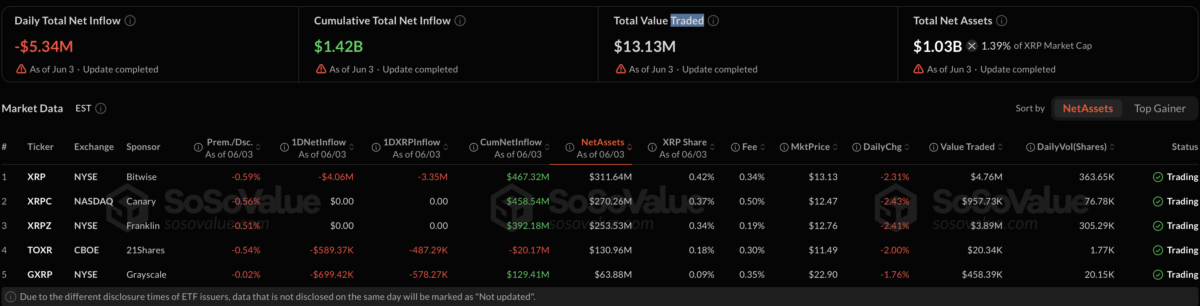
Meanwhile, the funds had attracted about $1.42 billion in total inflows since launch in late 2025, with Bitwise, Canary Capital, Franklin Templeton, and Grayscale among the major issuers. The recent shift in flows suggested the investors have cooled down on their demand.
XRP ETFs could swallow 5–6% of supply: Grayscale
Speaking on a recent podcast, Zach Pandl, Grayscale Head of Research, said XRP ETFs could end up holding around 5% to 6% of XRP’s circulating supply in the near future. Pandl explained that XRP ETFs have already brought in strong interest from investors. Since launching in the fourth quarter of 2025, these funds have recorded about $1.42 billion in total inflows.
Even with recent market weakness, this shows that demand has stayed active over time. At the moment, ETF holdings are estimated at about 1.4% of XRP’s total market value, which shows there is still a long way to go if they reach the 5% to 6% range being discussed.
On the podcast, Paul Barron pointed out that XRP ETFs have been building momentum in the market. He noted that Bitwise currently holds the largest position among XRP ETF issuers, while Grayscale ranks fourth. He also mentioned that total net assets across XRP ETFs had grown to around $1.1 billion before dropping slightly to about $1.03 billion, mainly because XRP’s price recently fell to around $1.15.
Pandl added that XRP has a unique role in crypto portfolios because its price does not always move in the same direction as Bitcoin and Ethereum. This difference makes it useful for investors who want to spread risk. He compared XRP ETFs to Bitcoin and Ethereum ETFs, saying those products typically hold around 5% to 6% of their underlying assets, which is why a similar range for XRP ETFs is being discussed.
Overall, the XRP price is still facing a downtrend. The initial sell-off began in early May after the price failed to hold the $1.55 resistance zone after being rejected many times. The latest decline also brought prices close to levels last seen during earlier market stress phases, as both Bitcoin and Ethereum also weakened during the same period.
Also Read: BNB Falls Over 4% in 24 Hours, Slips Near Key $600 Level