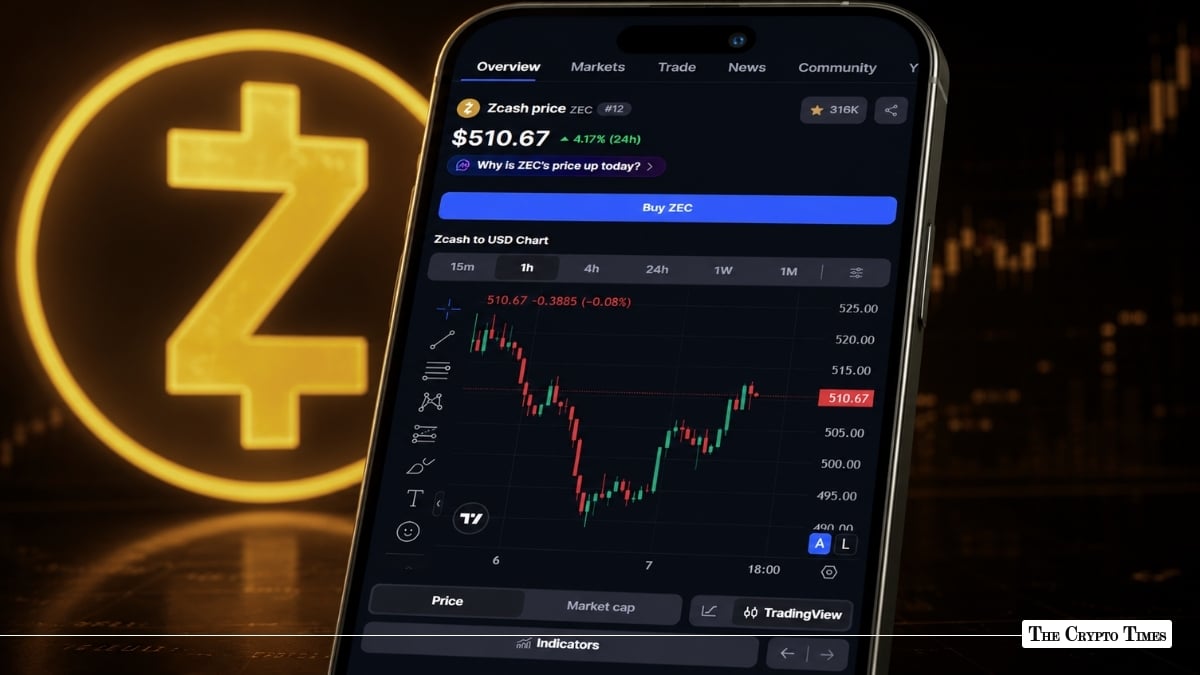
Zcash (ZEC), the privacy-focused cryptocurrency, is trading near $510 on August 7, 2026, marking a solid gain of roughly 5% over the past 24 hours and extending a broader recovery.
With a market capitalization hovering around $8.6 billion and circulating supply of approximately 16.8 million coins against a maximum of 21 million, ZEC ranks among the top 15 cryptocurrencies. Its trading volume has remained moderate, reflecting tighter liquidity conditions that analysts attribute to structural supply dynamics rather than fleeting speculation.
The token’s resilience stands out against Bitcoin’s performance. Over the past 10 months, BTC has declined about 44%, while ZEC has roughly doubled, delivering a dramatic relative outperformance. The ZEC/BTC ratio has climbed from around 0.45 milli-BTC to approximately 7.68 milli-BTC, representing a 17-fold relative gain.
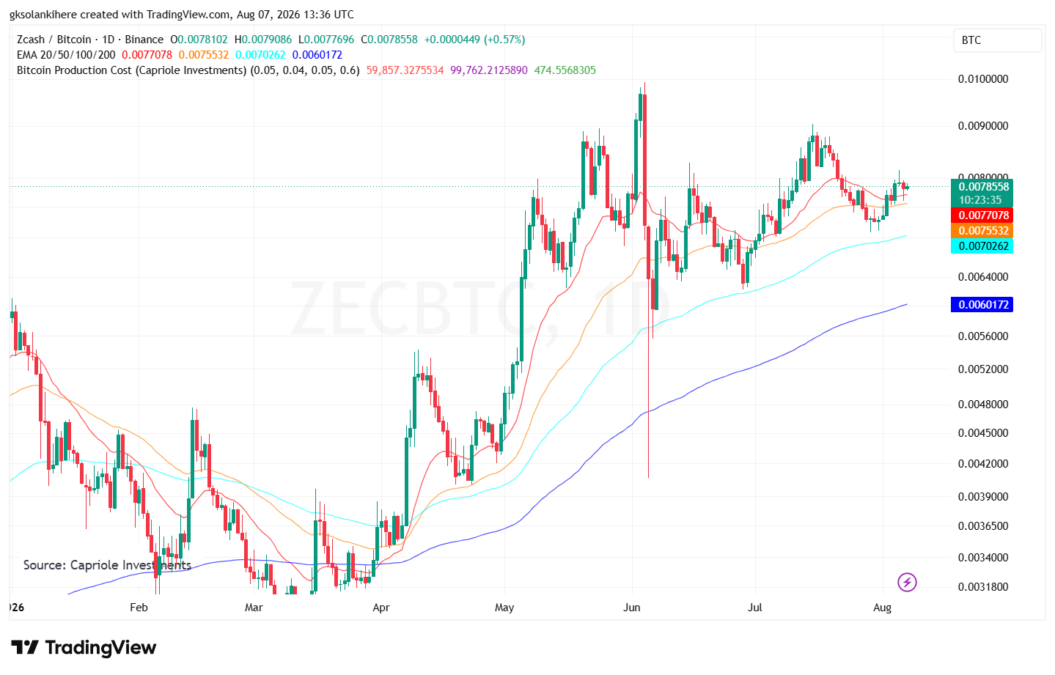
Notably, daily turnover for Zcash has collapsed from peaks near 22.5% of market cap to roughly 2.4%, signaling reduced speculative churn and greater stability among remaining holders.
Float Compression Drives the Rally
Analysts point to aggressive float reduction as the primary driver. Approximately 30-35% of the total ZEC supply is now effectively locked in the shielded pool, including holdings associated with entities such as the Grayscale trust, Cypherpunk positions, and protocol mechanisms. This locks away a substantial portion of coins from active trading, leaving a thinner sellable float that long-term holders appear unwilling to release.
Crypto observer YashasEdu on X highlighted these metrics in a recent analysis, noting that the data no longer resembles typical privacy-coin hype cycles. Instead, “this is float destruction turning ZEC into a partial bitcoin substitute at just 0.66% of BTC market cap.”
The June 2026 counterfeit scare—stemming from a vulnerability in the older Orchard shielded pool—triggered a sharp 50% price drop. Yet ZEC fully recovered and printed new local highs within eight weeks, demonstrating what the analyst described as pure holder conviction rather than temporary FOMO.
Fellow commentator Skylinee on X echoed the assessment, emphasizing that “sellable float is getting absorbed by long-term holders who simply refuse to dump.” The June event, far from permanently damaging sentiment, appears to have accelerated the transfer of coins into stronger hands. Both analysts frame the current setup as structural compression that could support further upside if the trend of absorption continues.
This dynamic coincides with the successful activation of the Ironwood network upgrade (NU6.3) on July 28, 2026. The upgrade introduced a new shielded pool with enhanced accounting features designed to address the earlier vulnerability and restore confidence in supply integrity. Migration of funds into the new pool has been voluntary but steady, further reinforcing the locked-supply narrative.
Privacy Narrative Gains Traction Ahead of Governance Vote
Beyond pure supply mechanics, the broader privacy narrative is gaining renewed attention. In an environment of increasing financial surveillance and regulatory scrutiny, Zcash’s zero-knowledge proof technology—allowing fully private yet verifiable transactions—positions it as a differentiated store of value and payment tool.
Analysts argue that the combination of Bitcoin-like scarcity (fixed 21 million supply and periodic halvings) with optional strong privacy creates a compelling hybrid proposition at a fraction of Bitcoin’s valuation.
Looking ahead, the community is preparing for a significant governance event. An NU7 coinholder vote is scheduled to begin around August 25, 2026, and run for approximately 18 days. Eligible participants must hold a spendable Ironwood-shielded ZEC at a snapshot on August 24.
The ballot will address key protocol decisions, including potential adoption of a Network Sustainability Mechanism for smoother issuance, adjustments to block times, deprecation of legacy transaction formats, and the overall upgrade roadmap. Organizers have indicated that participation of at least 1 million ZEC would lend strong legitimacy to the outcome.
Current technical and governance developments, layered on top of the observed float compression, differentiate Zcash from earlier cycles driven mainly by narrative momentum. While risks remain—including regulatory pressure on privacy coins and the inherent volatility of the broader crypto market—the recent price action and on-chain metrics suggest a maturing holder base less prone to rapid distribution.
As of 1:40 PM UTC on August 7, ZEC continues to consolidate near recent highs with 24-hour ranges typically spanning $489 to $514—as per CoinMarketCap data. Whether the current trajectory evolves into a sustained re-rating relative to Bitcoin will depend on continued absorption of free float, successful migration into the new shielded infrastructure, and constructive outcomes from the upcoming NU7 process.
Also read: Bitcoin Price Reclaims $65K Driven by 4-Day Spot ETF Inflow Streak