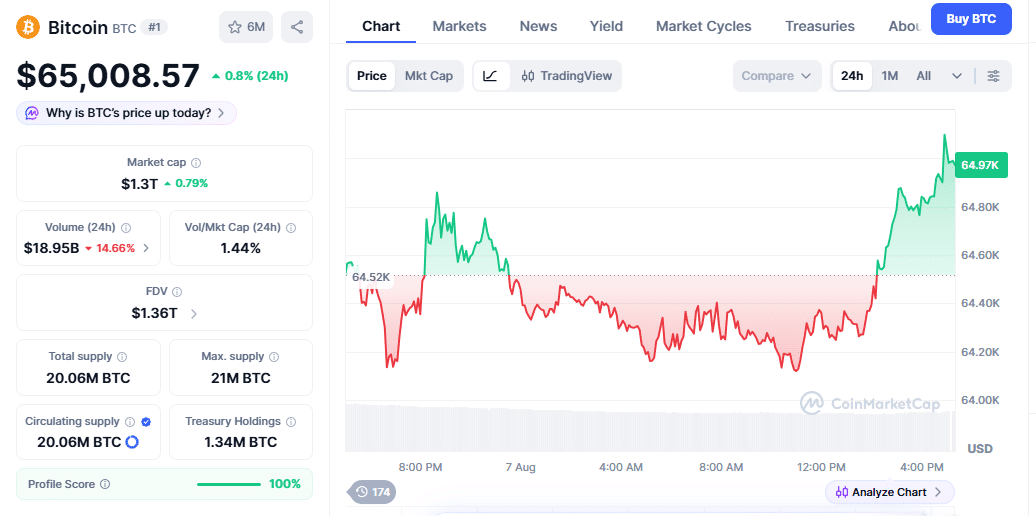
Bitcoin held near the $65,000 mark on August 7, trading at about $65,008, up 0.8% over 24 hours, and touching an intraday high of $65,098 at around 4:55 PM IST, according to CoinMarketCap and CoinGecko data. The move left the largest cryptocurrency slightly ahead of a broadly flat market, with a total market capitalization near $1.3 trillion.
The modest bid has a clear driver, a renewed run of inflows into U.S. spot Bitcoin exchange-traded funds, but the fuller picture is more mixed than the price alone suggests. Volume is down, sentiment sits in “extreme fear,” and fresh filings show heavy redemptions from the market’s largest fund earlier this year, all of which temper the case that institutional demand has decisively returned.
What’s Behind the Bid
The clearest support has come from ETF flows. According to SoSoValue data and Farside Investors data, U.S. spot Bitcoin ETFs pulled in about $626 million over the first three trading days of August — $170.1 million on the 3rd, $211.49 million on the 4th, and $244.4 million on the 5th — before adding a further $137.6 million on August 6, extending the streak to a fourth straight session without a single day of net outflows. BlackRock’s IBIT dominated the run, accounting for roughly $479 million, or about 76%, of the three-day total. The turnaround is notable because July was the weakest month for Bitcoin ETF flows in 2026, closing with heavy redemptions.
Two other factors helped. Blockchain-analytics firm Santiment reported that wallets holding between 10 and 10,000 BTC accumulated more than 20,000 BTC, worth roughly $1.2 billion, since July 29, a sign of larger holders buying below $65,000. And leverage-driven selling eased sharply: 24-hour liquidations fell about 68% to $17.63 million, per derivatives data cited by TokenPost, with short positions bearing the brunt. With less forced selling in the system, even modest spot buying can move the price more easily.
But the Bounce Lacks Conviction
Several signals cut against reading this as a durable shift in demand. Most striking, new SEC filings reported on August 6 show that BlackRock’s spot Bitcoin and Ethereum ETFs recorded a combined $3.5 billion net decrease from capital-share activity in the second quarter, a swing of $17.4 billion from a $13.9 billion gain a year earlier, with August’s inflows described as only a small offset. In other words, the recent daily inflows are recovering ground lost during a quarter of substantial redemptions, not building on a position of strength.
Sentiment reflects that caution. The crypto Fear & Greed Index remained in “extreme fear” at a reading around 25 even as the inflows arrived, indicating investor confidence has not recovered. Trading volume tells a similar story: 24-hour spot volume fell roughly 16% on the day, meaning the uptick came on lighter, not heavier, participation, the kind of low-conviction move that can fade quickly. And not every large holder is buying: Strategy, the largest corporate Bitcoin holder, disclosed selling 1,638 BTC for about $104.7 million between July 27 and August 2, at an average of $63,957, to help fund its obligations.
Bitcoin’s behavior also looks heavily macro-driven rather than crypto-specific. The asset showed an 83.6% correlation with the S&P 500 over the past week, suggesting its moves are being shaped by broad risk sentiment more than by developments within crypto itself.
The Macro and Regulatory Overhang
That macro sensitivity points to the week’s key swing factors. Bitcoin was consolidating ahead of the July U.S. jobs report, the first major read on the labor market since the Federal Reserve held interest rates at 3.50–3.75% in late July, a decision in which three officials dissented in favor of a hike. A hot jobs number would strengthen the case for higher-for-longer rates, a headwind for risk assets like Bitcoin, while a soft print could do the opposite.
On the regulatory side, the CLARITY Act, the crypto market-structure bill, missed its pre-recess deadline as the Senate left town without a floor vote, pushing the legislation to September at the earliest. The delay removes a potential near-term catalyst and leaves a measure of policy uncertainty hanging over the market.
What to Watch
Bitcoin near $65,000 sits on a genuine but narrow base of support: four days of ETF inflows, whale accumulation, and a cleaner derivatives picture have steadied the price after a difficult July. But the move is running on thin volume, against a backdrop of extreme fear, second-quarter fund redemptions, and at least one major holder selling, and it remains tightly tethered to macro forces outside crypto.
Whether the bounce firms into something more durable is likely to depend on the jobs data, the Fed’s path, and whether the ETF inflows persist, rather than on any decisive break in the chart. This report makes no prediction on that outcome, and nothing here is investment advice.
Also Read: Bitcoin Active Addresses Hit 0.98M After Coldcard Wallet Exploit