Circle Internet Group has disclosed that Binance took a $100 million equity position in the company and signed a new five-year commercial arrangement around USD Coin, or USDC, the world’s second-largest dollar-pegged stablecoin. The disclosure landed in a Form 8-K filed before the New York open on Tuesday, September 22, 2026, five calendar days after the two firms closed the transactions on September 17.
Shares of Circle, listed on the New York Stock Exchange under the ticker CRCL, were quoted at $96.00 in pre-market trading at 7:34 a.m. Eastern Time, up 1.77% from Monday’s close of $94.49.
What the SEC filing actually says
The Form 8-K, a current report that public companies file with the U.S. Securities and Exchange Commission (SEC) to disclose material events, presents two linked items under Item 8.01. Certain subsidiaries of Circle first entered into arrangements with Binance that expand the existing strategic partnership relating to “the promotion of USDC held through Circle’s Modular Smart Contract Wallet infrastructure service,” a wallet product that lets exchanges and applications hold and move stablecoins on behalf of end users without those users managing private keys directly.
Under the deal, Circle agreed to pay Binance a monthly incentive fee “representing a percentage of the amount of USDC held” through that wallet stack, with Binance undertaking activities to promote USDC on its platform in return.
The term is five years; either party can terminate early upon the occurrence of specified events, and the actual fee percentage is not disclosed anywhere in the report. The 8-K also states plainly that the new commercial package “supersedes and replaces” the agreements Circle and Binance signed in November 2024 and August 2025.
Immediately after signing the commercial pact, Circle issued and sold Binance 1,237,011 shares of Class A common stock at a purchase price of $80.84 per share, for aggregate proceeds of $100 million. The par value of each share is $0.0001. Circle described the strike as reflecting “a discount to the market price of the Class A common stock prior to the closing.”
The sale was a private placement exempt from registration under the Securities Act of 1933, which means the shares Binance received are unregistered and cannot be freely resold in the United States without registration or another exemption.
The lockup provisions are the tightest constraint on Binance. The exchange agreed not to sell, transfer, assign, pledge, hypothecate or otherwise dispose of the shares from the closing date until the earlier of the second anniversary of the closing or a termination of the commercial arrangements by Binance under certain circumstances.
It also cannot use hedges, swaps, or similar contracts that would shift the economic risk of the position during that window, subject to customary carveouts for transfers among Binance affiliates, board-approved business combinations, and legally required dispositions. Binance retains full stockholder rights, including the vote, for the duration of the restriction.
Why the stock is reacting today
The economic close was on September 17, but the public market did not see the underlying agreements until Circle filed the current report on Tuesday morning. That calendar-day disclosure lag is why pre-market on September 22 is the first session in which listed equity holders can price the news.
CRCL closed Monday at $94.49, up $2.71 or 2.95% on the session, after opening at $98.09 and trading in a $93.12 to $99.97 range on roughly 16.5 million shares, according to Yahoo Finance. The 52-week range remains $49.90 to $159.47.
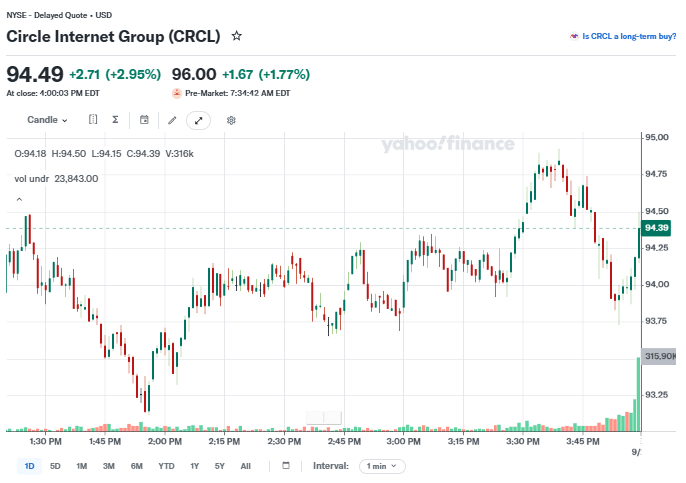
Against that Monday close, the $80.84 subscription price sits about 14.4% lower, which is not the same discount Circle described in the 8-K. The filing anchors its discount language to the tape “prior to the closing,” and CRCL closed September 16 at $80.45 and September 17 at $85.09. On that reading, the effective concession at signing was in the low single digits versus the days around signing rather than a double-digit discount to Tuesday’s tape.
The dilution math is small. The 1,237,011 new shares represent roughly half of one percent of Circle’s outstanding Class A share count, and the $100 million check is a fraction of a percent of Monday’s market value. What pre-market pricing is sentiment around distribution, not the size of the raise itself.
How the two firms got here
The Tuesday filing is an extension of an existing relationship rather than a first handshake. Circle and Binance announced their original strategic USDC alliance at Abu Dhabi Finance Week on December 11, 2024, with Binance committing to make USDC broadly available across its products and to adopt USDC as a corporate treasury asset. The Crypto Times covered that first pact here.
The new 8-K explicitly retires the November 2024 and August 2025 versions of that agreement, meaning the commercial relationship between the two firms has now been rewritten twice inside two years.
The disclosure lands six days after Circle opened the public mainnet of Arc, its USDC-native Layer 1 blockchain, on September 16, and just under two weeks after Circle agreed to a roughly $400 million stock deal for Singapore-based cross-border payments firm Tazapay. Neither the 8-K nor the supporting language attaches the Binance check to the Arc launch or the Tazapay transaction.
For context on Circle’s revenue base, the company reported Q2 2026 results on August 5 showing $73.3 billion of USDC in circulation at quarter-end, $701 million of total revenue and reserve income (up 7% year over year), and $143 million of adjusted EBITDA, or earnings before interest, taxes, depreciation and amortization. Reserve income, which Circle earns on the short-duration U.S. Treasury and cash assets backing USDC in circulation, remains the dominant contributor to the top line.
Any incremental USDC balances that stay on Binance and settle through Circle’s Modular Smart Contract Wallet product can lift that reserve pool, but the monthly fee described in Tuesday’s filing clips part of that economics on the specific wallet slice the 8-K refers to. Because the percentage is not disclosed, the net spread cannot be modeled from the public disclosure alone.
What the 8-K does not say
The document is deliberately narrow. It does not disclose the fee percentage, the precise definition of “USDC held through” the Modular Smart Contract Wallet infrastructure, the list of specified events that let either side end the commercial arrangement early, or any minimum balance Binance must maintain to keep the incentive live.
Each of those terms determines whether the arrangement is a modest distribution rebate or a material transfer of reserve income from Circle to its largest global exchange partner. Circle’s other principal distribution partner, Coinbase, operates under a separate long-standing contract that Tuesday’s filing does not touch.
The structure of the equity leg is the cleanest signal in the document. Binance accepted restricted stock with a two-year sale prohibition and an explicit hedging ban rather than cash-only compensation, which ties part of its outcome to CRCL’s share price and to the survival of the commercial deal itself.
The early-release trigger on the lockup also gives Binance a defined exit path if it chooses to end the promotional arrangement under one of the allowed events. Neither company had issued a matching press statement by the time of the 8-K’s publication.
Also Read: Strive Buys 1,355 Bitcoin for $107.7 Million, Treasury Hits 26,355 BTC