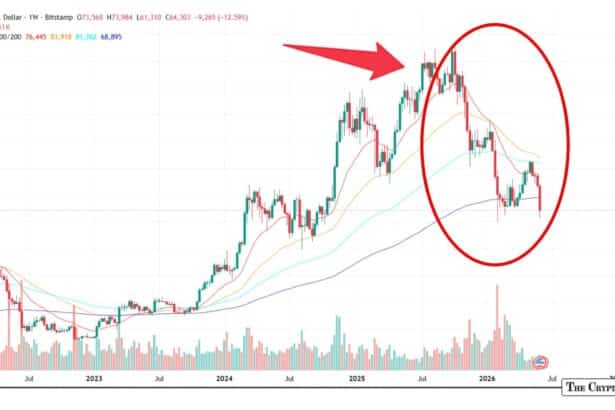
Michael Saylor, Executive Chairman of Strategy (formerly MicroStrategy) and a prominent Bitcoin advocate, has framed the recent downturn in Bitcoin prices as a temporary capital rotation rather than a fundamental flaw in the cryptocurrency’s value proposition.
Bitcoin has faced significant pressure, with prices dipping toward the $61,000 range amid sustained ETF redemptions and broader market sell-off. Strategy itself made a modest Bitcoin sale—around 32 BTC worth roughly $2.5 million—sparking additional commentary, though Saylor maintains the firm’s long-term accumulation strategy.
In his latest X post, Saylor highlighted that spot Bitcoin ETFs have witnessed approximately $4 billion in net outflows since May 14, occurring alongside an unprecedented ~$400 billion in capital markets funding directed toward AI infrastructure over the past six months.
Saylor’s commentary underscores a classic market dynamic where investors are shifting allocations from one high-conviction asset class to another perceived as offering superior near-term returns. This rotation narrative has gained traction among analysts, who point to surging AI-related equities and infrastructure projects as magnets for institutional capital.
Bitcoin ETF Outflows and Market Pressure
Since May 2026, U.S. spot Bitcoin ETFs have recorded substantial net outflows, with cumulative figures reaching around $4 billion by early June. This streak includes some of the largest weekly and multi-week redemptions on record, contributing to Bitcoin’s price decline of roughly 13% in the past seven days.
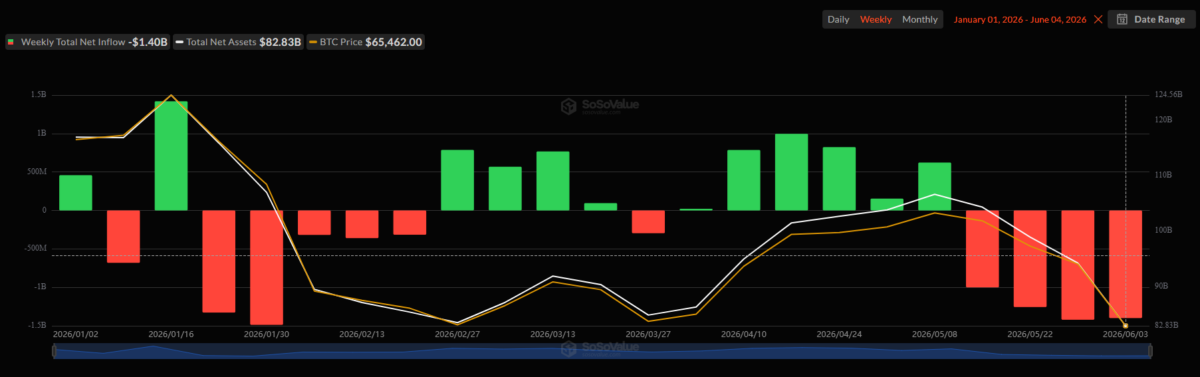
These redemptions reflect a broader de-risking among institutional investors. After strong inflows earlier in the year, the reversal has coincided with Bitcoin trading below key psychological levels, amplifying liquidations in leveraged positions.
Market observers note that ETF flows have become a dominant price driver for Bitcoin in 2026. When inflows fueled rallies to new highs earlier, outflows now exert the opposite force.
However, total assets under management in Bitcoin ETFs remain positive since inception—currently sitting at $82.83 billion—suggesting the rotation may represent reallocation rather than outright abandonment.
AI Infrastructure Boom Draws Massive Capital
In contrast to Bitcoin’s outflows, AI has attracted historic levels of investment. According to Saylor, capital markets have poured approximately $400 billion into AI buildout over six months, funding data centers, GPUs, cloud infrastructure, and related technologies.
Major hyperscalers—Microsoft, Amazon, Google (Alphabet), Meta, and Oracle—project combined 2026 capex exceeding $650-700 billion, much of it AI-focused.
This surge stems from explosive demand for compute power to train and deploy advanced models. Private funding for data centers and AI infrastructure alone is projected to surpass prior records, with debt markets and equity raises supporting expansion. Tech giants are issuing bonds and tapping balance sheets to finance the “picks and shovels” of the AI era, creating a feedback loop of investment and innovation.
AI-related tokens and equities have also outperformed, drawing marginal dollars away from crypto. This dynamic echoes past market cycles where capital chases the “shiny new thing,” leaving established assets to consolidate.
Saylor acknowledges the scale of AI funding but positions Bitcoin as complementary rather than competitive. He has previously argued that AI could ultimately reinforce Bitcoin’s role as “digital capital”—scarce, neutral, and resistant to technological disruption—potentially serving as settlement money for AI agents in the future.
Long-Term Bitcoin Resilience and Accumulation Opportunity
Saylor views the current volatility as a strategic buying window. “This is a capital rotation, not a Bitcoin impairment,” he stated, emphasizing that Bitcoin’s core attributes—fixed supply of 21 million coins, decentralized network, and store-of-value thesis—remain intact. He urges investors to accumulate during dips, consistent with Strategy’s approach of treating Bitcoin as a primary treasury asset.
Broader market context supports a measured outlook. Despite short-term outflows, Bitcoin’s correlation with traditional risk assets has fluctuated, and long-term holders continue to show conviction.
The weekly Bitcoin chart paints a clear picture of a maturing bull market currently undergoing a sharp corrective phase. After surging to all-time high to $126,198 in early 2026, BTC has given back significant gains, closing the latest week at approximately $63,435—down roughly 13.8% on the week and trading below all major EMAs (20-week at $76,362, 50-week at $83,884, and 100-week at $81,745).
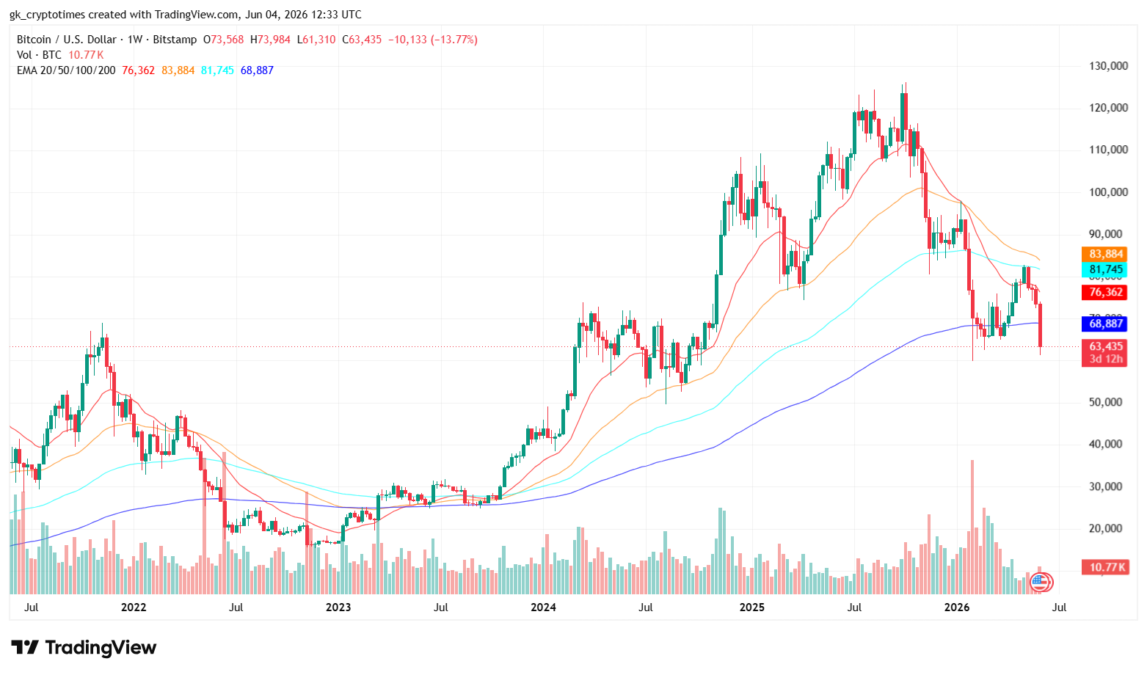
The price is now testing the 200-week EMA near $68,887, a key long-term support level that has historically acted as a strong accumulation zone.
For long-term bulls, the current levels represent a potential re-entry point, especially if Bitcoin can hold above the 200-week moving average and stabilize before the next leg higher. Some analysts predict a “choppy summer” but maintain Bitcoin remains undervalued relative to equities, especially if AI growth eventually boosts overall risk appetite and infrastructure needs that Bitcoin could underpin.
Critics point to potential risks, hinting toward sustained outflows, which could test lower supports around $60,000, and any slowdown in AI hype might reverse flows. Yet Saylor’s framing resonates with Bitcoin maximalists who see temporary rotations as features of a maturing market.
Historical precedents—from previous bull cycles—show capital often returns to Bitcoin after chasing alternatives. This interplay between AI and Bitcoin will likely define the second half of 2026.
Also read: Bloodbath for Altcoins: SOL, ZEC, HYPE Price Down Over 10% as Bitcoin Tests 2026 Lows