
Key Highlights
- RLUSD has expanded to 40+ blockchain networks through Wormhole, making it usable across major ecosystems like Ethereum L2s.
- The stablecoin is now being used more widely in payments, trading, and derivatives, including over 280 trading pairs on OKX.
- RLUSD is gaining stronger adoption with a $1.72B market cap and integration into major systems like Mastercard’s 24/7 settlement network.
Ripple’s RLUSD stablecoin has been deployed across more than 40 blockchain networks through an integration with Wormhole, a cross-chain interoperability protocol.
In an X post on Thursday, Wormhole announced that RLUSD is now active across many ecosystems using its Native Token Transfers (NTT) system. This includes Ethereum Layer-2 networks such as Coinbase Base, Ink, Optimism, and Unichain, as well as the XRP Ledger’s EVM sidechain.
This means that the stablecoin is no longer just limited to one or two blockchains. Instead. It can now move across many networks easily. The main idea is to enable users and developers to send and use RLUSD across different blockchains without the need for complex bridging tools or wrapped tokens.
This is expected to make RLUSD more useful for real-world payments, particularly for cross-border transfers, and also allows institutions to move money in and out of crypto systems more smoothly. It also supports tokenization, which is the process of turning real assets into digital form on the blockchain. Developers now have access to USD-backed liquidity that works across many networks at the same time, instead of being locked in one place.
RLUSD’s growth since launch
RLUSD was launched in December 2024 and has been performing well since then. The stablecoin is backed by U.S. dollar reserves, which means each token is supported by real-world money.
According to CoinMarketCap, its market presence has reached a reported valuation of about $1.72 billion and is ranked among the top stablecoins in the crypto market. Moreover, this growth is happening during a time when stablecoins are becoming more important in global finance.
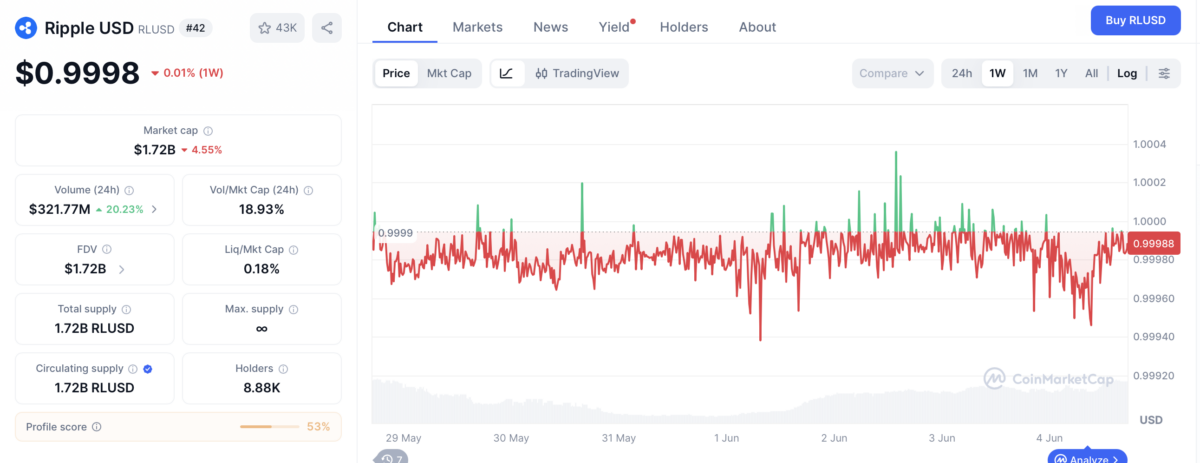
They are now widely used for payments, trading, and moving money across borders. RLUSD is being placed into all of these areas at once, which increases its role in the crypto economy.
OKX expansion boosts trading activity
RLUSD has also expanded its presence on major exchanges. The stablecoin recently launched on OKX exchange and is now available in over 280 spot trading pairs, including against XRP.
It is also used as margin collateral in derivatives trading, including perpetual futures on supported markets. Additionally, RLUSD can be directly deposited and withdrawn on the XRP Ledger, making it more convenient for daily crypto activities like trading and transfers.
Integration with Mastercard’s settlement network
Mastercard announced on June 3 that RLUSD had been added to its 24/7 on-chain settlement network alongside other stablecoins, including USDC and PYUSD. The network supports continuous settlement across blockchains, including Ethereum, Solana, Arbitrum, and the XRP Ledger. It allows payments to be settled anytime, across multiple blockchains such as Ethereum, Solana, Arbitrum, and XRP Ledger.
RLUSD is also expanding into new regions as Ripple partnered with exchanges like BiLira, Bitexen, and Bitlo to bring RLUSD into Turkey’s crypto market. This gives more people and institutions access to the stablecoin in that region, especially in trading and financial services.
Broader adoption across the crypto ecosystem
Ripple said RLUSD is now designed to move across ecosystems in a way that supports real-world financial use cases at scale. Wormhole noted that the rollout is powered by its Native Token Transfers system, which enables assets to move across networks without traditional wrapped token structures.
All these updates show RLUSD moving into many parts of the crypto world at the same time. It is now used in trading, payments, settlement systems, and cross-chain networks, making it easy to use anywhere, on many blockchains, without limits.
Also Read: 32.3 ETH Left Unclaimed From Euler’s $197M DeFi Hack