
Key Highlights
- Bitcoin fell to roughly $59,083 on June 29, down about 1.7% in 24 hours.
- Strategy authorized a $1.25 billion program to sell Bitcoin, while sitting ~22% below its cost basis.
- ETF outflows, a hawkish Fed, and “Extreme Fear” sentiment compounded the slide.
Bitcoin dropped to around $59,083 on June 29 after Strategy authorized a $1.25 billion program to sell part of its 847,363-BTC stash, adding a fresh bearish signal to an already weak market.
Bitcoin slipped to roughly $59,083 on Monday, down about 1.7% over 24 hours, hours after the largest corporate holder gave itself formal authority to sell Bitcoin for the first time on a recurring basis.
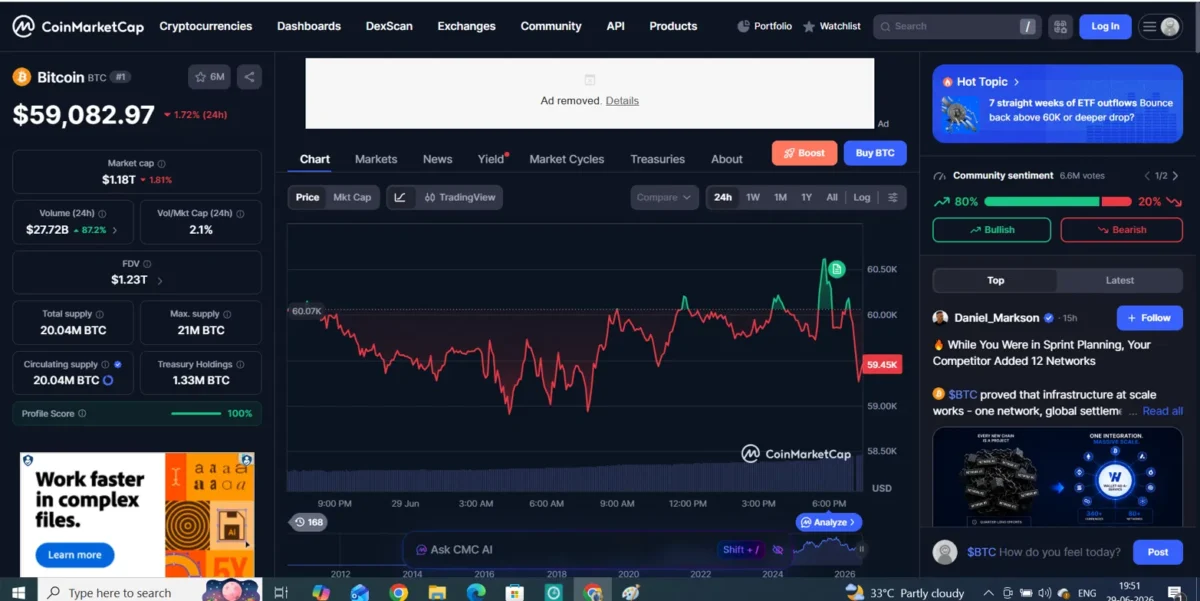
Why is Bitcoin down today? Bitcoin fell below $60,000 after Strategy filed an 8-K authorizing a $1.25 billion BTC sale program. a signal that the “never sell” company is now willing to sell while underwater. Continued ETF outflows, an 80% chance of a December Fed hike, and “Extreme Fear” sentiment added to the pressure.
Strategy Just Authorized Selling Bitcoin
The trigger came Monday, when Strategy filed an 8-K unveiling a “Digital Credit Capital Framework” that, for the first time, formalizes selling Bitcoin as a funding tool. The centerpiece is a BTC Monetization Program of up to $1.25 billion, alongside a $2.55 billion USD Reserve and twin $1 billion buyback authorizations for its Class A common stock and Digital Credit securities. The company also lifted its STRC preferred dividend to 12.00% per annum for record dates on or after July 1. TCT broke down the full filing in Michael Saylor’s Strategy Boosts Reserve to $2.55B and Raises STRC Dividend to 12%.
The program permits sales only for three defined purposes — funding the reserve, servicing dividends and interest, and financing buybacks — and “does not obligate the Company to sell any bitcoin.” Strategy framed it as disciplined liquidity management, not a retreat.
A “Never Sell” Company, ‘No More’
The market read the signal, not the fine print. Strategy holds 847,363 BTC at an average cost of $75,651 — meaning the firm built on a “never sell” identity just authorized selling roughly 22% below its own entry price.
It is the institutional version of the pivot Saylor first telegraphed in May, covered in Michael Saylor’s U-Turn? Why Strategy May Finally Sell Bitcoin. The dollar impact on price is small, but the signal validates a long-running short thesis: that Strategy would eventually have to sell to meet its preferred-dividend obligations. The reflexive risk in its leveraged structure where MSTR and its preferred series amplify Bitcoin’s moves, is examined in MSTR and STRC Plunge as Bitcoin Weakness Persists.
The Backdrop: ETF Outflows and a Hawkish Fed
Strategy did not start the selloff; it landed on an already weak tape. U.S. spot Bitcoin ETFs have logged roughly $4 billion in net outflows in June, removing the institutional bid that cushioned earlier drops, and TCT tracked the support test in Bitcoin Price Holds Onto $60K Key Support Amid Extreme Fear Sentiment.
Macro offers no cushion either. Under Chair Kevin Warsh, the Fed has held a hawkish line, with markets pricing roughly an 80% chance of a December rate hike as inflation prints drift back toward 4%. The next read is the July 2 nonfarm payrolls report, and the Fear & Greed Index sits at 12 — deep in “Extreme Fear.”
How Far Bitcoin Has Fallen in 2026
Today’s dip is part of a rare slump. Bitcoin is now down 52.93% from its all-time high of $126,198, set on October 7, 2025, per CoinMarketCap. The retreat reflects back-to-back quarterly losses to open the year — down roughly 22% in Q1 and about 13% in Q2, near a 30% first-half decline from its $87,500 January open. Per CoinDesk’s analysis, opening a year with two straight quarterly losses has happened only twice before in Bitcoin’s history, the last time during the 2022 bear market.
Price Levels to Watch
Bitcoin fell as low as $58,856 in the past 24 hours before reclaiming the $59,000 handle, leaving that intraday low as the first line of support to watch. A clean break below it puts $56,000 in focus. Bulls need to reclaim the $62,000–$65,000 zone for any stabilization signal — likely requiring ETF flows to turn neutral, a softer Fed tone, or cooler inflation data, none of which is confirmed yet.
Also Read: Bitcoin’s Uncertain Path: Geopolitical Storm, Global Market Shakeouts, and Strategy (MSTR) Tension