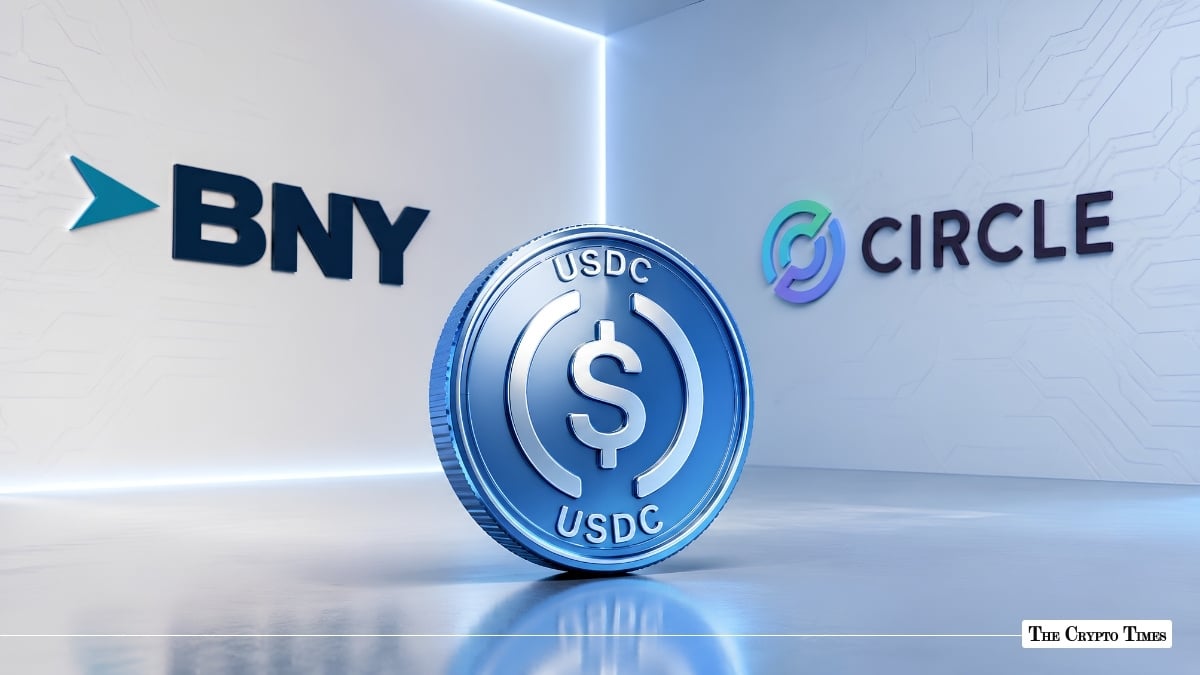
BNY, a global financial services company, is expanding its digital asset strategy by making Circle’s USDC the first stablecoin supported on its Digital Asset Custody platform, allowing institutional clients to custody, transfer, mint, and redeem the dollar-backed stablecoin through a single banking infrastructure.
The move, announced today, deepens BNY’s relationship with Circle and expands the bank’s role beyond safeguarding USDC reserves to supporting the full lifecycle of institutional stablecoin transactions.
USDC takes center stage at BNY
Under the expanded arrangement, institutional clients can now hold USDC directly in digital asset custody wallets maintained by BNY. The bank will also enable clients to instruct Circle to convert U.S. dollars into USDC (mint) and redeem USDC back into dollars (burn), bringing fiat custody and blockchain-based settlement into one operational framework.
According to BNY, the integrated service is designed to simplify how institutions move between traditional financial systems and digital asset networks without relying on multiple service providers.
Why BNY started with USDC
USDC is the first stablecoin to be integrated into BNY’s Digital Asset Custody platform, although the bank said it intends to add support for additional stablecoin issuers and digital cash workflows over time. The announcement also expands BNY’s existing role as the primary custodian of USDC reserves, strengthening its involvement in Circle’s institutional infrastructure.
Carolyn Weinberg, BNY’s Chief Product & Innovation Officer, said institutions increasingly require infrastructure that operates across both traditional financial markets and blockchain networks. She added that the new stablecoin capabilities are intended to provide the operational resilience and governance standards expected by institutional clients.
Global expansion continues
The expanded partnership with BNY comes as Circle continues to deepen USDC’s role in institutional finance globally. Last week, the company announced plans to work with Nomura Securities to launch a blockchain-based foreign exchange settlement platform for Japanese enterprises by 2027, aiming to speed up cross-border payments and reduce the need for corporations to hold large cash balances for international transactions.
Circle is also extending USDC’s reach across blockchain infrastructure. The company recently confirmed that native USDC, alongside EURC and its Cross-Chain Transfer Protocol (CCTP), will be integrated into the Cronos network.
The upgrade will allow users to deposit funds, trade tokenized stocks, cryptocurrencies, and prediction markets, and transfer assets across supported blockchains using Circle-issued stablecoins, further expanding USDC’s role as settlement infrastructure for both institutional and on-chain markets.
Why institutions are embracing stablecoins
BNY said the new capabilities are part of its broader Digital Assets platform, which combines digital asset custody with traditional cash management services. The bank said integrating these services within a single operating model is intended to help institutions access blockchain-based financial networks while maintaining existing operational controls and compliance processes.
Rather than treating stablecoins as standalone crypto products, the offering positions them as another payment and settlement rail within institutional finance.
Broader context
For Circle, the partnership gives USDC deeper integration into one of the world’s largest custody banks. Kash Razzaghi, Circle’s Chief Commercial Officer, said selecting USDC as the first stablecoin supported under BNY’s expanded offering reflects the regulatory and operational framework the company has built around stablecoin.
The expanded relationship allows BNY clients to move between traditional financial assets and on-chain dollars using infrastructure already embedded within the bank’s custody platform, further extending USDC’s role in institutional digital asset markets.
Also Read: BIS Warns Stablecoins Fuel Dollarization and Threaten National Banks