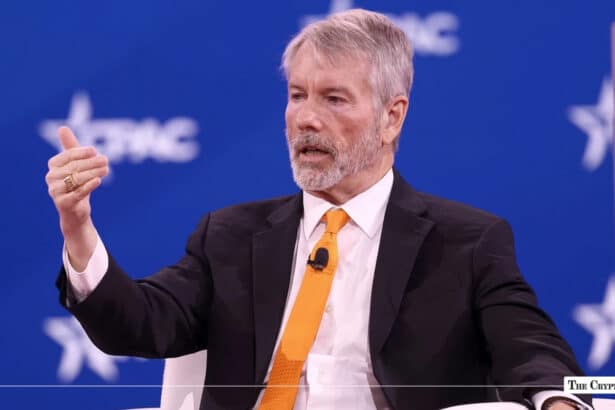
Michael Saylor built the most aggressive corporate Bitcoin treasury in history on a single, unshakable idea: you buy Bitcoin, and you never sell it. He said it publicly, repeatedly, and turned it into a brand identity that attracted billions in capital. On Monday evening, that era ended.
During Strategy’s Q1 2026 earnings call, the man who once told the world “You do not sell your Bitcoin” told investors he is now preparing to do exactly that.
Not because he has to. Because he wants to. Michael Saylor and CEO Phong Le laid out a calculated framework for selling Bitcoin to fund dividends on the company’s $8.5 billion STRC preferred stock, the largest preferred stock by market cap in the world, while simultaneously revealing plans to retire all of Strategy’s traditional debt and simplify the entire balance sheet down to three things: common equity, STRC, and a Bitcoin stack.
Strategy holds 818,334 BTC worth roughly $66 billion. The company is not retreating from Bitcoin. It is evolving from a one-directional accumulation machine into something far more complex: a full-spectrum capital structure operator where the Bitcoin treasury is no longer an untouchable reserve but a deployable strategic asset.
And the reason Saylor is doing it now? He wants to destroy the short sellers before they can build a case against him.
The “Inoculation” play
Saylor’s language was precise. He framed the upcoming Bitcoin sale not as a necessity but as a strategic inoculation.
“We’ll probably sell some Bitcoin to fund the dividend, just to inoculate the market, just to send the message that we did it,” Saylor said during the call.
The logic runs like this: Short sellers have long argued that Strategy would eventually be forced to sell equity to cover STRC’s 11.5% annual dividend obligations. By voluntarily choosing to sell a small amount of Bitcoin instead, Strategy preemptively kills that thesis.
The company can service its dividends from its BTC holdings, it can stop common stock issuance entirely if it wants, and it can prove both of those things on the public record.
Saylor put it bluntly: “If you’re a short seller and your thesis is the company’s got to sell equity in order to fund the dividends, I would like nothing better than to rip your wings off.”
CEO Phong Le reinforced the shift without ambiguity. “We will sell Bitcoin when it’s advantageous to the company. We’re not going to sit back and just say we’ll never sell the Bitcoin,” Le said. “We want to be net aggregators of Bitcoin, increasing our total Bitcoin, but more importantly, increasing our Bitcoin per share.”
This is a critical distinction. Strategy is not abandoning accumulation. It is replacing an absolute rule (“never sell”) with a conditional framework: sell when it serves the capital structure, buy when the math is accretive, and always prioritize Bitcoin per share over raw coin count.
The math behind the confidence
The numbers explain why Saylor is comfortable opening this door. Strategy currently needs Bitcoin to appreciate at just 2.3% annually for its existing holdings to cover STRC dividend obligations indefinitely, without selling any common stock at all.
Given Bitcoin’s historical compound annual growth rate, which has consistently exceeded 20% over any multi-year horizon, the 2.3% hurdle is almost trivially low.
The company has previously disclosed this breakeven threshold at approximately 2.05% in April, with the slight uptick reflecting continued STRC issuance since then.
Saylor described this breakeven ARR as “the inflection point where stretch issuance results in more Bitcoin being stacked by our company than the Bitcoin we use to pay dividends, if we choose to pay dividends with Bitcoin.” In plain terms, even after selling BTC to cover dividends, Strategy expects to be accumulating more than it sells over any meaningful time frame.
STRC: The real story of Q1
While the $12.54 billion net loss grabbed the headlines (driven entirely by mark-to-market unrealized losses as Bitcoin fell from $87,000 to $68,000 during Q1), the actual operational story of the quarter was the explosive growth of STRC.
STRC raised $5.58 billion year to date through May 3, a 189% growth clip relative to the start of 2026. Daily trading volume reached $375 million. Price volatility dropped to just 3%. The instrument has now scaled to $8.5 billion in total issuance in just nine months since launch, which CFO Andrew Kang described as producing a 2.53 Sharpe ratio, an extraordinary figure for a fixed-income-style instrument.
The ecosystem building around STRC was a major theme of the call. Protocols like Apex, Saturn, and Hermetica are already issuing yield coins powered by STRC. DeFi protocols are offering 2x to 10x leverage loops on the instrument.
Corporate treasuries, including Prevalon, Strive, and Anchorage, collectively hold $150 million of STRC, and over $270 million is deployed across DeFi protocols. Saylor described “three dozen initiatives” now underway that did not exist eight to twelve weeks ago.
The company has also proposed a shareholder vote to double STRC’s dividend payment frequency from monthly to semi-monthly, a move designed to further reduce volatility and improve the instrument’s attractiveness to yield-seeking capital.
Going debt-free: The clean balance sheet vision
Perhaps the most underreported statement from the entire call was Saylor’s declaration that Strategy’s goal is to become completely debt-free.
All six convertible bonds currently outstanding are slated to be retired, either swapped for STRC, converted into equity, or repaid with cash. The clean-sheet design Saylor outlined for any Bitcoin treasury company is strikingly simple: one common equity instrument, one variable-rate preferred stock (STRC), and a Bitcoin stack. Nothing else.
The four other credit instruments in Strategy’s capital stack, STRF, STRK, STRD, and STRE, are not being retired because doing so would destroy billions in optionality. But they are not being prioritized for new issuance either. Strategy is going all-in on STRC as its singular credit instrument going forward.
Saylor explicitly said STRC gets a deliberate carve-out because its variable rate means investors are not locking into a mispriced trade. He expressed far more enthusiasm for selling STRC at 11.5% than STRF at 10%, because scale matters more than margin. His framing was direct: he would rather sell $500 billion of STRC at 11% than $50 billion at 9%.
The volatility arbitrage
One of the most analytically rich segments of the call addressed how Strategy’s model adapts to different Bitcoin volatility regimes.
In a high-volatility environment, equities benefit. MSTR was described as the single largest options trade in the entire U.S. market on the day of the call. In a low-volatility environment, credit instruments benefit because lower Bitcoin volatility reduces credit risk, and amplification ratios can expand.
Saylor laid out specific thresholds. At a Bitcoin volatility of 40 with a BTC credit rating of 3, the strategy’s instruments start looking investment grade. At a volatility of 30, they become investment grade at a rating of 1.5. Below 30, amplification can triple or quadruple, potentially enabling 8:1 leverage ratios instead of 3:1. The long-run expectation is that Bitcoin matures from 40% volatility with 40% ARR toward 20% volatility with 20% ARR as the asset’s market cap grows and liquidity deepens.
If that trajectory plays out, everything Strategy sells in the credit market eventually becomes investment grade, which would unlock an estimated 10x expansion in the addressable bid for its instruments.
The market does not agree, yet
Despite all of this, Saylor openly acknowledged that the market has not yet repriced Strategy’s instruments to reflect this thesis. When asked whether the market agrees with his risk framing, Saylor’s answer was blunt: “The market doesn’t agree. If it did, STRF would be at $200.”
He drew a parallel to Amazon, Netflix, Apple, Google, and Nvidia, all of which operated for years, sometimes over a decade, before the market fully understood what they were building. The rerating, in his view, will happen “when we least expect it,” similar to how Buffett’s buying Apple sent multiples from 10x to 25-30x overnight.
Regulatory outlook and the Basel Card
On the regulatory front, Strategy is in a surprisingly comfortable position. The company does not need any regulatory change to execute its current strategy. BTC, MSTR equity, and STRC are all sitting in what Saylor described as “regulatory safe harbors,” built on settled securities law going back a hundred years, all NASDAQ-listed, with no legal ambiguity.
The single regulatory change Saylor identified as most impactful would be an update to Basel rules recognizing Bitcoin as legitimate collateral on par with gold. That would unlock insurance company and regulated bank participation without requiring a regulatory gatekeeper’s permission.
Strategy President Andrew Fong added that tokenization of securities, whether through the Clarity Act or SEC rulemaking, would accelerate the layer-2 STRC ecosystem. Already, $270 million of tokenized STRC has been sold outside the U.S. via Apex and Kraken. Domestic regulatory clarity would open the U.S. market to the same dynamics.
The ownership shift nobody is talking about
Bloomberg’s Eric Balchunas raised an important data point during the Q&A. River data shows that businesses, ETFs, and governments have collectively purchased approximately 1 million BTC over the past 16 months, while individuals have sold 730,000. It is a quiet institutional accumulation on a massive scale.
Saylor reframed this as a $1.4 trillion wealth transfer to early holders. Despite corporations and ETFs spending $150 billion to $200 billion on Bitcoin, they still control less than 10-15% of the total supply.
The remaining 85-90% sits with non-institutional holders. Saylor argued the network is more decentralized now than before, because BlackRock’s ETF alone has 50 to 100 million beneficiaries, and Strategy adds another 100 million. Institutional holders distribute exposure orders of magnitude wider than concentrated whale wallets.
Quantum security and the next announcement
Fong disclosed that Strategy is assembling a Bitcoin Security Program across custodians, exchanges, and large treasury companies. The goal is to develop a shared framework on quantum risk timelines, what mitigation tools are being developed, and how to build consensus.
An announcement is expected within approximately one month. Fong noted that there are currently a lot of divergent views across the industry, and this group is intended to be the organizing catalyst.
By the numbers: Q1 2026 at a glance
Strategy reported Q1 revenue of $124.3 million, up 11.9% year over year, with gross profit of $83.4 million at a 67.1% margin. These numbers are almost irrelevant to the investment thesis at this point, but they do confirm that the legacy software business continues to operate profitably.
The headline operating loss of $14.47 billion was driven entirely by unrealized digital asset losses under ASU 2023-08 fair value accounting, reflecting the roughly $87,000 to $68,000 decline in Bitcoin during Q1. The company held $2.21 billion in cash and cash equivalents at quarter’s end.
On the BTC side, Strategy achieved a 9.4% BTC Yield year to date through May 3, representing 63,410 BTC Gain and approximately $4.97 billion in BTC Dollar Gain. The company has raised $11.68 billion year to date and paid $692.5 million in cumulative preferred stock dividends across 23 consecutive distributions without a single missed payment.
Bitcoin per share stood at 213,371 sats, up approximately 18% year over year. The company’s stated goal is to double this metric within seven years.
MSTR common stock closed at $186.90 on Tuesday, up 1.7% on the day, with a 46% gain over the past month but still down 26.7% over six months.
What this actually means
Strategy did not become bearish on Bitcoin. It became more sophisticated about how it uses Bitcoin. The “never sell” stance was a branding tool for a simpler era. What the company is building now is an interconnected capital machine where Bitcoin, equity, and credit all serve as levers that can be dialed up or down depending on market conditions, volatility regimes, and interest rate cycles.
The Bitcoin sale, whenever it comes, will be small, symbolic, and designed to prove a point about capital flexibility rather than signal any fundamental change in conviction.
The real story is that STRC has grown into an $8.5 billion instrument in nine months, a “Cambrian explosion” of DeFi and TradFi products is being built on top of it, and Strategy is positioning itself as the dominant issuer of digital credit globally with a long-term vision to retire all traditional debt and simplify into what Saylor calls the optimal Bitcoin treasury structure.
The market, in Saylor’s own admission, has not caught up yet. Whether that gap is opportunity or overconfidence will depend on whether Bitcoin does what it has always done: go up over time.
Also Read: Bitcoin ETFs See $532M Inflows as Institutional Demand Holds