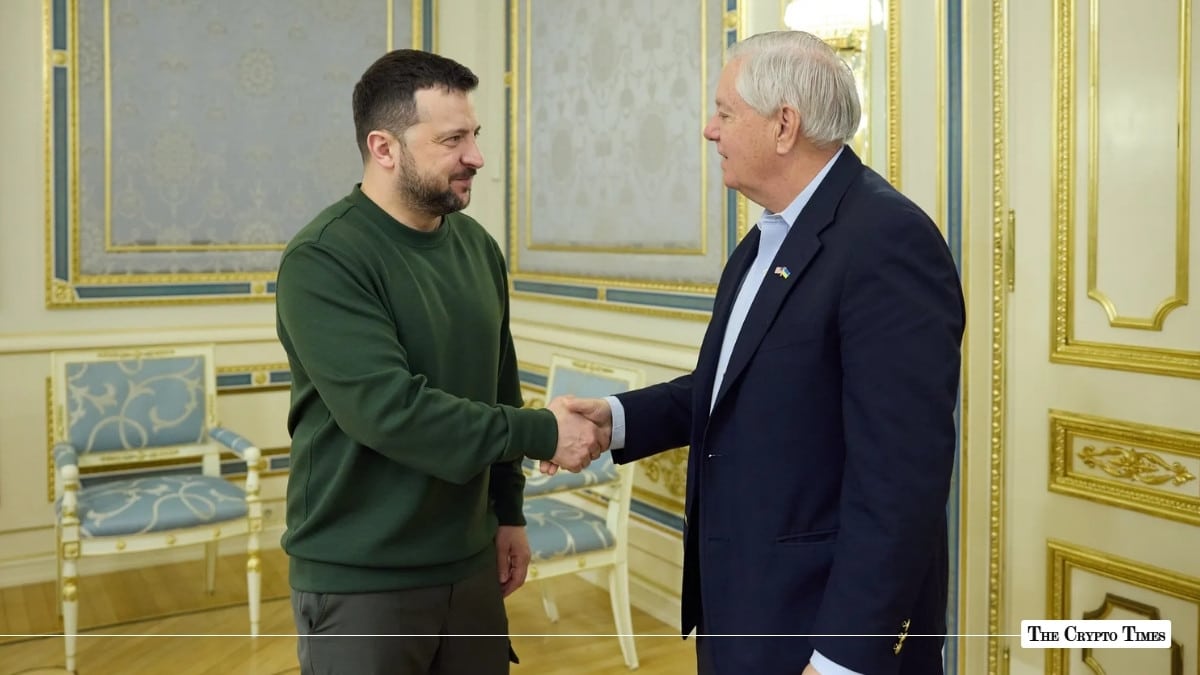
The U.S. Senate advanced the Lindsey O. Graham Sanctioning Russia Act of 2026 by an 86-12 procedural vote on Tuesday evening, with Ukrainian President Volodymyr Zelensky watching from the visitors’ gallery. The bipartisan package, renamed in tribute to the late South Carolina senator and expanded to include certain Iran sanctions, imposes mandatory sanctions on Russian leadership, banks, energy projects and the shadow fleet while authorizing tariffs of up to 100% on the top five purchasers of Russian oil and gas.
For the crypto industry the most consequential language sits in the definition of sanctionable activity. Section 102 of the bill targets persons engaged in “deceptive or structured transactions or dealings that circumvent the application of any sanctions imposed by the United States, including through the use of digital currencies or assets or the use of physical assets.”
This is the clearest statutory recognition yet that digital assets form part of Russia’s sanctions-evasion infrastructure.
The digital-currency clause in context
The provision does not create new registration requirements or ban crypto. Instead it strengthens the Treasury Department’s ability to designate facilitators—exchanges, OTC desks, wallet providers or payment processors—when they enable Russian entities to move value outside the formal banking system.
The timing is deliberate. Just days earlier, Russia’s State Duma completed legislation that recognizes digital assets as property and explicitly authorizes their use for cross-border trade settlements while maintaining a ban on domestic payments. That framework, expected to operate under Central Bank licensing, formalizes the same channels Russian firms have already used to settle discounted oil sales with buyers in China, India, and elsewhere.
Western designations of individual platforms have repeatedly forced Russian actors to reconstitute infrastructure. The Graham bill now gives OFAC clearer legal footing to pursue the broader ecosystem supporting those workarounds.
Shadow fleet, energy buyers, and secondary pressure
The legislation also targets Russia’s “shadow fleet,” the network of aging, often reflagged tankers used to transport oil outside the G7 price-cap regime. Payment for these cargoes has frequently relied on opaque methods, including stablecoins and other digital assets. By naming digital currencies alongside physical assets in the evasion definition, the bill raises the compliance cost of any residual exposure to those trades.
Secondary tariffs of up to 100% on goods from the five largest purchasers of Russian crude and natural gas (and the five largest facilitators of oil-sanctions evasion) add another layer. China and India rank high on both lists. Any sustained commercial pressure on those energy relationships increases the incentive for alternative settlement methods, precisely the activity the digital-currency language is designed to deter.
At the request of the White House, the advanced text also extends certain Iran-related energy and weapons sanctions. Both Russia and Iran have used crypto channels for restricted transactions, creating dual-use compliance considerations for platforms that service either jurisdiction.
CLARITY Act delay and impact
The same Senate calendar that cleared the first hurdle for the Graham package has delayed floor consideration of the Digital Asset Market Clarity Act. Majority Leader John Thune prioritized the Russia sanctions vehicle and a batch of nominations, leaving the market-structure bill with a compressed pre-recess window. The market immediately reacted to that delay.
The two bills operate in different lanes. Clarity is the long-sought domestic framework that would allocate SEC/CFTC jurisdiction, create digital-commodity registration regimes and deliver statutory definitions. The Graham bill is a geopolitical and sanctions instrument that treats digital currencies as an existing vector of evasion.
Immediate impact on crypto firms
U.S.-regulated platforms already subject to OFAC will need to update risk matrices for Russian-linked energy and shipping counterparties. Non-U.S. exchanges that continue processing residual Russian volume face elevated secondary-sanctions exposure even without U.S. customers. Structured or layered stablecoin flows connected to the shadow fleet or sanctioned banks now carry clearer statutory risk.
Secondary market and operational effects
- Heightened AML and travel-rule scrutiny around any Russia-adjacent activity
- Potential further de-risking by Western platforms, pushing remaining volume deeper into less transparent channels
- Indirect pressure if secondary tariffs sustain higher energy prices, affecting mining economics and risk-asset correlation
- Dual-use complexity from the Iran expansion, requiring platforms to monitor both jurisdictions’ restricted networks
Longer-term geopolitical signal
The bill confirms that U.S. lawmakers now view digital assets as standard infrastructure in financial conflict rather than a peripheral technology. It closes a perceived loophole at the exact moment Russia is formalizing crypto for cross-border trade, reinforcing the arms-race dynamic already visible in EU packages and Moscow’s new licensing regime.
Legislative path
The 86-12 vote cleared the first procedural hurdle. Additional Senate votes and House action remain before the package can reach President Trump’s desk. The president has signaled support for the revised text negotiated by Graham shortly before his death. Waiver authority is available if the president certifies a national-interest justification to Congress.
But the bottom line is that the Graham package does not rewrite U.S. crypto law. It does place digital currencies explicitly inside the sanctions-evasion toolkit while the domestic Clarity Act waits. For crypto-native businesses the practical result is higher compliance expectations around residual Russian exposure, particularly energy settlements and the shadow fleet, without resolving the broader regulatory uncertainty that CLARITY is designed to end. Further procedural votes are expected this week.
Also Read: 44 State AGs Tell CFTC It Lacks Authority Over Sports Prediction Markets