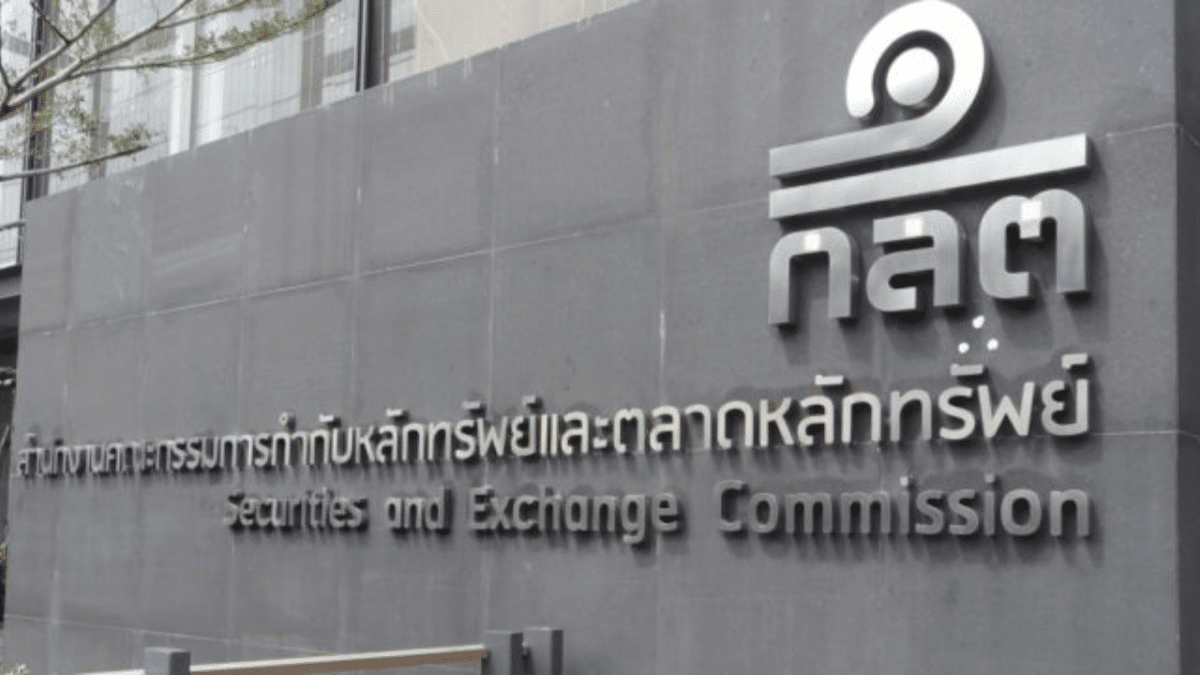
Thailand’s Securities and Exchange Commission (SEC) has opened a public hearing on principles that would tighten how licensed digital asset operators handle stablecoin deposits and withdrawals.
The proposal would require every inbound and outbound stablecoin transfer to move between accounts or wallets verified as belonging to the same customer, and would cap those transfers at 5 million baht (~$151,550) per person, per operator, per day. The package is a Board-approved set of principles, not a final rule, and comments are due within 14 days.
What the Same-Owner Rule Would Require
At the centre of the draft is a same-owner test. Stablecoins entering a customer account at a licensed operator would have to come from an account or wallet verified as belonging to that customer, and withdrawals would have to go to an account or wallet verified as belonging to the same customer. Transfers into a Thai licensed account from a third party’s wallet, or out from that account to someone else’s wallet, would not be allowed on the regulated rail, according to the official SEC announcement published as No. 191/2569 on 11 September 2026.
Origin and destination wallets would also have to satisfy Travel Rule checks. Operators would be expected to classify customers, screen for mule accounts, reject wallets linked to illicit activity or watchlists, and use tracing tools to follow the movement of digital assets. Transfer size would have to match the customer’s documented income and financial position.
On top of that qualitative test sits a hard number. Inbound and outbound stablecoin transfers would each be capped at 5 million baht per person, per operator, per day, which is about $150,000 in each direction at prevailing USD/THB rates. The Thai SEC published the consultation document under SECID 1206 and is accepting written comments through its website, the government Legal Hub, or the emails kanin@sec.or.th and thapanee@sec.or.th, until 25 September 2026.
Exemptions and the Inter-Operator Waiver
The 5 million baht ceiling would not apply to transfers between customer accounts at two Thai licensed operators when both firms already apply the Travel Rule. Three further exemptions are written into the draft.
First, digital asset businesses moving stablecoins in their own name for business purposes. Second, operators supervised by the Bank of Thailand (BOT) that receive case-by-case authorisation to use stablecoins in specified formats. Third, market makers on stablecoin-baht pairs who need to move coins through Thai operators to maintain liquidity on regulated books.
The same-owner test and the daily cap apply only to flows processed by licensed digital asset operators. Peer-to-peer transfers that never touch a Thai licensed platform sit outside this draft. That is a structural limit of the SEC’s jurisdiction, not an oversight, and it is one reason the package is being written alongside the Travel Rule rather than as a stand-alone control.
Rules for Off-Platform Trades, Market Makers and Liquidity Providers
The hearing is broader than wallet ownership. For off-platform activity by digital asset brokers (DA Brokers) and digital asset dealers (DA Dealers), the SEC proposes a minimum ticket size of 3 million baht, mandatory disclosure of buy and sell prices on the firm’s website or platform, and a prohibition on brokers arranging customer-to-customer off-platform deals. Brokers would still be able to match buyers and sellers by routing them through a licensed exchange.
Exchanges would have to publish the names of their market makers (MMs) and the digital assets those firms support, and would have to screen the source of the assets used in market-making activity. Brokers would be barred from using liquidity providers (LPs) on stablecoin-baht pairs.
Any remaining LP would have to sit in a jurisdiction that applies the Financial Action Task Force (FATF) recommendations, be supervised for anti-money laundering (AML) or business conduct, and be disclosed to customers together with any conflict of interest. Source exchanges used by brokers would have to sit under comparable supervision.
The SEC also proposes a sharper enforcement handle. Where an operator fails to collect or disclose required data, the regulator could order corrections within a set period and, if the firm does not comply, order it to take or refrain from specified actions until the SEC has complete information.
Why 5 Million Baht Is Not an Arbitrary Number
The number mirrors the BOT’s existing cash threshold. Since 1 April 2026, cash withdrawals of 5 million baht or more have been classified as high-risk transactions requiring a documented commercial purpose. Governor Vitai Ratanakorn has said large cash withdrawals fell by about 30% after the rule took effect, and a matching source-of-funds declaration on cash deposits above 5 million baht is expected to take effect from the fourth quarter of 2026. The stablecoin cap places the same figure on licensed crypto rails.
That alignment is the policy story. Thailand is not writing a stand-alone crypto rule. It is trying to close a substitution route: as cash and bank remittances become harder to use above 5 million baht, dollar stablecoins become the next pipe.
Deputy Secretary-General Jomkwan Kongsakul has put numbers on that concern. Citing early 2026 BOT data, she told local media that USDT trading had risen abnormally and accounted for as much as 50% of Thailand’s cryptocurrency turnover, moving ahead of Bitcoin.
She said the increase could not be explained by investment demand alone and carried risks of foreign-exchange circumvention, remittance evasion and money laundering. If the measures take effect, she said, unwanted transactions could fall by more than 80% without hurting legitimate investors.
The Thai SEC’s own July 2026 market snapshot supports that concentration. On licensed digital asset exchanges, average daily trading value was 1,378 million baht, down 27.13% from June. Client assets stood at about 61.7 billion baht, and active accounts were about 121,000. USDT accounted for 66% of trading value, or roughly 914 million baht a day.
Bitcoin was 16% and Ethereum 4%. Licensed capacity included 7 exchanges, 14 brokers, and 4 dealers. USDT itself is not banned. The SEC added USDT and USDC to its approved cryptocurrency list on 16 March 2025.
How the Draft Connects to the Travel Rule
The stablecoin consultation should be read alongside a rule that is no longer a draft. On 2 September 2026, the SEC issued the Travel Rule for Digital Assets under Notification of the Office of the Securities and Exchange Commission No. Sor Thor. 9/2569, dated 25 August 2026. It takes effect on 27 February 2027.
Operators must write risk policies for sending and receiving digital assets, collect customer and counterparty information, conduct due diligence on counterparties and any intermediary on the route, verify ownership or control of self-hosted wallets, and retain information for five years. The framework was developed jointly with the Anti-Money Laundering Office (AMLO).
The 11 September principles are designed to lock into that machinery. Same-owner wallets must meet Travel Rule screening. The 5 million baht cap falls away when both Thai operators on a transfer already apply the Travel Rule. The stablecoin principles carry no effective date yet. The Travel Rule already does.
The July Audit That Preceded This Hearing
On 11 July 2026, the BOT Governor said the central bank and the SEC were using data analytics on high-volume USDT trades. Early reviews had flagged transactions that appeared structured to hide ownership or bypass ordinary remittance channels, and findings were referred to the SEC.
That joint audit programme sits inside a wider grey-economy campaign covering gold trading, online-gambling mule accounts and the Speed Bump system used to delay and inspect large crypto transfers.
The Regional Frame
Thailand is not writing an issuer statute. Hong Kong already has one. The Stablecoins Ordinance took effect on 1 August 2025, and the Hong Kong Monetary Authority (HKMA) granted its first two issuer licences in April 2026 to HSBC and Anchorpoint Financial. Singapore is one step behind. On 1 September 2026, the Monetary Authority of Singapore (MAS) published consultation P015-2026 on draft Payment Services Act amendments to legislate its single-currency stablecoin framework, with comments due by 16 October 2026. Japan revised its Payment Services Act in August 2026 to treat fiat-backed stablecoins as electronic payment instruments.
The Thai proposal is narrower and more operational. It does not licence Tether. It does not create a Thai baht stablecoin, though a separate BOT-led baht-backed token is being progressed for an interbank sandbox. What the 11 September draft does is tell licensed intermediaries that stablecoins may only be received and released on a same-name basis, and only up to the same 5 million baht threshold the banks already use for cash. That is a virtual asset service provider (VASP) conduct rule, not an issuance rule.
What Happens Next
The stablecoin hearing closes on 25 September 2026. A separate SEC consultation on draft rules for domestic Bitcoin and Ethereum exchange-traded funds (ETFs) and on foreign digital asset custodians used by funds closes on 20 September 2026.
Whichever way the stablecoin principles land after the 14-day window, the Travel Rule arrives on 27 February 2027, and licensed operators will have to build systems to collect, verify and retain transfer information from that date.
Also Read: MoneyGram Rolls Out In-App Stablecoin Spending Card