Circle Internet Group (NYSE: CRCL) reported second-quarter revenue that fell short of Wall Street estimates, sending the stock swinging in volatile pre-market trading on Wednesday as investors weighed a softer top line against the company’s regulatory milestones, raised guidance, and a renewed distribution deal with Coinbase.
The Quarter: Growth, but Below Estimates
Circle reported total revenue and reserve income of $701 million, up 7% year-over-year but short of analyst consensus of roughly $744 million. The bulk of that, $668 million in reserve income, came from interest on the reserves backing USDC, up 5% year-over-year, as a 25% rise in average USDC in circulation was partly offset by a lower reserve return rate of 3.5%, reflecting the declining rate environment. Other revenue rose 41% to $34 million.
Net income from continuing operations was $48 million, with diluted earnings per share of $0.18, a swing of roughly $530 million from a year earlier, when a one-time IPO-related stock-based compensation charge produced a large loss. Adjusted EBITDA rose 8% to $143 million. USDC in circulation ended the quarter at $73.3 billion, up 19% year-over-year but down from $77 billion at the end of Q1, while on-chain USDC transaction volume grew 151% to $14.8 trillion.
CEO Jeremy Allaire attributed the financial results to “the current rate environment and a crypto market that has slowed” — both, he said, conditions outside Circle’s network.
The Market Reaction
CRCL was volatile after the report, swinging between gains and losses in pre-market trading before the market open. CRCL traded around $64.14 in pre-market, up about 1.41% (roughly $0.89), according to Google Finance data on 5th August around 12:11 UTC, after Circle reported results before the opening bell. That extended a 4.81% gain from Tuesday’s regular session, when the stock closed at $63.25 — a run-up that came before the earnings release. The prior close ahead of Tuesday was $60.35.
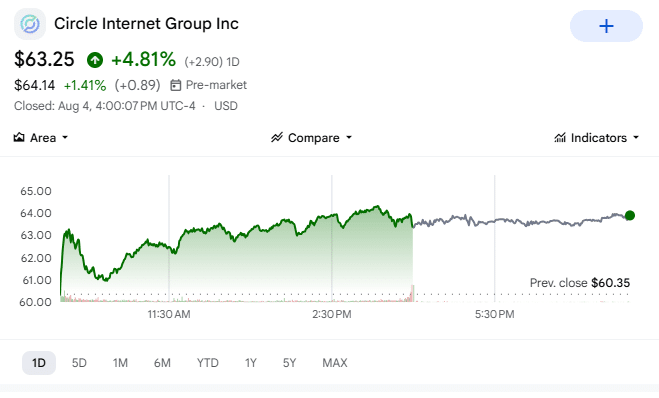
The mixed reaction reflected a quarter with a soft headline number but several forward-looking positives, leaving investors to weigh near-term margin pressure against Circle’s longer-term platform build-out.
On the Earnings Call
On the call, CFO Jeremy Fox-Geen framed the soft top line as a function of forces outside the network — the lower reserve return rate (about 3.5%, down 66 basis points) and a roughly $8 million sequential decline in other revenue that he tied to a deliberate decision to prioritize Arc over other blockchain partnerships.
CEO Jeremy Allaire emphasized what he called a decoupling of USDC usage from crypto prices, noting circulation grew about 19% year-over-year even as the broader digital-asset market shrank, and said USDC reached nearly 70% of stablecoin transaction volume in June, up from 36% a year earlier, per Visa data.
Allaire also said Circle’s distribution agreement with Coinbase had been renewed on its existing terms, keeping USDC central across Coinbase’s products. That renewal, along with a new shared-revenue arrangement with Hyperliquid and expanded infrastructure roles for Visa and Mastercard on Arc, formed the company’s answer to a growing investor concern — raised directly by a Citi analyst — that sharing reserve income with distribution partners is becoming “table stakes” and could pressure Circle’s margins.
Allaire argued Circle already has more than 150 distribution partnership agreements and can strike such deals alongside Coinbase rather than being constrained by that relationship. Asked about a dividend, management said no, describing Circle as a growth company that would reinvest rather than return capital.
Pressed on the Hyperliquid deal, Circle disclosed that about 90% of Hyperliquid’s USDC sat on Coinbase’s platform and 10% on Circle’s at quarter-end, with the two companies jointly sharing the arrangement’s economics; Allaire framed such high-liquidity venues as “liquidity supernovas” that spread USDC adoption to other applications, justifying the economics given up.
The Offsetting Positives
Several disclosures cut against the weak top line. Circle raised its full-year 2026 guidance for other revenue to $310–330 million, roughly doubling its prior $150–170 million range — though management was explicit that the increase comes almost entirely from recognizing revenue from the $242 million ARC Token presale, not from core growth. It also lifted its RLDC margin outlook to 41.7–43.7%.
The company also confirmed it received final approval from the U.S. Office of the Comptroller of the Currency to establish Circle National Trust, making it one of the first stablecoin issuers to hold a federal bank charter, and set a September 16 public mainnet launch for Arc, its institutional blockchain — with a validator cohort that Circle says includes BlackRock, DTCC, ICE, Mastercard, and Visa. Circle’s payments network reached about $15 billion in annualized transaction volume at quarter-end and, management said, roughly $23 billion by July 31.
Context
Circle went public in June 2025 and its stock has been volatile since, swinging on interest-rate expectations, stablecoin competition, and the trajectory of US crypto legislation. USDC held a 27% share of the fiat-backed stablecoin market at quarter-end. Analysts remain broadly constructive — TD Cowen recently initiated coverage with an $82 target — though the stock trades well below the average target amid questions about profitability as reserve yields decline. On the call, Allaire said the CLARITY Act remains “very actively” negotiated and that he hoped for Senate movement, though its near-term path remains uncertain.