Circle Internet Group (NYSE: CRCL) on Wednesday published the list of founding institutional validators for its Arc blockchain and confirmed a September 16, 2026 public mainnet launch.
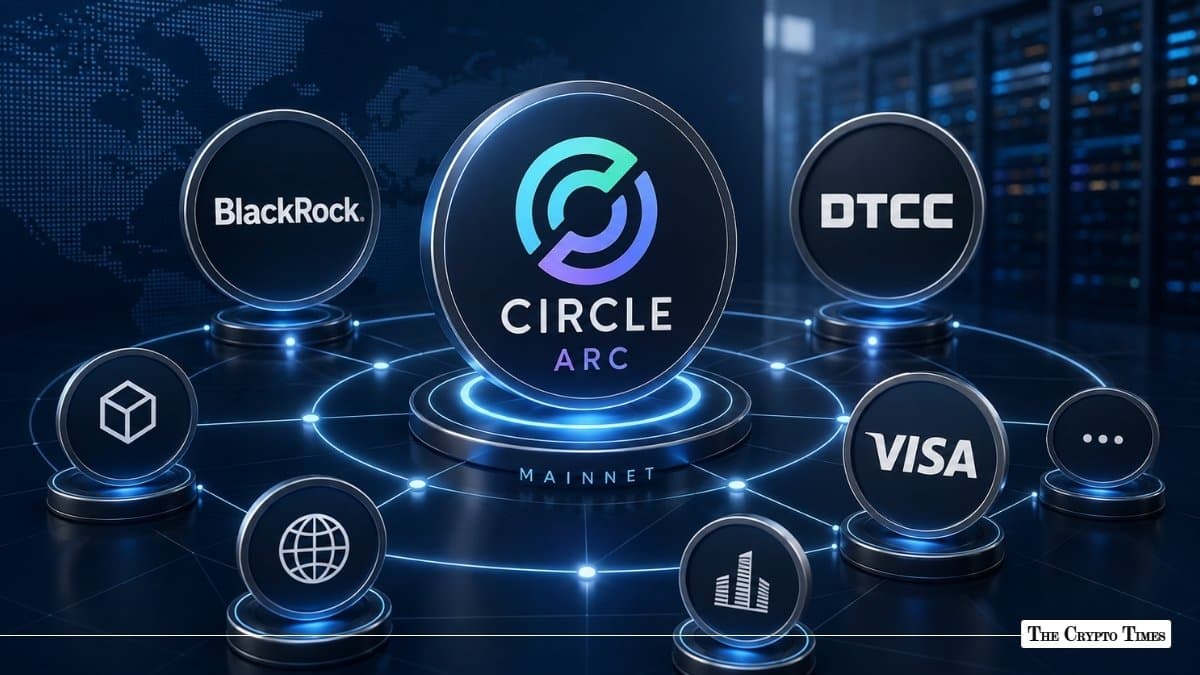
The 11 institutions joining Circle in the initial validator set are BlackRock, the Depository Trust & Clearing Corporation (DTCC), Galaxy, Global Payments, Intercontinental Exchange, Mastercard, MoneyGram, SBI Group, Standard Chartered, Sumitomo Corporation, and Visa.
According to the company’s press release, Arc is currently in private mainnet with more than 100 ecosystem and institutional builders. CRCL traded around $66.84 in the pre-market session following the announcement, against a prior close of $63.25, as per YahooFinance data.
Details of the announcement
Arc is a Layer-1 network that uses USDC as its native gas asset, with EVM compatibility, sub-second finality, and an in-protocol FX engine called StableFX. It is being operated by a permissioned validator set at launch, with Circle stating that expansion toward broader participation and eventual proof-of-stake governance is on the roadmap. CEO Jeremy Allaire told CNBC the operator count could grow to 20 to 40 over time, and that ARC token holders would eventually be able to stake and vote on protocol decisions.
The company also outlined three institutional integrations that are separate from the validator function:
- BlackRock is expected to deploy BUIDL, its tokenized institutional liquidity fund, on Arc. BUIDL currently operates across Ethereum, Solana, Polygon, Aptos, and Arbitrum. Deploying on Arc would allow subscriptions and redemptions to occur in a single onchain environment using USDC.
- DTCC will collaborate with Circle to enable tokenization of DTC-custodied assets on Arc, with work slated to begin in the second half of 2027. The stated design allows Arc-based applications to enable stablecoin-native settlement outside DTC against DTC-tokenized securities.
- BNY and Standard Chartered are exploring additional integrations spanning digital asset custody, stablecoin access and settlement services. No timelines were disclosed.
Day-one applications listed by Circle include Aave, Aerodrome, FalconX, GSR, Keyrock, Morpho, Nonco and Uniswap on the DeFi side; Rain, Thunes, and Wirex for payments; and Binance Wallet, Chainlink, Fireblocks, Kraken, Ledger, MetaMask, and Upbit for custody, wallets and connectivity.
ContexArc’s road to mainnet, and the field it enters
Today’s announcement follows a sequence of prior Arc disclosures. Circle launched the public testnet in October 2025 with roughly 100 participants. In May 2026, it raised $222 million in an ARC token presale at a $3 billion fully diluted valuation, with a16z, BlackRock, Apollo, ICE, and Standard Chartered among the participants. In late July, it acquired the bulk of IBM’s blockchain patent portfolio. Circle has also published a post-quantum security roadmap covering wallets, validators and infrastructure.
Arc’s design targets a market segment now contested by multiple purpose-built chains. Tether’s Plasma is live and using USDT as its native asset; a sister network, Stable, is in testnet. Stripe and Paradigm’s Tempo is stablecoin-agnostic, allowing any supported issuer’s token to serve as gas. Each network targets a different distribution channel: Plasma and Stable are aligned with Tether’s remittance and merchant footprint, Tempo with Stripe’s payments network, and Arc with USDC and the traditional-finance participants aggregated by the GENIUS Act framework.
What the arrangement changes, and for whom
For Circle, the validator cohort and BUIDL integration expand the surface area on which USDC is used beyond issuance. Gas paid in USDC on Arc, CCTP flows, and StableFX volume all contribute to a revenue base separate from stablecoin reserve yield, which the GENIUS Act restricts.
For the validating institutions, participation provides direct access to the network on which their tokenized products may settle, and optionality on future staking economics if Arc transitions to proof-of-stake as planned. BlackRock currently manages roughly $60 billion in USDC reserves for Circle; validating a chain designed around USDC narrows the operational distance between reserve management and settlement.
For DTCC, the arrangement is consistent with the multi-chain strategy the company has previously disclosed. If executed on the stated 2027 timeline, it would establish a defined route between DTC-custodied securities and a public blockchain, with stablecoin settlement occurring off the DTC ledger.
For DeFi applications listed as day-one participants, Arc offers exposure to whatever institutional flow the founding validators route through the network. The extent of that flow is unknown at this stage.
What to watch after September 16
Three variables will determine whether the September launch translates into measurable network activity rather than announced partnerships.
First, mainnet performance. Testnet transaction counts do not carry over to production, and the network will need to demonstrate throughput, uptime and settlement finality under real institutional load. Arc is scheduled to launch with post-quantum signature support, which has not been tested at production scale on any comparable network.
Second, the ARC token. Presale allocations are subject to vesting that begins after mainnet, and the token generation event has not been dated. Until it clears, validator staking and governance economics remain forward-looking.
Third, the DTCC integration. A second-half-2027 timeline leaves roughly 18 months during which competing infrastructure, additional stablecoin legislation, and any bank-issued stablecoin under GENIUS could alter the terrain in which Arc operates. Any slippage on that date reduces the differentiation the announcement establishes today.
Circle disclosed that Arc is operated by Arc Network Services LLC, and stated that the network has not been reviewed or approved by the New York State Department of Financial Services or any other regulatory authority.
Also Read: Circle Upgrades Gateway With ERC-1271 Smart Wallet Support