
Key Highlights
- Strategy began August after a 5% drop in July, with MSTR trading in a tight range as investors look for the next major price move.
- The company sold 1,638 Bitcoin for $104.73 million and used the proceeds for dividends and share buybacks instead of buying more Bitcoin.
- Despite reporting an $8.22 billion quarterly loss, analysts remain positive on MSTR, while investors watch Bitcoin’s price, technical levels, and August’s historical weakness.
Strategy (NASDAQ: MSTR, formerly MicroStrategy) started August 2026 with one question: can the stock recover after a difficult July, or will another historically weak August put more pressure?
The company closed July down about 5% for the month. While the drop was not severe, the stock spent most of the month moving within a narrow range instead of making sharp moves.
As of late July 2026, Strategy was trading at $93.28. As of August 3, the stock trades at $95.14, giving the company a market value of about $34.67 billion, with average daily trading volume of around 20.2 million shares.
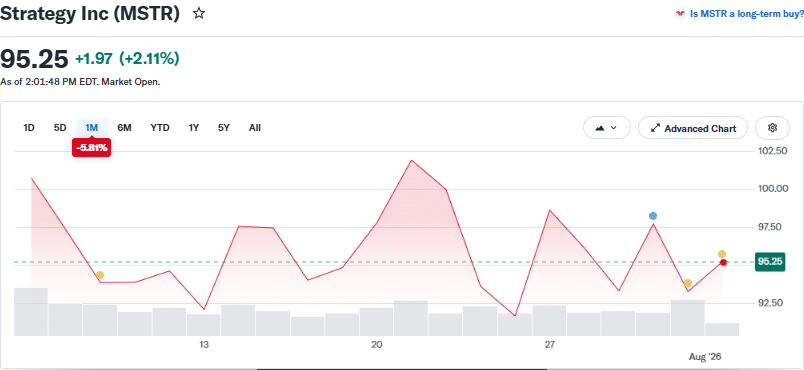
Looking at the chart, July was mostly a month of patience. Strategy climbed to almost $102, but buyers could not push the stock any higher after running into selling pressure. At the same time, the price repeatedly found support below $92.50, keeping MSTR locked in a trading range for most of the month. In simple terms, neither buyers nor sellers had enough strength to take full control.
Strategy makes one of its biggest Bitcoin moves
The company enters the new month following one of its most watched strategic decisions in recent years.
Strategy disclosed in a Form 8-K filed with the U.S. Securities and Exchange Commission (SEC) that it sold 1,638 Bitcoin between July 27 and August 2, 2026. The sale generated approximately $104.73 million at an average price of $63,957 per Bitcoin.
The transaction marked a notable shift for a company that built its reputation around accumulating Bitcoin rather than reducing its holdings. The average selling price was roughly 15% below the company’s average acquisition cost of around $75,419 per Bitcoin, resulting in a realized loss on the sale.
Rather than using the proceeds to purchase more Bitcoin, Strategy directed the funds toward corporate obligations. Around $52.4 million went to preferred dividend payments, while another $52.3 million funded the repurchase of STRC preferred shares, the company’s Variable Rate Perpetual Stretch Preferred Stock, through its Digital Credit Securities Repurchase Program.
Even after the sale, Strategy remains the world’s largest corporate holder of Bitcoin with holdings of 842,138 BTC, underscoring that Bitcoin continues to sit at the center of the company’s long-term strategy despite the recent reduction.
Building cash while buying back shares
The filing also revealed that Strategy repurchased 912,143 STRC shares for $81.2 million during the same period. Those buybacks were financed through two sources: proceeds from the Bitcoin sale and fresh capital raised by issuing new MSTR common shares.
During the week, the company issued 3,011,361 new common shares, raising approximately $290.6 million. Of that, $250 million was allocated to the company’s U.S. dollar reserve, $28.9 million supported the STRC repurchase program, and the remaining $11.7 million was added to the company’s cash balance. Those stock sales lifted the USD reserve to about $4 billion.
Following these transactions, Strategy still has approximately $893.8 million available under its $1 billion Digital Credit Securities buyback program, while its separate $1 billion MSTR Class A common stock repurchase authorization remains unused. The company also retains significant capacity across several at-the-market fundraising programs, including more than $22 billion available under its MSTR program.
August has not been kind to Strategy’s stock
Moving forward, it’s important to look back at previous years to give investors something to think about. According to StockAnalysis, August has not been a friendly month for Strategy. The stock has finished the month in the red for four straight years. It dropped 16.78% in August 2025, 17.98% in 2024, 18.35% in 2023, and 19.05% in 2022. The last positive August came in 2021, when the stock gained 10.91%, while 2020 delivered a stronger 16.56% return.
However, history does not decide what will happen next, but these numbers explain why many investors are entering August with extra caution.
Breaking down Strategy’s latest earnings
The company’s latest financial results are another key consideration for investors. In the second quarter of 2026, Strategy reported a net loss of $8.22 billion. At first glance, the number looks alarming. However, most of that loss did not come from money leaving the business.
Instead, it came from an accounting rule that requires companies to update the value of their digital assets at the end of every quarter. Because Bitcoin traded much lower during the period, Strategy recorded an unrealized loss of $8.32 billion on its Bitcoin holdings. In simple terms, the company still owns most of those Bitcoins. Their value simply fell during the quarter, and accounting rules required that decline to appear in the earnings report.
That explains why many investors looked beyond the headline loss. While Bitcoin reduced the company’s reported earnings, the software business continued to grow. Strategy generated about $122.4 million in revenue during the quarter, up 6.9% from the same period last year. Although software is now a much smaller part of the company’s story, it continues to provide a steady source of income.
Michael Saylor signals a change in Strategy
During the earnings call, Executive Chairman Michael Saylor revealed that Strategy is changing how it thinks about buying Bitcoin. “Perhaps the best way to buy the most Bitcoin is not to buy the most Bitcoin immediately,” Saylor said.
The comment suggests an important shift. For years, Strategy was known for using almost every opportunity to buy more Bitcoin. Now management says it wants to keep a healthier balance between cash and Bitcoin so the company can remain flexible during difficult market conditions.
Analysts still back MSTR despite recent challenges
Wall Street analysts are divided on the near-term outlook but continue to see longer-term potential, and most price targets sit far above the current price.
Benchmark maintained its Buy rating while lowering its price target from $570 to $435. Analyst Mark Palmer said much of the company’s second-quarter earnings call focused on bringing STRC back toward its target value, suggesting that Strategy intends to continue raising capital before expanding its Bitcoin purchases again.
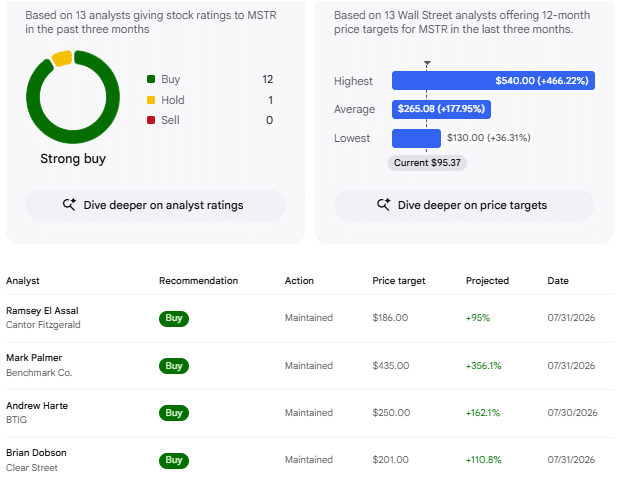
H.C. Wainwright reaffirmed its Buy rating with a $325 target, saying Strategy’s growing cash reserves and ongoing STRC repurchases could strengthen the balance sheet and reduce concerns that the company may need to lean more heavily on debt if Bitcoin stays under pressure.
Not every revision was positive: Clear Street cut its target to $201 from $240 following the Q2 results, while keeping a Buy rating, and other firms trimmed targets on lower Bitcoin-price assumptions. Even after the cuts, published targets span a wide range, from roughly $155 at the low end to the mid-$500s at the high end, reflecting how much MSTR’s valuation hinges on the Bitcoin price outlook.
Regulation could also play a key role
The regulatory development in the U.S. is another story. Investors will be watching for updates on the proposed CLARITY Act, which aims to create clearer rules for digital assets in the United States and remains a major topic across the industry.
Although the bill is not directly tied to Strategy’s business, clearer regulations could improve confidence among investors and companies operating in the digital asset market. Saylor has been among those pushing for progress on the bill. In a recent post on X, he urged lawmakers to move the legislation forward through bipartisan support before Congress begins its August recess.
According to Saylor, Bitcoin itself does not depend on regulation to succeed, but the broader digital asset industry would benefit from having clear and consistent rules.
Key chart levels to watch this month
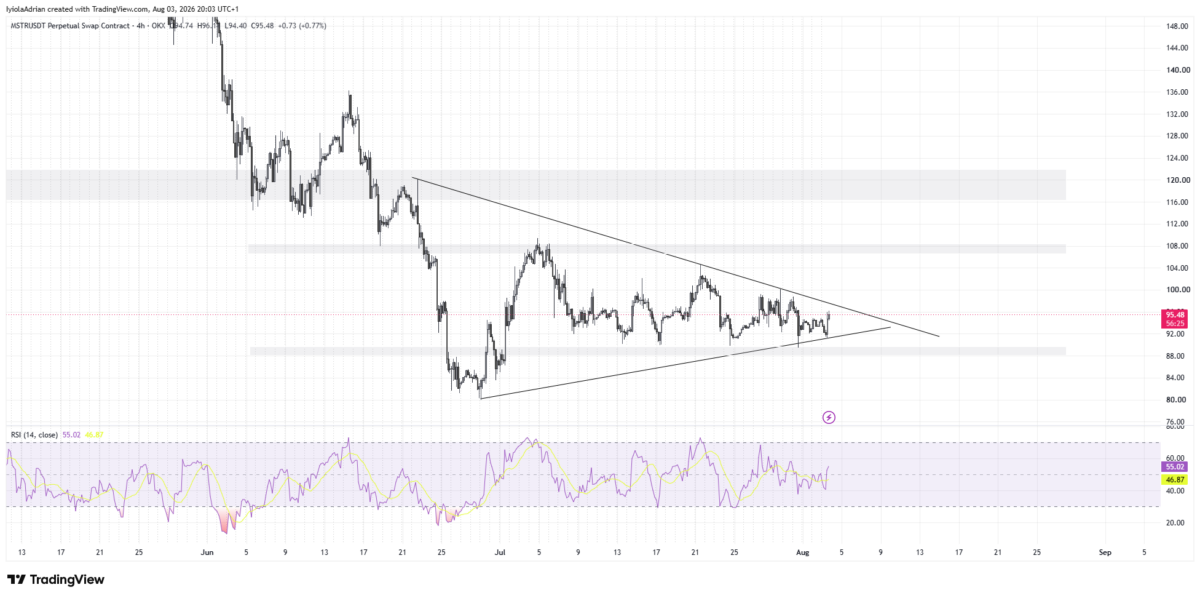
MSTR is trading within a symmetrical triangle it has been forming since June 2026, which is what kept the price consolidating through last month. A descending trendline from the late-July high near $104 continues to cap the upside, while a rising trendline supports the lows, compressing the price toward the triangle’s apex. Immediate resistance lies along the descending trendline, while the broader range is defined by $88 as support and $108–109 as the next major resistance zone if a bullish breakout occurs.
The Relative Strength Index (RSI) is hovering around 54–55, indicating neutral momentum. This suggests neither buyers nor sellers have gained a decisive advantage, leaving the market waiting for a breakout to determine the next directional move.
Three possible paths for August
Bullish case
The bullish outlook is for Strategy to break above the resistance level at $109 with a strong bullish candle. If this happens, this could propel the price to the weekly resistance at $116, which might have a strong rejection if the initial buy momentum is not strong enough.
Base case
A base case is for the price to continue trading in its current close range for the month. MSTR could continue moving and bouncing off the triangle until it gets tight and either buyers or sellers take charge to break the pattern.
Bearish case
If sellers manage to overpower buyers and break the triangle to the downside. It could trigger a sell-off and push the price down, breaking the $89 support to clear out the sell liquidity that had been building up the pattern.
This will result in another weak August, which would be similar to the declines seen over the past four years.
Conclusion
As August unfolds, investors will watch several key developments. Bitcoin’s price will remain one of the biggest drivers of MSTR. Any improvement in the cryptocurrency could help lift Strategy’s stock, while another sharp decline may create pressure. Investors will also watch the company’s fundraising plans, share buybacks, and any signs that management is preparing to increase its Bitcoin holdings again.
For now, Strategy enters August with a very different story from previous years. It is still the world’s largest corporate holder of Bitcoin, but it is no longer focused only on buying more of the cryptocurrency. Instead, management is working to strengthen the balance sheet, build larger cash reserves, and improve financial flexibility while staying committed to its long-term Bitcoin strategy.
Also Read: Coinbase Stock Prediction: Can COIN Defy August’s Losing Streak?