Zcash (ZEC) is trading near $1,555 after a sharp September advance, with a 24-hour range roughly between $1,435 and $1,585. Market value sits close to $26 billion, placing ZEC among the largest assets by capitalization—as per CoinGecko data.
About 16.9 million ZEC of the 21 million hard cap is already issued. Daily issuance is still about 1,800 ZEC, or roughly 3.9% annual inflation against current supply, and that rate declines with every subsidy cut.
The last month has been unusually strong. ZEC began September near the mid-$800s, cleared $1,000, then $1,300, and is now pressing the mid-$1,500s. That kind of vertical move often leaves the market stretched. A pullback would not cancel the larger trend; it would test whether buyers defend the levels that launched the breakout.
What Is Zcash?
Zcash (ZEC) is a privacy-focused cryptocurrency launched in 2016 from a Bitcoin-derived codebase. It uses zero-knowledge proofs, known as zk-SNARKs, so users can send shielded transactions that hide the sender, recipient, and amount while still letting the network verify that the coins are valid. Transparent addresses remain available, so privacy is optional rather than mandatory. The protocol is maintained by the Electric Coin Company and the Zcash Foundation. That design is why ZEC often moves with broader crypto rallies and with news that touches on-chain privacy, regulation, and institutional products.
Recent Structure and Technical Map
ZEC spent much of 2025 rebuilding from the $50–$80 area and closed that year near $513. 2026 opened around $525, dipped toward $190 at the yearly low, then recovered through mid-year.
The Ironwood pool was activated on July 28, 2026 at block 3,428,143. Price was still in the $400s around that event. From late August through mid-September the chart changed character: higher highs, expanding volume, and a break above the $1,000–$1,250 supply zone that had capped earlier attempts.
Key levels now:
- Immediate resistance: $1,585–$1,600 (local high).
- First stretch target: $2,000.
- Major historical magnets: $3,200, then the 2016 peak near $5,940.
- Near support: $1,100–$1,120 (mid-September base).
- Deeper support: $790–$830 (early September).
- Cycle defense: $500–$525 (August and the 2026 open).
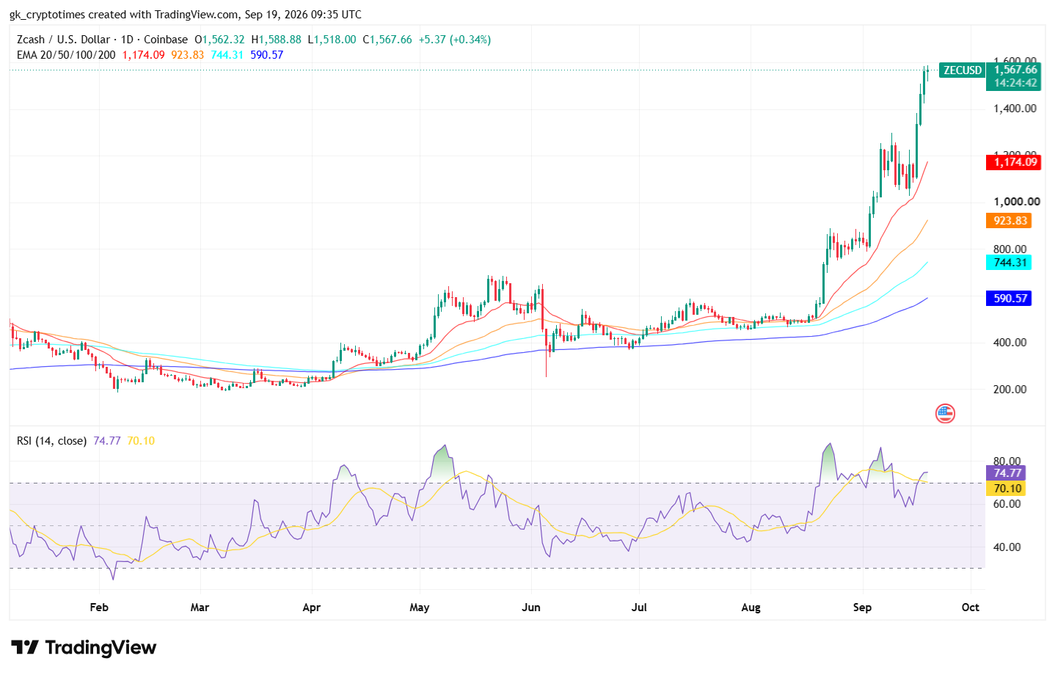
After a move of this size, short-term oscillators are likely elevated. That raises the odds of a pause or a sharp mean-reversion before any sustained push toward $2,000. The bullish case stays intact while daily closes hold above $1,100. A weekly close back under $790 would argue that September was a blow-off rather than a new regime.
What Actually Moves ZEC From Here
Zcash is a 21-million-cap, proof-of-work chain whose product is optional, strong privacy. Transparent addresses behave like a public ledger. Shielded addresses hide sender, receiver, and amount using zero-knowledge proofs. That split is the whole investment argument: scarce issuance plus a payment rail people use when they do not want a permanent public history.
On-chain, that argument is no longer theoretical. About 4.92 million ZEC, or 29% of supply, sits in shielded pools. Ironwood, the current flagship pool, holds about 3.97 million ZEC. Orchard is sealed and still migrating; roughly 411,000 ZEC remains there. Sapling still holds about 512,000 ZEC. Sprout is a residual sliver. The interesting signal is not only migration out of a sealed pool. It is new shielding from transparent balances into Ironwood. That flow is the demand side of the privacy thesis.
Network activity has expanded with price. Daily transactions have moved from the low thousands earlier in the year toward 9,000-plus. Shielded actions per day are several times higher than a year ago. Hashrate has climbed as well, which matters for a mined asset: security spend is rising with the coin’s market value.
Two protocol items dominate the next 24 months.
- NU7. Ecosystem teams have aligned on a testnet target of October 6, 2026 and a mainnet target of November 5, 2026, with a final height decision around October 20. The headline change is ZIP-218: target block time from 75 seconds to 25 seconds. Confirmation latency falls. Throughput for shielded actions can rise if block limits scale as designed. Per-block subsidy is reduced so issuance per day stays on the existing monetary schedule. NU7 also disables older v4 transactions and turns on the Network Sustainability Mechanism: at least 60% of transaction fees are pulled out of circulation and scheduled to return as supplemental miner rewards beginning February 2031. Coinholders separately backed keeping discrete halvings rather than smoothing issuance.
- The next halving. At block 4,406,400, expected around November 2028 under the current 75-second target (the calendar date shifts if 25-second blocks activate and the interval math is adjusted to keep time-based issuance constant), the subsidy steps from 1.5625 ZEC to 0.78125 ZEC. Daily issuance halves. Inflation falls again. That is the same stock-to-flow logic Bitcoin uses. Zcash simply layers privacy and a fee-lockbox on top of it.
Risks are not cosmetic. Privacy coins attract listing, banking, and policy pressure. Wallet and exchange support for new pools can lag an activation. A cryptography or circuit issue — Ironwood exists because Orchard was sealed after a soundness concern — can freeze shielding demand overnight. Mining revenue after the 2028 cut depends on fees plus the later recycled-fee stream. If shielded usage stalls, the fee side of that story weakens.
Zcash Price Prediction 2026
The rest of 2026 is a three-variable problem: whether $1,100 holds, whether NU7 activates cleanly in November, and whether the market treats faster shielded payments as a reason to keep capital in ZEC after the September squeeze.
Base case: ZEC spends the fourth quarter digesting $1,100–$2,000. A successful NU7 rollout and continued Ironwood inflows support an average closer to the top of that band. High case: a full-market risk-on tape plus a clean upgrade push price toward the low-$3,000s, where older cycle memory sits. Low case: a broad altcoin washout tags the early-September shelf.
| 2026 Range for Zcash (ZEC) | |
| High | $2,850 |
| Average | $1,850 |
| Low | $920 |
That high is not a promise of a new all-time high. It is a stretch target if the November upgrade is uneventful and $1,100 never gives way on a weekly close.
Zcash Price Prediction 2027–2030
2027: This is the first full year of 25-second blocks, assuming NU7 ships. Usability improves. The fee lockbox begins to matter only if people actually transact. If shielded share holds near 30% or climbs, ZEC can trade as a scarce privacy asset rather than a leftover 2016 name. Failure to grow fees leaves the chart dependent on beta to Bitcoin.
| 2027 Range for Zcash (ZEC) | |
| High | $4,200 |
| Average | $2,600 |
| Low | $1,400 |
2028: Halving year. Markets usually price the cut early and the disappointment, if any, after. A subsidy drop from 1.5625 to 0.78125 ZEC per block is mechanical. The variable is whether hashprice stays high enough to keep security robust. If it does, 2028 can be the year ZEC retests the $5,000–$7,000 zone that sits between the local 2026 high and the 2016 peak.
| 2028 Range for Zcash (ZEC) | |
| High | $7,400 |
| Average | $4,100 |
| Low | $2,100 |
2029: Post-halving inflation is lower. The network is then waiting on the 2031 recycled-fee start. Price in this year is mostly a function of whether private payments became a habit or remained a niche toggle.
| 2029 Range for Zcash (ZEC) | |
| High | $12,500 |
| Average | $6,800 |
| Low | $3,200 |
2030: By 2030 the outstanding supply is closer to the cap, daily issuance is smaller still, and the sustainability mechanism is one year from releasing banked fees into miner rewards. That setup can support a higher equilibrium if Ironwood (or its successor pool) is where value actually settles. If privacy demand is regulated away or users migrate to other tools, the same supply schedule produces a much lower tape.
| 2030 Range for Zcash (ZEC) | |
| High | $18,000 |
| Average | $10,500 |
| Low | $4,800 |
Longer Horizon
These figures assume the 21 million cap holds, halvings continue, shielded usage does not collapse, and Zcash remains a listed, mineable asset. They are scenario bands, not targets you can mark on a calendar.
| Year | Potential low | Potential average | Potential high |
|---|---|---|---|
| 2026 | $920 | $1,850 | $2,850 |
| 2027 | $1,400 | $2,600 | $4,200 |
| 2028 | $2,100 | $4,100 | $7,400 |
| 2029 | $3,200 | $6,800 | $12,500 |
| 2030 | $4,800 | $10,500 | $18,000 |
How to Read the Setup
Zcash is no longer a forgotten privacy coin trading like a penny beta. It is a top-ten asset with a fixed cap, a visible shielded float, a new pool that already holds nearly four million ZEC, and a scheduled upgrade that tries to make private payments feel closer to ordinary ones. The November NU7 window and the 2028 subsidy cut are the two dates that matter most.
None of that makes $18,000 in 2030 inevitable. The same market that repriced ZEC from the $500s to the $1,500s in a quarter can reprice it the other way if listings tighten, if an upgrade slips, or if shielding growth stalls. Treat the table as a map of outcomes under different adoption paths. Size any position as if the low column is livable, not as if the high column is owed.
Also read: Top 7 AI Crypto Coins by Real Usage and Revenue in 2026