As of 6:00 AM UTC – September 19, HYPE is trading near $92 after a sharp September advance, with a 24-hour range roughly between $88 and $94.50. The token’s market value sits close to $20 billion depending, placing HYPE among the largest crypto assets—as per live market data from CoinGecko.
Of the total 955.307 million in total token supply, about 222 million HYPE is treated as circulating. Another ~48.7 million, or about 4.9% of the original supply, has already been removed by fee-funded burns.
Hyperliquid’s daily revenue still funds a large buyback machine: recent weeks show protocol revenue around $13.5 million and burns of ~157,000 HYPE. That rate is not fixed. It rises and falls with perpetual volume.
The last month has been unusually strong. HYPE began September near the mid-$70s to low-$80s, cleared prior June highs, and is now pressing a fresh all-time high around $94.50. That kind of vertical move often leaves the market stretched. A pullback would not cancel the larger trend; it would test whether buyers defend the levels that launched the breakout.
Hyperliquid’s September tape highlights growing appetite for on-chain exchange tokens that actually throw off cash. HIP-3 builder markets and HIP-4 outcome markets are turning a crypto-perp venue into a broader risk-transfer layer.
With nearly all eligible fees routed into HYPE buybacks, the token is no longer just a governance badge. It is the residual claim on exchange cash flow.
What Is Hyperliquid?
Hyperliquid is a purpose-built Layer 1 launched to run an on-chain central limit order book at CEX-like speed. The original product was perpetual futures. Spot followed. HyperEVM then added a general-purpose smart-contract environment that shares state with the matching engine, HyperCore. HYPE is the gas, staking, and value-accrual token.
Most protocol fees are converted into HYPE and burned through the Assistance Fund. That design is why HYPE often moves with crypto risk appetite and with news that touches perp market share, token unlocks, ETFs, and regulation of on-chain derivatives.
Recent Structure and Technical Map
The TradingView chart shows HYPE printed its all-time low near $3.81 at the November 2024 TGE, spent 2025 digesting between roughly $10 and $59, and closed 2025 near $26. 2026 opened around $25, tagged a yearly low near $21, then changed character in May when spot ETFs listed and price ran toward the low-$70s.
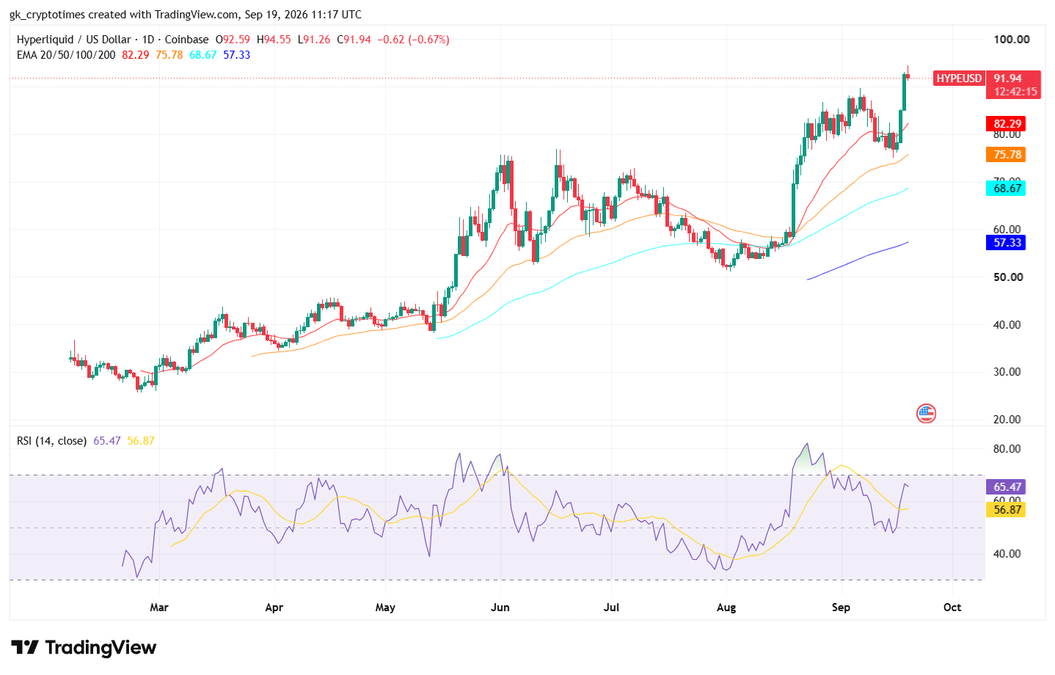
June and July gave that move back toward the $52–$55 shelf. From mid-August through mid-September the chart flipped again: higher highs, expanding volume, and a break through the $85–$88 supply zone.
Levels now:
- Immediate resistance: $94.50–$96 (local and all-time high).
- First stretch target: $120.
- Major magnets: $150, then $200.
- Near support: $75–$76 (mid-September pivot).
- Deeper support: $52–$55 (July shelf).
- Cycle defense: $21–$26 (2026 open and yearly low).
After a move of this size, short-term oscillators are likely elevated. That raises the odds of a pause or a sharp mean-reversion before any sustained push toward $150–$200. The case stays intact while weekly closes hold above $75. A weekly close back under $52 would argue that September was a blow-off rather than a new regime.
What Actually Moves HYPE From Here
Hyperliquid is a scarce-ish exchange token on a 1-billion original cap whose product is high-speed on-chain trading. Native crypto perps still pay most of the bills. HIP-3 lets outside builders list stocks, commodities, FX, indices, and pre-IPO names by bonding HYPE. HIP-4 adds fully collateralized event contracts. HyperEVM is the general-purpose layer sitting on the same validator set. That is the investment argument: exchange cash flow plus a buyback sink, layered on a chain that is trying to become market infrastructure rather than a single app.
On-chain, that argument is no longer theoretical. Trailing 30-day perpetual volume recently printed about $239 billion, or roughly 36% of tracked perp-DEX volume, with open interest measured in the billions—as per DeFiLlama data.
Cumulative protocol revenue is around $1.31 billion. Cumulative burns are about 48.7 million HYPE. HyperEVM TVL has been cited near $1.5 billion. HIP-3 has accounted for a large slice of volume at times — around 30% of trailing activity in early September prints — though builder markets keep a fee share, so a dollar of HIP-3 volume is worth less to HYPE than a dollar of native crypto perps.
Network activity has expanded with price. Daily perp volume has printed in the multi-billion range. Spot and HyperEVM flow is smaller but no longer rounding error. Staking secures HyperBFT. Spot ETFs from 21Shares, Bitwise, and Grayscale opened a regulated bid in May–June 2026.
Risks are not cosmetic. Perp volume is cyclical. Competitors can copy the product faster than they can copy the liquidity. HIP-3 oracles and builder risk sit outside the core team. A regulatory squeeze on on-chain equity perps or prediction markets would hit the new growth lines first. If fees stall while unlocks continue, the buyback bid shrinks just as float rises. If price rips faster than fee growth, each buyback dollar retires fewer tokens.
Hyperliquid Price Prediction 2026
The rest of 2026 is a three-variable problem: whether $75 holds, whether late-September and Q4 unlocks are absorbed by the Assistance Fund and ETF bid, and whether HIP-3/HIP-4 keep adding fees after the September squeeze.
- Base case: HYPE spends the fourth quarter digesting $75–$150. Continued native-perp share, a clean unlock tape, and steady burns support an average closer to the top of that band.
- High case: a full-market risk-on tape plus expanding non-crypto markets push price toward $160–$200, where the first round-number magnet sits above this week’s high.
- Low case: a broad washout tags the July shelf.
| 2026 Range for Hyperliquid (HYPE) | |
| High | $165 |
| Average | $105 |
| Low | $55 |
That high is not a promise of a clean run to $200. It is a stretch target if $75 never gives way on a weekly close and fee burns keep pace with new float.
Hyperliquid Price Prediction 2027–2030
2027: This is the first full year in which HIP-4 and a broader HIP-3 complex can be judged without launch incentives doing all the work. Contributor vesting is still active. If Hyperliquid keeps 30%+ of on-chain perp volume and non-crypto markets become a real second engine, HYPE can trade as an exchange cash-flow asset rather than a 2024 airdrop beta. Failure to grow fees leaves the chart dependent on Bitcoin beta and ETF flows.
| 2027 Range for Hyperliquid (HYPE) | |
| High | $240 |
| Average | $145 |
| Low | $70 |
2028: Heavy contributor vesting is scheduled to be mostly complete around this window, while future-emissions still drip. Markets usually price the end of a known unlock calendar early and the disappointment, if any, after. The variable is whether volume stays high enough to keep burns meaningful against a larger circulating float. If it does, 2028 can be the year HYPE tests the $300–$350 zone that sits between a matured exchange multiple and a full “on-chain CME” narrative.
| 2028 Range for Hyperliquid (HYPE) | |
| High | $340 |
| Average | $195 |
| Low | $90 |
2029: Vesting databases point to a November 2029 end for the tracked unlock calendar. Price in this year is mostly a function of whether Hyperliquid became default venue infrastructure or remained a dominant but still-cyclical crypto perp DEX.
| 2029 Range for Hyperliquid (HYPE) | |
| High | $480 |
| Average | $260 |
| Low | $110 |
2030: By 2030 the known vesting book is done, outstanding float is much larger, and the token’s equilibrium depends on whether buybacks still retire a meaningful share of supply. That setup can support a higher price if HyperCore is where global risk actually trades. If volume migrates to faster copies, or if equity-perp and event-market rules shut the new lanes, the same revenue engine produces a much lower tape.
| 2030 Range for Hyperliquid (HYPE) | |
| High | $620 |
| Average | $340 |
| Low | $130 |
Longer Horizon
These figures assume the burn mechanism keeps running, Hyperliquid remains a top on-chain venue, HIP-3/HIP-4 do not get regulated into irrelevance, and HYPE stays a listed, liquid asset. They are scenario bands, not targets you can mark on a calendar.
| Year | Potential Low | Potential Average | Potential High |
|---|---|---|---|
| 2026 | $55 | $105 | $165 |
| 2027 | $70 | $145 | $240 |
| 2028 | $90 | $195 | $340 |
| 2029 | $110 | $260 | $480 |
| 2030 | $130 | $340 | $620 |
How to Read the Setup
Hyperliquid is no longer a forgotten airdrop trading like thin DeFi beta. It is a top-ten asset with a visible fee engine, a buyback sink that has already retired nearly 5% of supply, spot ETFs, a live permissionless market layer, and a circulating float that is still a minority of the original cap. The late-2026 unlock window and the 2027–2028 vesting tail are the two dates that matter most.
None of that makes $620 in 2030 inevitable. The same market that repriced HYPE from the $50s to the $90s in a month can reprice it the other way if listings tighten, if volume share slips, or if unlocks finally show up as real sell pressure. Treat the table as a map of outcomes under different volume and float paths. Size any position as if the low column is livable, not as if the high column is owed.
Disclaimer: This is informational only and is not financial advice. Crypto assets are volatile. Do your own research and consult a qualified adviser before making investment decisions.
Also read: Zcash Price Prediction 2026, 2027–2030: Is $2,000 the Next Stop for ZEC?