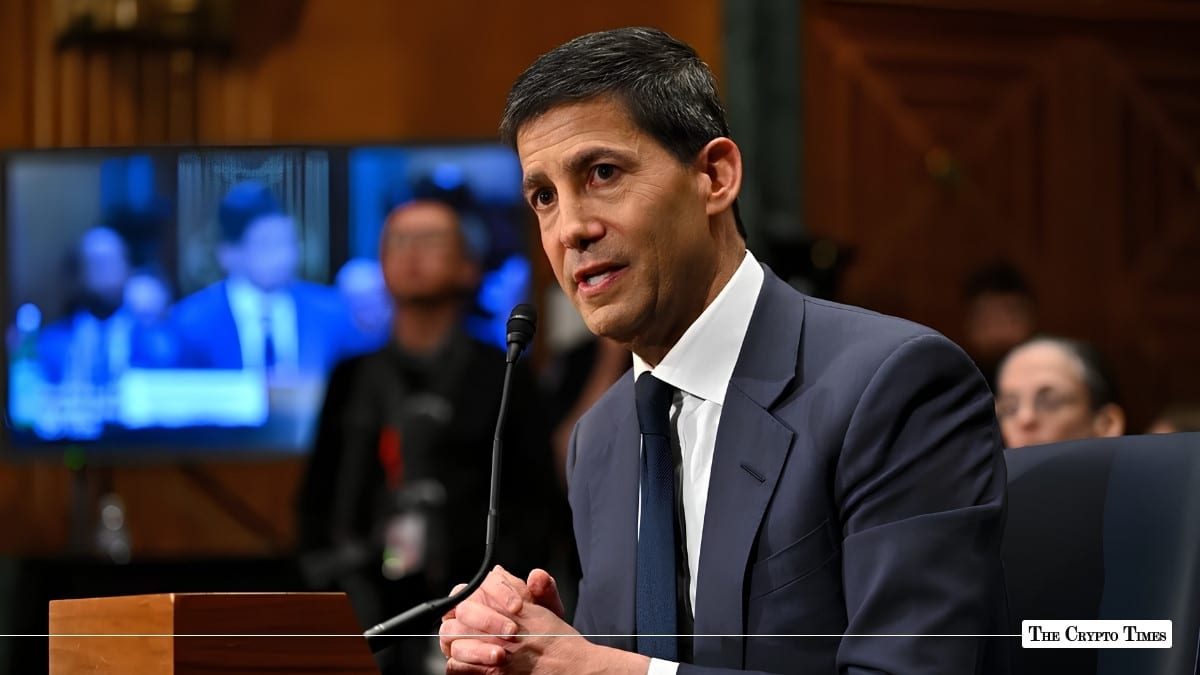
The current Fed Chair Kevin Warsh will testify before the House Financial Services Committee on July 14 at 10 a.m. ET, with a Senate Banking Committee appearance expected the next day. This marks his first turn at the semi-annual Humphrey-Hawkins hearings since taking over the Fed, and the first chance for lawmakers to question the most crypto-connected chair the central bank has ever had.
A crypto-fluent chair, on the record for the first time
Warsh arrives at the witness table with a background no prior chair has shared. Before his confirmation, he disclosed stakes, since divested to meet Fed ethics rules, in a Bitcoin payments startup, the crypto index manager Bitwise, and a stablecoin venture, along with exposure to a dozen-plus blockchain protocols. He has called Bitcoin “the new gold” for investors under 40 and described it as a “policeman for policy,” while dismissing most other crypto as “software, not money.”
That makes the hearings more than a rate-watch exercise. The Fed sits at the center of several questions crypto cares about, stablecoin oversight, bank custody of digital assets, access to Fed payment rails, and the future of a central bank digital currency, and Warsh’s first extended public questioning will be parsed for where he lands on each. His one firm, consistent position is opposition to a U.S. CBDC; his stance on private stablecoins is far less settled, and notably, he abstained from a June Fed vote on new stablecoin policies that his predecessor Jerome Powell supported, a recusal consistent with his recent holdings.
The GENIUS Act clock runs out four days later
The timing sharpens the stakes. The hearings fall just before July 18, the statutory deadline for key rulemaking under the GENIUS Act, the federal stablecoin law, and the Fed is one of the agencies whose piece of that framework remains unfinished. In the law’s division of labor, the Treasury, OCC, FDIC, FinCEN, and NCUA each control a lane, while the Federal Reserve sits behind the banking-system risk and the question of how far supervised banks can move into stablecoin issuance, tokenized deposits, and reserve services.
Expect lawmakers to press Warsh on whether the Fed will meet that deadline, how strict its posture toward bank stablecoin activity will be, and where tokenized deposits fit. His answers would land directly on issuers and the banks weighing how aggressively to enter the market.
Beyond stablecoins: Custody and the master-account question
A second policy thread is bank access to the Fed itself. The central bank controls master accounts, which grant direct entry to U.S. payment rails, and the bar for crypto firms has been a contested question for years. Kraken’s banking arm became the first digital-asset-focused institution to secure a Fed master account, with Circle, Crypto.com, and Ripple pursuing similar federal access.
How a Warsh-led Fed treats those applications and bank custody of digital assets more broadly will shape how willing traditional institutions feel to work with crypto, regardless of what Bitcoin’s price does. On this, his tone may matter more than any single rule.
The rate signal still dominates the tape
For markets, the rate read remains the headline act. Warsh’s first FOMC meeting held rates but gutted the Fed’s forward guidance, and the updated projections showed nine officials expecting higher rates and six penciling in two hikes — a sharp turn from March. With inflation at a three-year high of 4.2% on an energy shock tied to the Iran war, markets now price roughly a 69% probability of no cuts at all in 2026, and the CME FedWatch tool showed a 60.7% chance of an October hike after his debut.
The backdrop is unforgiving for crypto: Bitcoin is down about 27% year-to-date, and Goldman Sachs trimmed its gold target, citing Warsh’s “surprisingly hawkish” turn, logic that maps directly onto Bitcoin as a fellow non-yielding asset. The wildcard is Warsh’s “AI productivity” thesis, the argument that technology-driven disinflation could justify cuts despite hot inflation. If he leans on it before Congress, analysts say it could read as a dovish opening; if he doubles down on “price stability,” the higher-for-longer trade tightens further.
The independence question hanging over the room
A third undercurrent is political. Warsh was nominated by President Donald Trump amid open demands for lower rates yet has insisted he would never predetermine a decision at the White House’s request—a stance that triggered a Bitcoin selloff when he voiced it during his Senate testimony.
The hearings also unfold against an unusual backdrop: the Justice Department opened a criminal investigation late last year into statements Powell made in his July 2025 Senate testimony, and House Financial Services Chair French Hill never scheduled Powell for this year’s February session. For crypto, Fed independence is not an abstraction; it feeds directly into the dollar, real rates, and risk appetite.
What to watch on July 14-15
Three things will tell the story:
- First, any signal on the GENIUS Act timeline and the Fed’s stance on bank stablecoin activity, days before the deadline.
- Second, the rate tone, whether the “AI disinflation” framing surfaces or “price stability” hardens.
- Third, how Warsh handles the independence questions in a politically charged room. The most crypto-fluent chair in the Fed’s history has, so far, let his hawkishness speak loudest.
His first testimony is the next test of whether policy fluency ever points somewhere the market can trade.