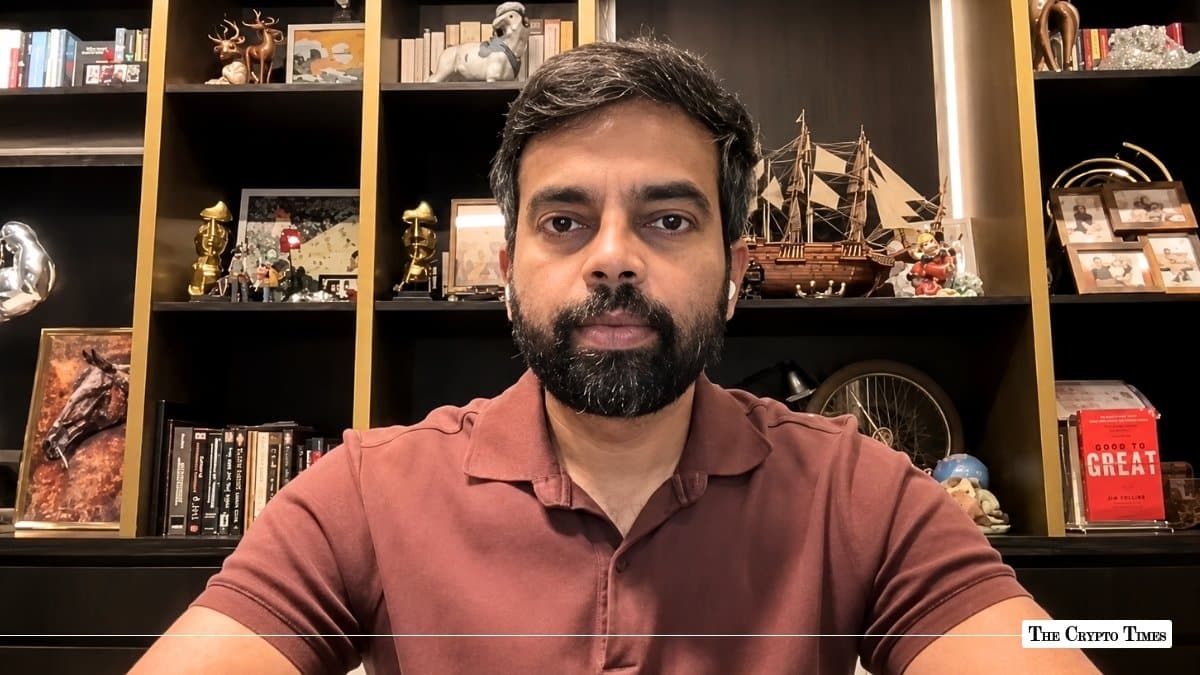
In a wide-ranging interview with Press Trust of India (PTI), WazirX Founder and CEO Nischal Shetty spoke extensively about the exchange’s post-hack journey, upcoming product launches, and his vision for AI-powered trading.
But beneath the polished narrative of innovation and resilience lies a hard truth that Shetty’s words repeatedly danced around: nearly two years after a $230 million hack attributed to North Korea’s Lazarus Group wiped out close to half of user reserves, 15% of user funds remain locked in non-tradable Recovery Tokens with no confirmed buyback to date. And the man responsible for the platform that lost Rs 2,000 crore of user money is now pitching AI chatbots and futures trading as the path forward.
The numbers Shetty himself admitted
Shetty confirmed in the interview that WazirX currently holds roughly 7 to 10% of the Indian crypto trading market. For an exchange that once commanded 50 to 60% market share, this is a staggering fall. “We are probably at about 8 to 10% now,” he said. “We’ve got a few million dollars worth of trades happening every day.”
He acknowledged the gap openly: “We are far away from the original level.” His target? Getting back to a 50% plus market share. But he offered no concrete timeline, no revenue figures, and no clear roadmap for how an exchange that lost the trust of millions plans to reclaim dominance in a market where competitors like CoinDCX, CoinSwitch, and even newer entrants have already moved aggressively to capture the users WazirX left stranded.
The exchange went live after restructuring on October 24, 2025, following a Singapore High Court-approved scheme backed by 95.7% of creditors. Users received approximately 85% of their holdings. The remaining 15% was converted into Recovery Tokens issued in January 2026.
Those tokens are not tradable on any exchange, are not withdrawable, and their value depends entirely on WazirX generating at least $10 million in recoverable value per quarter. WazirX has not publicly confirmed hitting that threshold even once.
Product launches galore, but where is the creditor money?
The interview was heavy on product announcements. Shetty spoke about WazirX ZERO, the Rs 99/month unlimited trading subscription. He spoke about futures trading. He spoke about staking. And he spoke at length about WazirX AI, an upcoming feature that would let users instruct an AI to research markets, track sentiment from news and social media, and even execute trades on their behalf.
“You just tell the AI that you know buy Bitcoin when it drops by 5%,” Shetty said. “I feel that’s a much more natural and easy direction to go rather than you know doing the math on what’s that 5% and then setting a limit order and then figuring out a stop-loss.”
He painted a picture of users “trading like a boss,” delegating everything to AI. “You become the decision maker rather than having to execute and having to research, having to do all of that manually,” he said.
It is a compelling product pitch. But the timing raises uncomfortable questions. The Crypto Times has previously reported on how WazirX’s aggressive product expansion since the restart has drawn scrutiny. The WazirX ZERO subscription, launched in November 2025, drew immediate backlash from users who argued the exchange should focus on recovering locked funds rather than launching new revenue products.
The futures launch in March 2026 initially offered 20x leverage before being scaled back to 10x. And all the while, the promised decentralized exchange (DEX) meant to generate additional revenue for creditors has not materialized.
The question that Shetty was not asked, and did not volunteer an answer to, is this: how much profit has WazirX actually generated since the restart? How much of it has gone toward buying back Recovery Tokens? And when can the 4.4 million affected users expect to see the remaining 15% of their money?
The self-reinforcing ecosystem problem
One element absent from the PTI interview is the matter of Shetty’s overlapping business interests. He is the co-founder of WazirX. He is also the co-founder of Shardeum, a Layer 1 blockchain.
In February 2026, WazirX listed Shardeum’s SHM token and ran a 52.9 million SHM trading contest. In March, WazirX announced a partnership with Sikka.fun, a memecoin launchpad built on Shardeum. WazirX lists Shetty’s token. WazirX runs contests that incentivize volume on Shetty’s token. WazirX partners with platforms built on Shetty’s chain. The 16 million registered users of WazirX become the distribution channel for all of it.
There has been no public disclosure from WazirX about how its commercial relationship with Shardeum is structured, whether Shardeum is paying for these integrations, or whether the revenue generated from SHM-related trading activity contributes in any way to the Recovery Token buyback pool.
SHM itself has crashed over 99.9% from its all-time high. The WRX token trades at approximately $0.02, down 99.64% from its April 2021 peak of $5.94, with daily trading volume below $20,000.
Shetty also co-launched Pi42, a crypto-INR perpetual futures exchange, in February 2024. That is the same product category WazirX has now entered with its own futures launch. None of this was mentioned in the PTI interview.
The Trust Narrative vs. The Track Record
Shetty spoke repeatedly about trust building. He highlighted that WazirX’s customer satisfaction (CSAT) score has climbed from 60% at relaunch to over 90%. “To build trust you need to have like the best product in the industry,” he said.
But trust is not just a CSAT score. The Crypto Times has documented how Shetty transferred 100% shares of a WazirX-linked UAE company, Shinjuku FZC LLC, to his wife weeks after the July 2024 hack, without public disclosure. The Supreme Court of India registered a criminal writ petition filed by 54 WazirX victims against Shetty and the exchange management.
The petition was dismissed in under five minutes, with the court citing the absence of proper crypto regulation in India. Users were left, at the mercy of Nischal Shetty.
In a previous podcast appearance in December 2025, Shetty said he “does not believe in regret” and described the post-hack period as a personal learning experience. The Crypto Times noted at the time: “If this was a lesson, why did the users have to pay the tuition?”
In the PTI interview, Shetty framed WazirX’s survival as exceptional. “Exchanges that have had attacks of the magnitude like ours, they’ve usually wound down and been unable to restructure and restart,” he said. “We are probably one of those rare situations where we’ve restarted with the objective that how do you earn back the 15% and distribute that back to all our creditors.”
It is worth noting that the reason WazirX is “rare” is not necessarily because of exceptional leadership. It is because most exchanges that suffer catastrophic hacks do not have the option of distributing 85% of losses across their entire user base, converting the remainder into untradable tokens, and then restarting operations while the remaining debt hangs indefinitely.
Custody, security, and the BitGo pivot
On the security front, Shetty confirmed WazirX has moved its cold wallet custody to BitGo, the US-based institutional custody provider, and is integrating Fireblocks for operational infrastructure. “BitGo is the largest custody provider in the world,” he said. “They’re also an IPOed company in the US.”
This is a concrete improvement. But it also raises the obvious question of why WazirX went with a lesser-known custody provider in the first place. Shetty addressed this indirectly: “When it comes to custody, choosing the biggest and the largest player is very very important especially in a sector like crypto which is fast evolving. There’s a lot of threat actors out there.”
He also noted the youth of the crypto custody industry. “The crypto industry itself is like seven years where it’s been something substantial,” he said. “When you want to track history and track record you might have four five years but that’s about it.”
Fair point. But the users whose $230 million was stolen because WazirX chose the wrong custody partner are unlikely to find comfort in a retrospective acknowledgment that the decision-making environment was “still complicated.”
Policy wishlist without accountability
Shetty used a significant portion of the interview to discuss Indian crypto policy. He called for the 1% TDS on crypto transactions to be reduced to 0.01% or eliminated entirely, arguing it has made spot trading “almost impossible” for high-frequency traders and driven volume to futures markets.
He advocated for crypto payment rails for international remittances. He called for consumer protection regulations, including requirements for exchanges to have a physical presence in India. And he expressed enthusiasm for real-world asset (RWA) tokenization, describing it as an opportunity for India to democratize access to real estate and other alternative investments.
“I think it’s high time that India actually gets into it,” he said about RWA tokenization. “It’s going to just increase the value for everyone involved.”
These are all reasonable policy positions shared widely across the Indian crypto industry. But there is an irony in Shetty calling for consumer protection regulations while leading an exchange that restructured through a Singapore court, issued untradable recovery tokens to Indian users, and has not publicly confirmed any progress toward meeting its own quarterly recovery thresholds. On May 20, 2026, WazirX representatives were called before India’s Parliamentary Standing Committee on Finance to discuss Virtual Digital Assets. The outcome of that discussion has not been made public.
The 12-Month Roadmap
When asked about priorities for the next 12 months, Shetty listed profitability as the number one goal. “The number one priority is generating profits so that we can distribute it to our creditors,” he said. “That’s like the ultimate goal.”
He outlined the mechanism: WazirX has distributed Recovery Tokens, and when the exchange generates profits, it will use those profits to buy back the tokens, thereby returning value to creditors.
He also listed WazirX AI, staking, and doubling down on futures as the key product bets.
“We want to be like the best customer focused platform for anyone in India,” he said.
The bottom line
Nischal Shetty is a skilled communicator. He knows how to frame a narrative. In this interview, the narrative was one of redemption: an exchange that rose from the ashes, a founder who stayed when others would have quit, a product roadmap that looks forward rather than backward.
But narratives do not settle debts. The 15% of user funds locked in Recovery Tokens remains unresolved. No buyback has been publicly confirmed. The WRX token has lost 99.64% of its value. The promised DEX has not launched. The SHM token Shetty co-founded has crashed 99.9%. And the exchange that once dominated Indian crypto trading now holds single-digit market share.
Shetty told PTI: “When we launched in 2018 also we were not the first ones. We were like the eighth or the 10th exchange and we started with 0% market share and it took us about 4 years to reach number one position.”
That is true. But in 2018, WazirX did not carry the weight of a $230 million hack, a Supreme Court criminal petition, documented share transfers to family members, overlapping founder ventures, and millions of creditors waiting for their money.
The products may be new. The AI pitch may be exciting. The CSAT score may be at 90%. But until the 15% question is answered with numbers, not narratives, the trust Shetty keeps invoking remains a work in progress at best, and a marketing exercise at worst.
Also Read: The 7% Premium Trap Exposed: How India Makes Crypto More Expensive Than Dollars