Key Highlights
- WRX and SHM have crashed over 99%, wiping out massive investor value and signaling a deep trust crisis.
- WRX’s daily trading volume has fallen to just $18,750, reflecting extremely weak market demand.
- Shardeum investors from the public sale now face near-total losses, with returns reduced to a fraction of initial investments.
Two tokens. One founder. A combined market cap under $9 million. And a trail of announcements that raises more questions than it answers.
This is not the story of a hack. That story has been told. This is the story of what happened after. Of where the priorities went. Of what the charts are saying while the press releases say something else entirely.
Because right now, at the time of writing, the two most prominent tokens attached to Nischal Shetty’s name are both in freefall. And the things being built around them do not look like a recovery plan. They look like a growth strategy.
For whom is the question.
The numbers first. Because numbers don’t have a PR team
WRX, the native token of WazirX, currently trades at $0.0213 per CoinMarketCap data. It reached its all-time high of $5.94 in April 2021, when WazirX was India’s most dominant crypto exchange and the WRX token was central to its incentive structure. That was five years ago.
Today, the token sits 99.64% below that peak. Its market cap is approximately $8.13 million. Its 24-hour trading volume is $18,750. Let that number sink in. $18,750 in daily volume for a token that represents an exchange with 16 million registered users. The volume-to-market-cap ratio is 0.23%, a figure that signals near-total abandonment of active trading interest. The number of onchain holders is roughly 11,200.

It did touch an all-time low of $0.00923 in June 2025, roughly a year after the hack. A brief recovery brought it to around $0.04 by late 2025. But since January 2026, it has bled back to its current level, losing over 46% in three months.
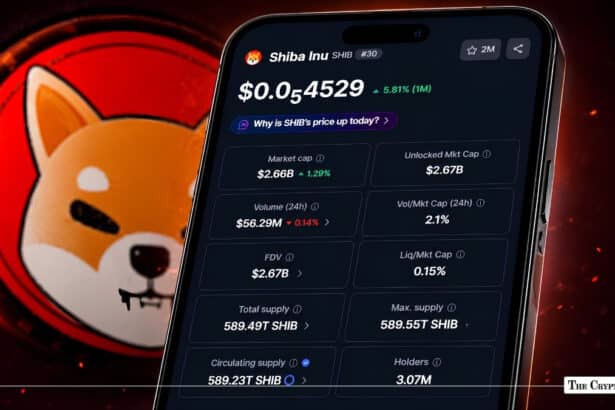
SHM, the native token of Shardeum, the Layer 1 blockchain co-founded by Shetty, paints a worse picture. It currently trades at $0.0000625, down 99.97% from its all-time high of $0.37, recorded in May 2025 around its Token Generation Event. Its market cap is approximately $635,000. Its all-time low of $0.0000555 was recorded yesterday, on March 25, 2026.

Shardeum ran a public token sale between March and May 2025, pricing SHM between $0.66 and $0.90 per token. If you bought at the lowest public sale price of $0.66, your investment is now worth 0.009% of what you paid. For every $10,000 invested at $0.66, you are left with $0.94 today.
In October 2025, Shardeum executed a 1:240 token redenomination, expanding the supply from 249 million to 60 billion. The community voted 85% in favor. The stated goal was to lower the per-token price and attract Indian retail users. What it did not change was the trajectory. SHM has only gone lower since the split.
The total circulating supply now stands at 10.16 billion SHM. The 24-hour volume hovers around $430,000, a number that sounds functional until you consider that a meaningful chunk of it is being generated through WazirX’s own promotional campaigns.
What WazirX has been doing instead
The timeline of WazirX’s post-hack recovery is, on paper, a textbook restructuring. In practice, it reads differently depending on what you choose to focus on.
The $234.9 million hack hit on July 18, 2024. Trading stopped. Withdrawals froze. The Singapore High Court sanctioned a restructuring scheme in October 2025. Trading restarted on October 24, 2025, with zero trading fees as a relaunch offer. Users were returned roughly 85% of their approved balances.
The remaining 15% was converted into Recovery Tokens (RTs), credited in January 2026. Those tokens are not tradable, not withdrawable, and their value is tied to WazirX generating at least $10 million in recoverable value per quarter before any buyback occurs.
Of the $234.9 million stolen, approximately $3 million has been frozen. That is a recovery rate of 1.27%.
No Recovery Token buyback has been publicly reported. The quarterly threshold for buyback eligibility has not been publicly confirmed as met. The DEX that was supposed to generate revenue for creditors has not launched.
And yet, in the same quarter that these obligations remain outstanding, here is what WazirX did launch:
In February 2026, it listed SHM on the exchange and ran a 52.9 million SHM trading contest called “Highest Trader Kaun,” with Shardeum-sponsored prizes. In March 2026, it rolled out INR-denominated perpetual futures contracts with up to 20x leverage. It announced a partnership with Sikka.fun, a mobile-first memecoin launchpad built on Shardeum. It offered 50,000 SHM to the first 1,000 users who verified on the Sikka.fun app. At current prices, that airdrop is worth $3.12 per person.
Each of these products routes users, attention, or liquidity toward ventures connected to Nischal Shetty. WazirX lists Shetty’s token. WazirX runs contests that incentivize volume on Shetty’s token. WazirX partners with a platform built on Shetty’s chain whose activity generates gas fees that flow back into Shetty’s ecosystem. And WazirX’s 16 million user base becomes the distribution funnel for all of it.
There has been no public disclosure about whether Shardeum is paying for these integrations, or whether revenue from SHM-related activity on WazirX is earmarked for the Recovery Token buyback pool.
The WazirX ZERO problem
There is another layer to this.
In late November 2025, just weeks after reopening, WazirX launched “WazirX ZERO,” a subscription model replacing per-trade fees with a flat ₹99 per month charge. On December 1, all users were given a 15-day free pass. When the free period expired, users across X began reporting that they had been auto-enrolled into the paid plan without their consent.
Users with idle wallets, some untouched since the hack, found charges deducted from their accounts. In cases where the INR balance was insufficient, WazirX’s system reportedly sold users’ lowest-value tokens to cover the subscription fee. Dormant accounts were billed. Users described the mechanism as a “dark pattern.”
WazirX pointed to prior blog posts and emails as evidence of communication. No refund policy was announced. No public statement confirmed whether ZERO subscription revenue would be used toward Recovery Token buybacks.
The backlash was immediate and loud. Users who had already lost access to their funds for over a year were now watching small amounts being drained to pay for a service they never signed up for. That is not a billing dispute. That is a trust collapse.
What $10,000 looks like today
If you invested $10,000 in WRX at its all-time high of $5.94, your holdings are worth $35.86 today.
If you invested $10,000 in SHM at its all-time high of $0.37, you would be left with $1.69.
If you bought SHM during the public sale at the floor price of $0.66, that same $10,000 is now $0.94.
These are not hypothetical numbers. These are the returns for anyone who believed in the products attached to Nischal Shetty’s name and held on.
What the charts are saying
The broader crypto market has not been kind in recent months. That is true. But 99% drawdowns are not market conditions. Bitcoin is down roughly 15% from its cycle high. Ethereum has corrected around 40%. WRX is down 99.64%. SHM is down 99.97%.
That gap is not explained by macro sentiment. It is explained by a combination of structural damage (the hack, the trust deficit, the frozen funds), poor token economics (unlimited SHM supply, massive circulating float post-redenomination), and a market that has priced in the possibility that neither project has a viable path to recovery.
WRX’s daily volume of $18,750 is a particularly damning signal. It suggests that the token has almost no active market makers, no significant retail interest, and no institutional presence. For an exchange token, volume is a proxy for platform health. This volume says the platform is on life support in the eyes of the trading market.
SHM’s volume of $430,000 looks better on the surface. But when a portion of it is being driven by exchange-sponsored contests and airdrops, the organic demand is likely far lower than the headline number suggests.
The uncomfortable question
There is a version of this story where everything WazirX and Shardeum are doing makes strategic sense. Where launching futures captures a growing Indian derivatives market. Where Sikka.fun brings developers to Shardeum. Where the subscription model stabilizes revenue. Where Recovery Tokens eventually get bought back. Where user trust is rebuilt over time.
That version exists. It is possible.
But there is also a version where an exchange that has not fully repaid its hack victims is using its user base to funnel activity into the founder’s other projects. Where memecoins are being promoted to the same people who are still waiting for their savings to be returned. Where 20x leverage is being offered by a platform that could not even protect its own wallets two years ago. Where a Layer 1 chain with a sub-million dollar market cap is being propped up by promotional campaigns on its sister exchange.
Both versions use the same facts. The difference is which facts you look at first.
And the charts, for what it is worth, are not looking at the press releases. They are looking at the second version. Every single day. For the last twelve months.
As Shetty himself said in a December 2025 podcast, he does not believe in regret. He believes in learning and moving forward.
The question is: forward for whom?
Because the charts are not moving forward. The Recovery Tokens are not moving forward. And the holders of WRX and SHM are certainly not moving forward.
They are just watching the numbers go lower.
Also Read: From Arrest to Bail in 72 Hours: What Really Happened With CoinDCX’s Founders