Key Highlights
- CoinDCX co-founders were dramatically arrested over a ₹71.6 lakh fraud case that later unraveled as an alleged impersonation scam.
- In a stunning twist, the complainant withdrew his claims and admitted he had no grievance against the founders.
- A Thane court granted bail, stating no prima facie case existed, raising questions about how the real culprits remain free.
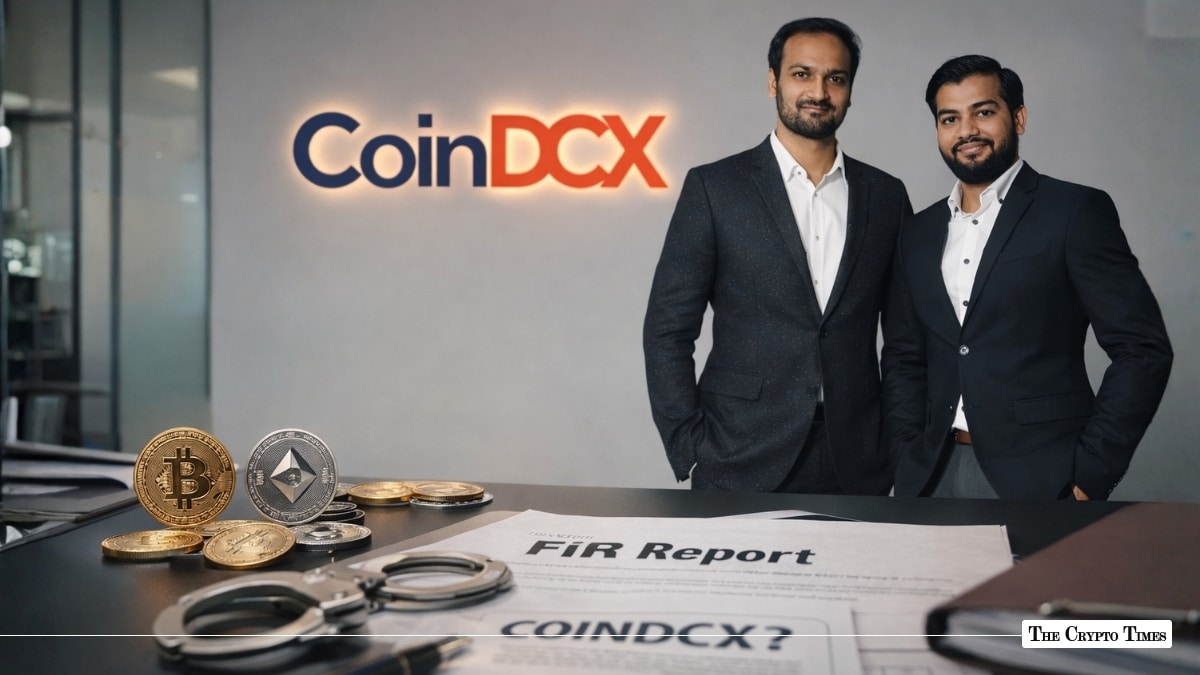
Last Friday night, something happened that nobody in Indian crypto saw coming. Thane Police walked into CoinDCX’s office in Bengaluru and arrested both co-founders of the company. Sumit Gupta and Neeraj Khandelwal, the two men who built India’s first crypto unicorn from a small apartment in Mumbai, were taken into police custody over a fraud complaint worth Rs 71.6 lakh.
The Indian crypto community went into shock. Social media exploded. Headlines screamed fraud. And for a few days, the founders of a $2.45 billion company sat in a police lockup in Thane.
But as the days passed, the story started to look very different from what the initial headlines suggested. A complainant changed his stance. A court said there was no case. And both founders walked free.
Here is everything that happened, step by step, based on court filings, police records, company statements, and verified reporting.
First, a quick background
For those who are new to this, CoinDCX is India’s largest cryptocurrency exchange. It was started in 2018 by Sumit Gupta and Neeraj Khandelwal, both IIT Bombay graduates. They started out with a team of five people, working out of a flat in Mumbai, with a simple goal: make it easy for Indians to buy and trade crypto.
Over the years, CoinDCX raised around $247 million from investors like Coinbase Ventures, Pantera Capital, B Capital (backed by Facebook Co-Founder Eduardo Saverin), and Polychain Capital.
By 2021, it became India’s first crypto unicorn after hitting a valuation of $1.1 billion. In October 2025, Coinbase had invested again, pushing the valuation to $2.45 billion.
The platform today has over 20 million registered users, more than 500 listed crypto assets, and quarterly trading volumes north of Rs 2.4 lakh crore. It is, by every metric, a big deal in the Indian crypto ecosystem.
Back-to-back brutal years for CoinDCX
Before we get into the arrest, let’s understand the context. CoinDCX was already having a very rough 2025.
In July 2025, hackers stole $44.2 million from an internal wallet that CoinDCX used for liquidity operations. The attack was traced back to a fake job offer. Hackers, posing as recruiters, tricked a CoinDCX software engineer named Rahul Agarwal into installing malware on his company laptop. His compromised login credentials gave the attackers access to the exchange’s backend systems.
Agarwal was later arrested by the Bengaluru police, and CoinDCX said customer funds were safe and covered the entire $44.2 million loss from its own treasury.
Following this, came the leadership exodus. Between June and September 2025, four senior executives left the company: CTO Vivek Gupta, Head of Legal Tushar Tarun, CHRO Mudita Chauhan, and CISO Sridhar G. That is your tech chief, your top lawyer, your HR head, and your security head, all gone in about four months.
Then in November 2025, the Enforcement Directorate’s (ED) Hyderabad office seized Rs 8.46 crore from 92 bank accounts, including some linked to CoinDCX, as part of a probe into a Rs 285 crore cyber fraud racket.
The ED found that Rs 4.81 crore had been converted to USDT through CoinDCX user accounts that allegedly lacked proper KYC checks. CoinDCX said it was cooperating with the investigation.
And separately, the company was part of a group of 17 crypto platforms being investigated by GST authorities for alleged tax evasion totalling Rs 824 crore. CoinDCX’s share was Rs 16.84 crore.
So when March 2026 rolled around, the company was already battle-scarred. And then, the founders got arrested.
The complaint that started it all
The latest case officially starts on March 16, 2026, when a 42-year-old insurance advisor named Ashish Brijkishore Singh walked into the Mumbra police station in Thane, Maharashtra, and filed a complaint. He claimed he had been cheated out of Rs 71,60,015 (that is about $85,000) over a period of roughly seven months.
Based on his complaint, the police registered a First Information Report (FIR) naming six people: CoinDCX co-founders Sumit Gupta and Neeraj Khandelwal, along with four others named Akash Rana, Rahul Gupta, P. Vasudev, and Shivam Sharma.
What the complainant said happened
According to the FIR, the scam played out like this:
In July 2025, a man named Akash Rana approached Singh at a cafe in Mumbra. Rana introduced himself as a franchise partner of Neblio Technologies Private Limited, the company that operates CoinDCX. He told Singh that he could buy the entire franchise of a website called coindcx.pro for the state of Maharashtra, for Rs 28 lakh.
Rana then allegedly introduced Singh to people he said were the CoinDCX co-founders and the company’s COO, Mridul Gupta, telling him they handled all transactions for Neblio Technologies.
To build trust, Singh was told that CoinDCX is India’s first crypto unicorn and that it was registered with Securities and Exchange Board of India (SEBI) and Reserve Bank of India (RBI). Registration with SEBI and RBI means the financial entity is officially approved by India’s top regulators and legally allowed to operate while following strict regulatory standards and rules. Therefore this claim convinced Singh that the opportunity was legitimate.
Later, in August 2025, someone claiming to be Neeraj Khandelwal allegedly called Singh from Akash Rana’s phone and asked him to go to a Thane branch of Equitas Small Finance Bank. There, Singh was told to deposit Rs 2 lakh to register his company ID, plus Rs 10,000 to generate the ID itself.
Singh claims he later handed over Rs 20 lakh in cash to Rana, Gupta, and Khandelwal on August 16, 2025, as payment for the franchise. He was also promised monthly returns of 10 to 12% on any investment he made through CoinDCX.
Excited by the prospect of big returns, Singh also convinced his friends to invest a combined Rs 45 lakh through the same scheme. But none of that money came back. The promised franchise never materialized. The returns never showed up. The people involved allegedly became unreachable.
On February 20, 2026, Singh says he met the founders one more time to raise his concerns but was given assurances that, again, went nowhere. He eventually went to the police.
The arrest: Friday night in Bengaluru
Cut to Friday, March 21, Thane Police officers flew to Bengaluru and went to CoinDCX’s office. They detained Sumit Gupta and Neeraj Khandelwal.
Entrackr, which appears to have broken the story first in English, reported that both founders were initially questioned at Bellandur Police Station in Bengaluru as part of a Thane Police-led investigation. The next day, The Economic Times reported the situation had escalated to a formal arrest. Both founders were produced before a weekend magistrate’s court and remanded to police custody until Monday, March 23.
The charges were filed under Sections 3(5), 316(2), 316(5), and 318(4) of the Bharatiya Nyaya Sanhita (BNS), which deal with cheating, fraud, criminal breach of trust, and criminal conspiracy.
The news hit the Indian crypto community like a bomb. These were not some unknown operators. These were the founders of a $2.45 billion company, with Coinbase as a backer, sitting in a police lockup over an Rs 71 lakh fraud complaint.
“This is a conspiracy”
CoinDCX was quick to hit back with a strong response. On the same day as the arrest, the company posted on X, calling the FIR “false and filed as a conspiracy against CoinDCX by impersonators posing as Founders of CoinDCX.”
The company’s defence rested on a few key points.
- First, the fraud happened through a fake website called coindcx.pro, which has absolutely no connection to CoinDCX. The real CoinDCX website is coindcx.com.
- Second, CoinDCX does not run any kind of franchise programme. That is simply not a product they offer.
- Third, CoinDCX does not accept cash transfers to third-party bank accounts, which is how the complainant says his money was collected.
- Fourth, the complainant never once contacted CoinDCX directly before going to the police.
To highlight the scale of the impersonation problem, CoinDCX revealed a striking number: between April 1, 2024, and January 5, 2026, the company had reported over 1,212 fake websites impersonating coindcx.com to cyber authorities.
A source close to the situation told Moneycontrol that the co-founders were “taken aback by the sudden complaint” and had no prior knowledge of it.
Moreover, CoinDCX also pointed to a 2024 Delhi High Court order that it had already obtained, restraining unknown persons from misusing its brand name and logo. The court had noted that any unauthorized use could cause “irreparable loss and injury” to CoinDCX.
The company further added that all its operations were running normally and that trading, deposits, withdrawals, and all user services were fully operational throughout the ordeal.
The big twist: The complainant changes his story
Here is where the whole case took a sharp turn.
On Monday, March 24 (one day before the bail hearing), the complainant, Ashish Singh, filed an affidavit in the Thane District Court. In this affidavit, he said he had recovered his money from one of the other six people named in the FIR.
He then went a step further and told the court that he has no grievances against the CoinDCX co-founders. He also admitted that he did not personally know Gupta or Khandelwal.
This was a dramatic shift. The same person who had filed the complaint that led to the arrest of two unicorn founders was now essentially saying he had no issue with them.
Following this affidavit, the founders’ lawyers filed a fresh bail application. The police remand had already ended, and both founders had been moved to judicial custody on Monday while the court reserved its order for the next day.
The court rules: “No case made out”
On Tuesday, March 25, Magistrate Nilesh Rathod of the Thane court delivered the order. He granted bail to both Sumit Gupta and Neeraj Khandelwal.
The magistrate directed the founders to furnish a surety of Rs 50,000 each and cooperate with the ongoing investigation. But the key line in the order was this: the court said prima facie, no case was made out against the two founders.
The magistrate referred to Article 21 of the Indian Constitution, which deals with the protection of life and personal liberty, and said that bail is the rule and jail is the exception, as per a local report.
The defence lawyers, Abhijeet Sawant, Pranav Badheka, and Rajan Salunke, had argued that the founders were victims of “mistaken identity” and fraudulent impersonation. They told the court that Gupta and Khandelwal were not present at the locations where the alleged meetings took place and that their identities had been misused by scammers.
In a separate but related development, a Bengaluru sessions court on March 24 also granted interim transit anticipatory bail to the CoinDCX founders and four others in connection with FIRs registered at both Nalasopara and Mumbra police stations. This was essentially to protect them from arrest while they approached the jurisdictional courts in Maharashtra for further relief.
After being released, CoinDCX issued a statement saying the startup and its leadership had “no involvement in the incident and were themselves victims of a fraud perpetrated through impersonation.”
What happens next
The founders are out on bail, but the story is not over. There are still four accused who remain absconding: Akash Rana, Rahul Gupta, P. Vasudev, and Shivam Sharma. The police investigation continues. Sources suggest more individuals could come under the scanner as the probe widens.
But the real question now is whether the police will be able to track down the actual fraudsters who impersonated the CoinDCX brand and its founders to swindle money from people.
The fact that CoinDCX has reported more than 1,200 fake websites in less than two years tells you just how massive this impersonation problem is in Indian crypto.
Why this matters beyond CoinDCX
This case is not just about one company or two founders. It points to something much bigger that is broken in how India handles crypto-related complaints.
Think about what happened here. Scammers built a fake website that looked like it was connected to a real, legitimate company. They impersonated the founders. They used the company’s reputation, its unicorn status, its association with SEBI and RBI (which was itself a false claim made by the scammers), to convince a regular person to hand over his life savings. And when the victim went to the police, it was the real founders who got arrested, not the scammers.
The scammers are still missing. The court found no case against the founders. And the complainant himself eventually said he had no issue with them. But before any of that was established, two people spent multiple days in a police lockup, the company’s stock of trust took another hit, and the entire Indian crypto ecosystem got another black eye in the media.
India still does not have a dedicated crypto regulatory framework. There is no licensing law. Everything operates under general criminal codes and the Prevention of Money Laundering Act. That means when something goes wrong, even when the actual victim is the company whose brand was stolen, the tools available to law enforcement are blunt and the outcomes can be messy.
For regular people who invest in crypto, the lesson is straightforward but important: always check the website URL. If it is not the exact official domain, walk away. No legitimate crypto exchange in India offers franchises. No legitimate exchange promises 10 to 12% monthly returns. And no legitimate exchange asks for cash payments to random bank accounts.
A timeline of CoinDCX’s toughest year
- June 2025: Chief Technology Officer (CTO) Vivek Gupta and Head of Legal Tushar Tarun resign.
- July 19, 2025: $44.2 million stolen from internal wallet in a sophisticated hack.
- July 31, 2025: Software engineer Rahul Agarwal arrested for facilitating the hack.
- September 2025: Chief Human Resources Officer (CHRO) and Chief Information Security Officer (CISO) also resign.
- October 2025: Coinbase invests fresh capital, values CoinDCX at $2.45 billion.
- November 2025: Enforcement Directorate (ED) seizes ₹8.46 crore from CoinDCX-linked accounts in a cyber fraud probe.
- December 2025: Competition Commission of India (CCI) approves Coinbase’s minority stake in CoinDCX parent DCX Global.
- March 16, 2026: FIR filed at Mumbra police station against co-founders and four others.
- March 21, 2026: Co-founders arrested from Bengaluru. CoinDCX calls FIR false, blames impersonators.
- March 24, 2026: Complainant files affidavit saying he recovered his money and has no grievance against founders. Bengaluru court also grants transit anticipatory bail.
- March 25, 2026: Thane court grants bail. The magistrate says no prima facie case was made out.
The bottom line
Sumit Gupta and Neeraj Khandelwal are back at work. The court found no case against them. The complainant withdrew his allegations. But the real fraudsters, the people who built coindcx.pro, who pretended to be the founders, who collected lakhs in cash from an insurance advisor and his friends, are still out there somewhere.
CoinDCX has survived a $44 million hack, a leadership meltdown, an ED probe, a GST investigation, and now the arrest of both its founders in the span of a single year. Whether investors, users, and regulators continue to give it the benefit of the doubt will depend on what happens next.
For now, the case is a reminder that in India’s fast-growing crypto market, the line between a legitimate exchange and a scammer pretending to be one is often just a different URL. And that gap can cost regular people everything they have.