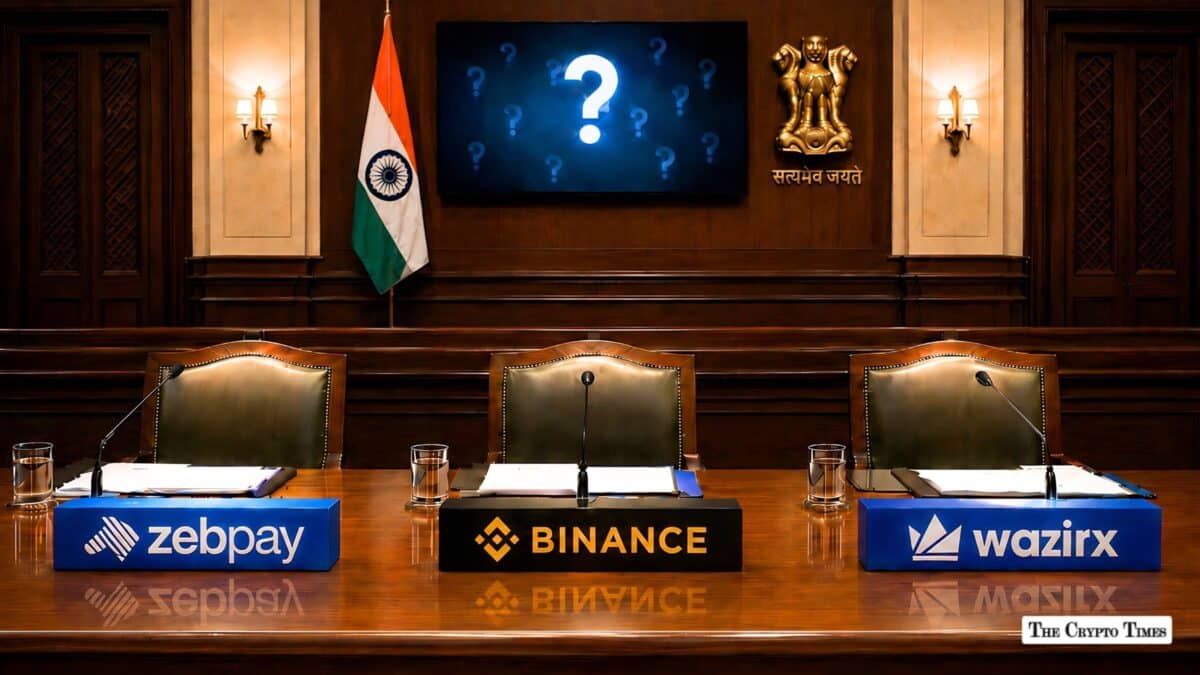
On May 13, 2026, The Crypto Times reported that the Parliamentary Standing Committee on Finance, chaired by BJP MP Bhartruhari Mahtab, has scheduled three separate sessions on May 20, 2026, as part of its ongoing study titled “A Study on Virtual Digital Assets (VDAs) and Way Forward.”
The first session (11:00 AM to 12:30 PM) will feature representatives of ZebPay, Binance, and WazirX. The second session (12:30 PM to 1:30 PM) will hear from the International Financial Services Centre Authority (IFSCA). The third session (2:00 PM onwards) will involve the Ministry of Finance (Department of Revenue) and the Ministry of Corporate Affairs.
The announcement has raised questions in crypto communities and policy circles: why these three exchanges, specifically, out of the 49 crypto exchanges registered with the Financial Intelligence Unit-India (FIU-IND) as of January 2026? No official explanation has been provided with the notice issued by Director Bharti Sanjeev Tuteja.
What follows is a compilation of publicly available information from official enforcement statements, parliamentary records, and reports by credible Indian sources. Readers may evaluate the connections independently.
The E-nugget thread: Where all three names appeared together in an enforcement action
The most direct publicly available link connecting ZebPay, Binance, and WazirX in Indian law enforcement is the E-Nugget online gaming app case.
According to a report published by Business Standard on April 30, 2024, the Enforcement Directorate (ED), Kolkata unit, seized funds worth approximately ₹90 crore from cryptocurrency wallets maintained across 70 accounts held with Binance, ZebPay, and WazirX. The funds were linked to the “E-Nugget” app, which the ED described as promising high returns before vanishing.
The investigation was registered under the Prevention of Money Laundering Act (PMLA) based on an FIR from Park Street Police Station, Kolkata, and had been ongoing since 2022.
As per the ED’s public statements cited in these reports, the total value of assets seized, attached, or frozen in the case stood at Rs 163 crore. This remains one of the largest documented instances of direct interaction between Indian authorities and these three platforms in a single probe. The Crypto Times also covered the development on May 2, 2024.
WazirX: The major hack and offshore restructuring
WazirX, once India’s largest domestic crypto exchange, faced its biggest crisis with a major security breach.
According to a report published by The Times of India on July 19, 2024, approximately $230 million (around Rs 2,000 crore) worth of digital assets were stolen from a multi-signature wallet on July 18, 2024. The platform immediately suspended trading and withdrawals. WazirX’s parent company, incorporated in Singapore, pursued restructuring through the Singapore High Court.
This offshore process, despite WazirX serving a primarily Indian user base, has raised questions in policy circles about jurisdictional accountability and consumer protection—issues a parliamentary committee examining VDA policy might explore. WazirX has attributed the breach to a third-party custody arrangement and stated it has since strengthened measures.
Binance: FIU Compliance, Enforcement Cooperation, and Pakistan Engagements
Binance, the world’s largest crypto exchange, has a regulatory history in India centred on compliance with anti-money laundering rules.
In December 2023, FIU-IND issued show-cause notices to offshore exchanges, including Binance, for operating without PMLA registration. Access was blocked in January 2024.
According to a report published by The Economic Times on August 15, 2024, Binance registered with FIU-IND in August 2024 after paying a penalty of Rs 18.82 crore and resumed operations. It later mandated fresh KYC re-verification for Indian users.
The exchange has cooperated with Indian authorities in cases such as E-Nugget, where it provided wallet details leading to seizures.
On the Pakistan front, according to a report published on April 8, 2025, Pakistan appointed Binance founder Changpeng Zhao (CZ) as a strategic adviser to the Pakistan Crypto Council (PCC).
Further, according to reports published by The Times of India on December 12, 2025, Binance CEO Richard Teng signed a non-binding MoU with Pakistan’s Finance Minister Muhammad Aurangzeb to explore tokenisation of up to $2 billion in sovereign and real-world assets.
Teng led a senior Binance delegation that held high-level meetings with Pakistan’s Prime Minister Shehbaz Sharif, Chief of Army Staff Field Marshal Asim Munir, and other officials. These engagements included discussions on regulation, blockchain infrastructure, and capacity building.
ZebPay: One of India’s oldest exchanges, enforcement links, and cybercrime flagging
ZebPay, founded in 2014 and headquartered in Ahmedabad, is among India’s oldest crypto exchanges with over six million users. It is registered with FIU-IND and has consistently positioned itself as a compliance-focused platform emphasising stringent KYC, AML, and cybersecurity protocols.
Its most prominent documented connection to enforcement remains the E-Nugget case. According to ED statements reported on April 30, 2024, significant funds linked to the alleged scam were held in ZebPay wallets, leading to seizures alongside Binance and WazirX.
This high-profile probe, involving dummy bank accounts and proceeds of crime, placed ZebPay directly in the spotlight of a major money laundering investigation.
Additionally, ZebPay has featured in broader government scrutiny of cyber fraud. The Indian Express reports, citing data from the Ministry of Home Affairs’ (MHA) Indian Cyber Crime Coordination Centre (I4C), has flagged it among multiple exchanges used as conduits in large-scale laundering of scam proceeds.
While ZebPay has strongly denied any wrongdoing and reiterated its robust monitoring systems to detect suspicious activity, its repeated appearance in enforcement-related data alongside other major platforms has drawn regulatory attention—particularly as authorities intensify focus on how VDAs are exploited in cybercrimes.
These intersections with high-value ED actions and cybercrime reporting could make ZebPay a key voice on practical compliance challenges and platform-level risk mitigation in the parliamentary discussion.
The broader context: What the committee has already heard
The May 20 sessions follow earlier committee work. According to a report published on August 16, 2025, the Standing Committee on Finance selected “A Study on Virtual Digital Assets (VDAs) and Way Forward” for detailed examination during 2024-25.
On January 7, 2026, the panel heard from FIU-IND and the Central Board of Direct Taxes (CBDT), where officials shared data on VDA-related tax notices and the 49 registered exchanges, as reported by The Crypto Times on January 7, 2026.
The Lok Sabha Secretariat records, FIU-IND compliance data, CBDT figures, and the ED’s E-Nugget action are all matters of public record. These data points show ZebPay, Binance, and WazirX appearing consistently across key enforcement touchpoints.
What May 20 could address
The separate-session structure on May 20 allows the committee to first hear directly from the exchanges on operational realities and compliance, then from IFSCA (which in 2025 excluded crypto assets from permissible financial products in GIFT City), and finally from the ministries on the broader policy framework.
- For WazirX, the committee may seek updates on the 2024 hack recovery and post-restructuring consumer protections.
- For Binance, questions could focus on its cooperation with Indian law enforcement, ongoing compliance practices, and its engagements with neighbouring countries.
- For ZebPay, the discussion may centre on its long operating history, direct experience with ED probes like E-Nugget, its role amid cybercrime flagging, and practical suggestions for strengthening India’s VDA framework while maintaining user trust.
A note to readers
This article does not claim to know the committee’s internal reasons for selecting these three exchanges. The committee’s deliberations are not public. The connections presented here are based solely on publicly available information from official enforcement agency statements, parliamentary records, and reports by ANI, Business Standard, The Economic Times, The Times of India, and The Crypto Times.
They represent one possible reading of the dots in the public domain and should not be construed as allegations or endorsements. Readers are encouraged to review the original sources and draw their own conclusions.
Also Read: CoinSwitch CEO Says Unlocking India’s Gold is Bigger than Just Crypto