The Securities Appellate Tribunal (SAT), an Indian statutory and quasi-judicial body, has delivered a sharp setback to Jetking Infotrain Ltd, India’s first listed company to embrace Bitcoin as a core treasury asset.
In an order issued on May 8, the tribunal upheld the Bombay Stock Exchange’s (BSE) refusal to list shares from a 2025 preferential allotment, ruling that the firm had used the fresh capital to buy virtual digital assets before properly updating its corporate charter. While no fine was imposed, the shares remain trapped in legal limbo.
The case revolves around a modest but symbolically charged fundraise. In April 2025, Jetking’s board approved issuing around 396,000 equity shares at ₹154 each to raise roughly ₹6.1 crore.
The company’s explicit plan was to channel most of the money into Bitcoin and related blockchain initiatives. BSE granted in-principle approval on May 9. Proceeds hit the company’s account by late May, and within days the funds—along with existing cash—were wired to CoinDCX for BTC purchases. By then, the firm already held a small stash and had publicly declared Bitcoin its primary treasury reserve.
Yet the company’s Memorandum of Association told a different story. An earlier amendment in late 2024 had allowed surplus funds to be parked in virtual digital assets as an ancillary activity. The crucial second change—elevating VDA investment, blockchain, and DeFi to main objects of the business—received Registrar of Companies approval only on July 7, 2025.
BSE later concluded that the fundraising and immediate deployment into Bitcoin were ultra vires, or beyond the company’s legal powers at the time. On September 23, 2025, the exchange returned the listing application on which Jetking appealed.
Timeline of the Preferential Allotment Dispute
The dispute highlights a classic tension between corporate ambition and regulatory caution. Jetking argued that the first MoA tweak provided enough cover and that the second amendment was merely clarificatory.
Senior advocate Ravi Kadam, appearing for the company before a bench headed by Justice P.S. Dinesh Kumar, contended that technical delays should not invalidate an otherwise compliant capital raise.
SAT disagreed. In a detailed order, the tribunal drew a clear line between “ancillary” investments using idle cash and a deliberate capital raise to fund a new line of business. “The preferential issue proceeds were utilised for investment in VDAs prior to the amendment of the main objects clause,” the bench noted. All actions taken before July 2025 fell outside the MoA as it then stood. The tribunal found no fault with BSE’s decision and dismissed the appeal outright.
Jetking disclosed the ruling to the exchange the next day, as required. In its filing, the company said it was “evaluating the financial and legal implications” and considering further remedies, including a possible appeal to the Supreme Court.
Market and Strategic Fallout for Jetking
The immediate impact is contained but telling. The unlisted shares represent new equity that cannot trade, effectively leaving existing shareholders diluted without the liquidity they expected.
Jetking’s core IT training business continues unchanged—it reported modest quarterly revenue of ₹4.67 crore for the period ended March 2026, though operating losses widened. Its Bitcoin holdings, acquired earlier and now valued at roughly ₹1.7 million for 21 BTC, remain on the balance sheet.
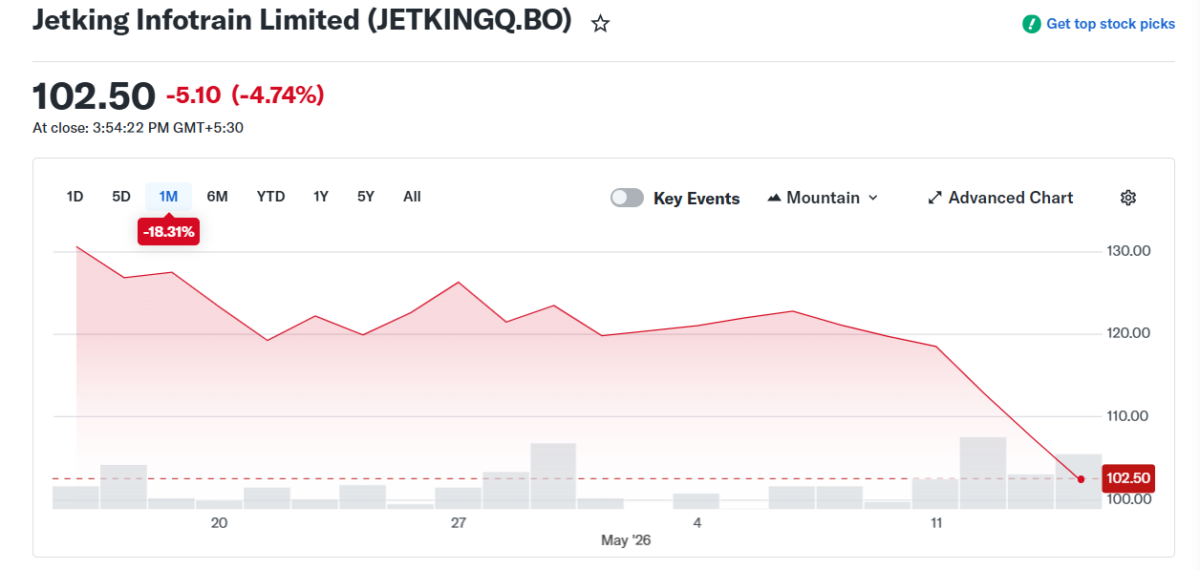
The stock, long a microcap darling on the back of its Bitcoin bet, has shown fresh volatility since the order. Shares have traded in a narrow range amid thin volumes, reflecting the uncertainty hanging over future capital raises.
The stock closed at around ₹121.15 on May 7. It then posted steady declines over the following sessions, closing at ₹119.75 (May 8), ₹118.55 (May 11), ₹112.90 (May 12), ₹107.60 (May 13), and further dropping to ₹102.25 on May 14—a daily fall of nearly 5%. Overall, the stock lost approximately 15.6% during this period amid thin trading volumes.
For a 77-year-old Mumbai firm that once trained generations of hardware engineers, the pivot to Bitcoin was never about quick flips. Joint MD Siddarth Bharwani has repeatedly described it as a long-term hedge against rupee depreciation and inflation, with ambitions to scale holdings dramatically.
The SAT verdict does not strip away existing Bitcoin, but it complicates the playbook. Any fresh fundraising aimed at crypto will now face even stricter scrutiny on timing, disclosures, and MoA hygiene.
The ruling arrives at a delicate moment for India’s corporate crypto experiment. While regulators have tolerated retail trading platforms, listed companies dipping treasury funds into volatile digital assets still trigger alarm bells over speculation and investor protection.
Jetking’s experience may become a cautionary tale—or, depending on its next move, a test case for how far Indian boards can push the envelope.
Also read: Why India’s Parliament Panel Called Binance, WazirX & ZebPay for the May 20 Meet