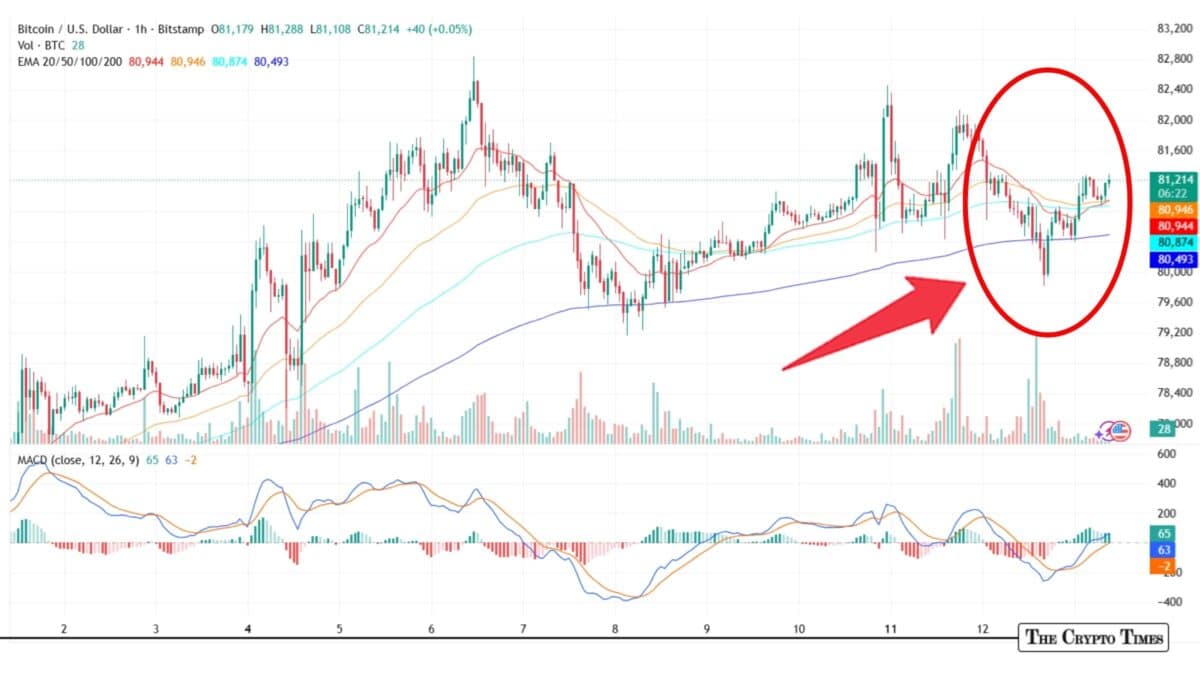
Bitcoin traded in a tight range over the past 24 hours, closing the session little changed around the $80,800–$81,000 level as investors digested fresh U.S. inflation figures and pulled money from the spot Bitcoin exchange-traded funds.
The cryptocurrency opened Wednesday near $80,900 after a quiet Tuesday that saw it dip about 0.5% from the prior day’s levels. Its daily trading volume stayed subdued, with no sharp breakout above the $82,000 resistance that has capped gains in recent sessions.
The lack of conviction reflected broader caution across risk assets following the release of April’s consumer price index data.
At the time of publishing, BTC was trading around $81,000—up decently 0.6% in the past 24 hours with its daily trading volume sitting at $30.65 billion.
ETF Outflows Signal Renewed Institutional Caution
On May 12, 2026, U.S. spot Bitcoin ETFs recorded net outflows of $233.25 million, one of the larger single-day withdrawals in recent weeks. The figure marked a reversal from the strong inflows that had supported the sector through March and April, when the funds pulled in nearly $2 billion and $2.44 billion respectively in those months.
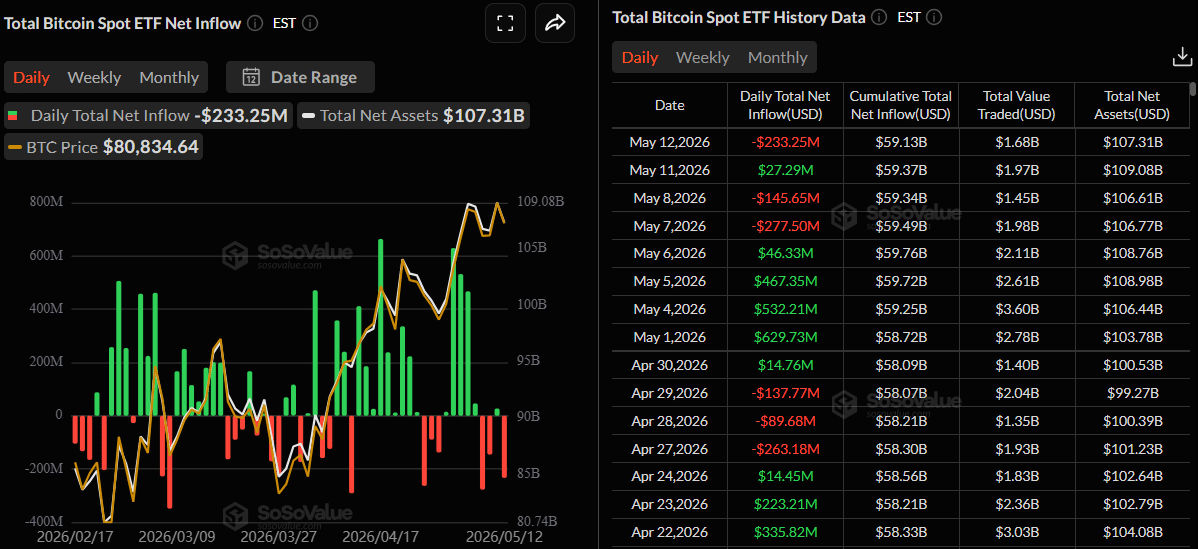
According to SoSoValue data, total assets under management across all U.S. spot Bitcoin ETFs remained robust at approximately $107.31 billion. The funds holds more than 1.33 million BTC—roughly 6.35% of Bitcoin’s total supply—and has accumulated over $59 billion in net inflows since the products launched in early 2024.
BlackRock’s iShares Bitcoin Trust (IBIT) continues to dominate with the lion’s share of AUM, followed by Fidelity’s FBTC and Grayscale’s GBTC, underscoring the resilience of institutional infrastructure even amid periodic redemptions.
Following Bitcoin, Ethereum ETFs faced similar pressure, shedding roughly $130 million on the same day, while smaller altcoin products like those tracking Solana and XRP actually saw modest inflows as some capital appeared to rotate. This pullback in demand comes after a tentative recovery earlier in 2026.
Following heavy outflows totaling billions in the wake of Bitcoin’s slide from its late-2025 peak above $126,000 toward $60,000 lows in February, institutional interest had begun returning.
Analysts point to profit-taking near the $81,000 level and a broader rotation out of Bitcoin amid macro uncertainty. Cumulative inflows for Bitcoin ETFs remain strongly positive since launch—well over $50 billion—but daily swings like Tuesday’s highlight how sensitive these vehicles remain to headline economic data.
Grayscale’s GBTC, with its higher fees, has continued to see structural outflows, a trend that has persisted for months.
The timing of the exodus aligned squarely with the Bureau of Labor Statistics’ release of the April CPI report. While the monthly increase of 0.6% met forecasts, the year-over-year headline rate accelerated to 3.8%—the highest since May 2023 and slightly hotter than the 3.7% consensus.
Core CPI, which strips out volatile food and energy, rose 0.4% for the month and 2.8% annually, both above expectations. The data reinforced the view that inflation remains sticky, dashing hopes for imminent Federal Reserve rate cuts and weighing on risk assets that thrive on cheap liquidity.
Macro Headwinds and Technical Outlook
Markets had priced in a more dovish path for monetary policy after earlier signs of cooling. Instead, the hotter print suggests borrowing costs could stay elevated longer, a dynamic that historically pressures Bitcoin, often viewed as a leveraged bet on liquidity and growth expectations.
The U.S. dollar strengthened modestly on the news, while equities opened mixed, underscoring the cross-asset caution.
Currently, broader 2026 trends continue to shape the narrative. After an explosive rally into late 2025 that pushed Bitcoin surged to an all-time high of $126,198, the asset has consolidated through much of this year. It recovered from February’s sub-$60,000 lows but has struggled to sustain momentum above $82,000–$85,000.
However, Bitcoin’s year-to-date performance has been choppy, with several failed breakout attempts. Traders are now watching key technical levels closely. Immediate support sits in the $78,000–$80,000 zone.
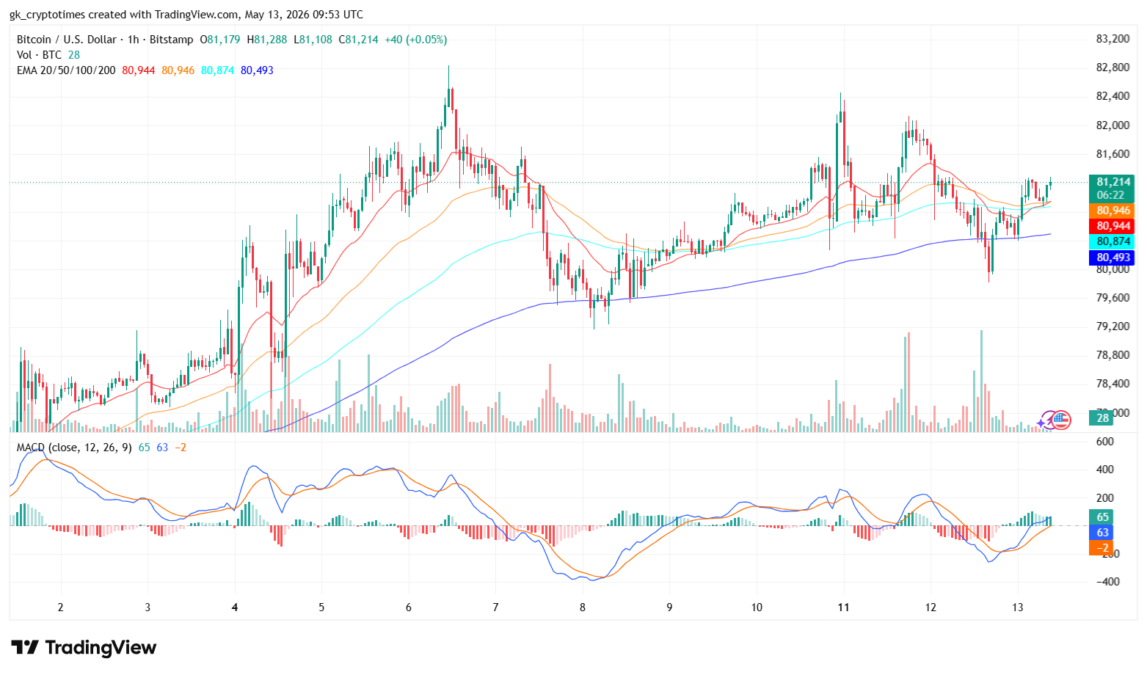
A decisive break lower could accelerate selling toward the 200-day moving average or even retest spring lows. On the upside, clearing $82,000 with conviction would require fresh catalysts—perhaps signs that the April inflation spike was transitory, or positive regulatory developments around digital assets.
Currently, Federal Reserve policy remains front and center. With Chair Jerome Powell’s term winding down, markets are speculating on potential successors and how any leadership change might influence the balance between fighting inflation and supporting growth.
The Fed’s balance sheet and pace of any future quantitative easing adjustments will also matter. In past cycles, periods of policy uncertainty have often led to Bitcoin volatility before clearer trends emerge.
On the onchain side, major metrics show mixed signals. Long-term holders have largely remained steadfast, with accumulation patterns visible during dips. However, exchange inflows ticked up slightly after the CPI release, hinting at some short-term selling pressure.
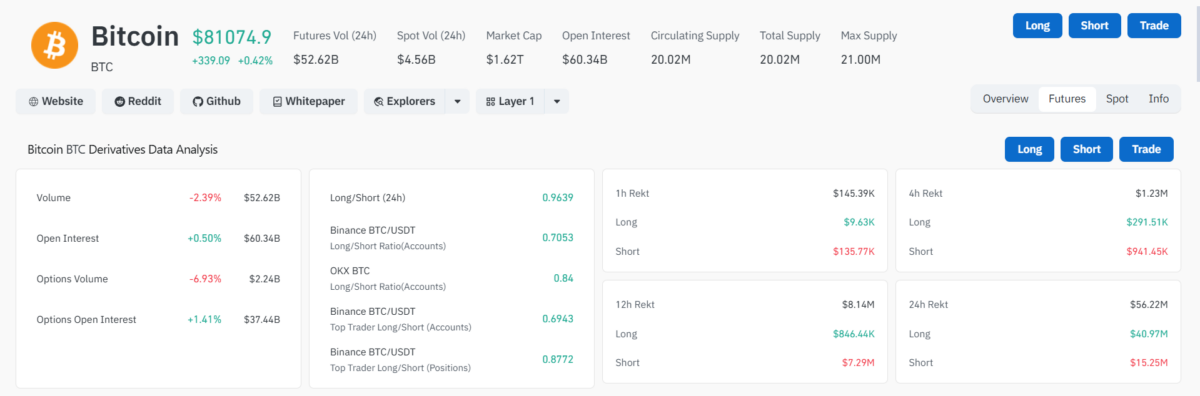
Derivatives markets reflected subdued conviction, with funding rates near neutral and open interest not showing aggressive positioning in either direction.
Looking ahead, the coming days will bring more data points, including producer prices and retail sales, that could further shape expectations for Fed policy. Geopolitical risks around energy supplies add another layer of uncertainty that could keep volatility elevated.
For Bitcoin, the path forward appears tethered to how quickly inflation moderates and whether institutional flows return once the dust settles on this week’s macro readings.
Also read: Bhutan Could Run Out of Bitcoin by September After Latest 100 BTC Transfer