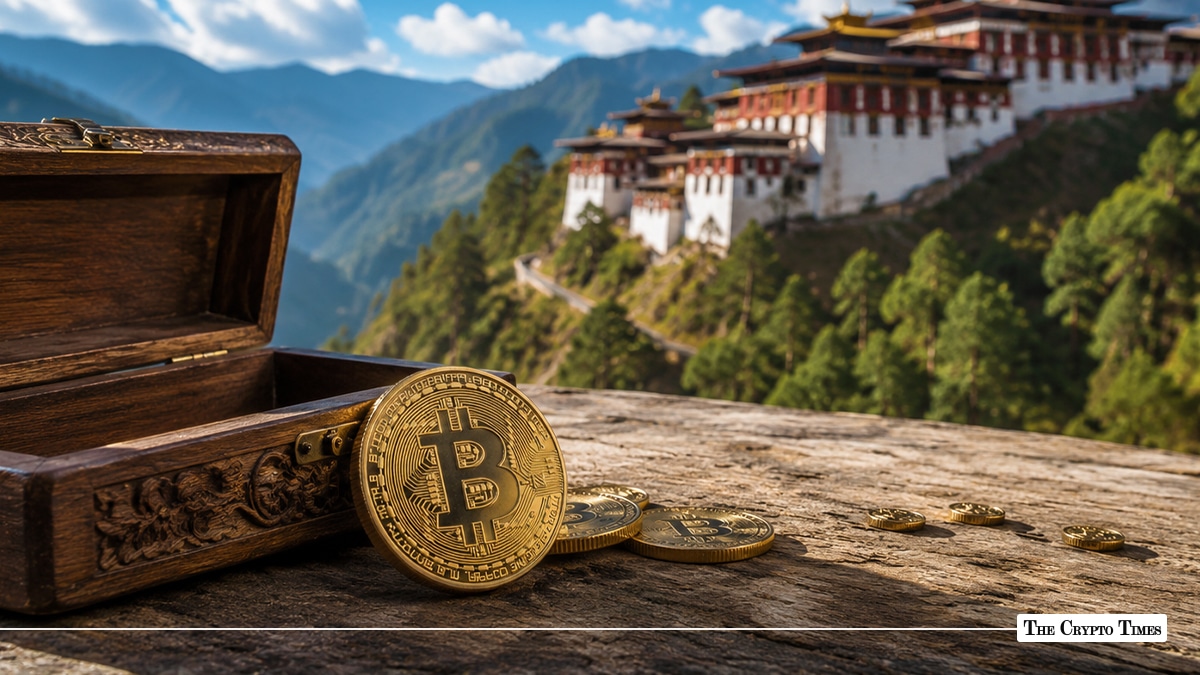
The Royal Government of Bhutan moved approximately 100.44 BTC, worth around $8.2 million, to an unlabeled wallet address on Tuesday morning. The transfer was executed in three separate transactions at 5:27 a.m. UTC, according to on-chain analytics platform Arkham Intelligence, which has been tracking the Himalayan kingdom’s bitcoin reserves since 2024.
The funds were sent to an address beginning with “bc1qn,” a native SegWit format that represents a more modern wallet standard compared to the older Pay-to-Script-Hash addresses (starting with “3”) from which the coins were moved.
While this could point to an internal consolidation of funds rather than an outright sale, previous transfers from Bhutan’s wallets have been tracked to crypto exchange Binance and institutional investment manager Galaxy Digital, suggesting a pattern of phased liquidation.
The latest move pushes Bhutan’s total bitcoin outflows for 2026 past the $230 million mark. At the current pace of roughly $50 million per month, the government is on track to significantly reduce its remaining position well before the end of the year.
Some analysts, including researchers at Watcher Guru, have projected that Bhutan could fully exit its bitcoin position by October 2026 if outflows continue at this rate.
Holdings have fallen 76% from peak
Arkham data shows that Bhutan now holds approximately 3,119 BTC, currently valued at around $252.1 million. That is a steep decline from the roughly 13,000 BTC the country held at its peak in October 2024, when the value of the reserves exceeded $1.4 billion and represented more than 40% of Bhutan’s gross domestic product.
The drawdown has accelerated sharply in 2026. In January and February, transfers were relatively small, in the range of $5 million to $15 million per clip. By March, the pace picked up considerably.
On-chain records show a 973 BTC transfer worth $72.3 million over just two days in mid-March, followed by a 519.7 BTC move worth $36.75 million on March 25 and a 374.9 BTC transfer worth $25.2 million on March 31. In April, multiple transfers continued in similar fashion, including a 319.7 BTC move worth $22.68 million on April 9 and an $18 million transfer the very next day.
A 250 BTC transfer on April 13 brought total outflows at that point to approximately 3,247 BTC worth $240.4 million. Later in April, another 100 BTC was moved on April 29, and the latest Tuesday transfer continues this steady rhythm of drawdowns.
A $767 million exit if Bhutan sells everything
Arkham analysts noted that the cumulative on-chain profit from Bhutan’s bitcoin operations could reach approximately $767 million if the government manages to sell its entire remaining stack at current market prices. This is because the kingdom’s cost basis on its bitcoin is effectively zero.
Unlike corporate treasuries such as Strategy (formerly MicroStrategy) or institutional buyers that purchased at market prices, Bhutan acquired its coins through state-backed mining powered by surplus hydroelectric energy.
The country has been running mining operations since approximately 2019, converting excess clean energy from its Himalayan rivers into bitcoin. At the time, network difficulty was far lower and profit margins were wide. But conditions have shifted.
The April 2024 halving cut the block reward from 6.25 BTC to 3.125 BTC, and mining difficulty has reached all-time highs. With bitcoin trading well below its late-2024 highs, the economics of small-scale sovereign mining have tightened considerably.
Arkham data shows no significant bitcoin inflow exceeding $100,000 to Bhutan’s government-linked wallets in over a year, strongly suggesting that active mining operations have either been scaled back or stopped entirely.
Eighth-largest nation-state Bitcoin holder
Despite the sustained selling, Bhutan remains the eighth-largest known nation-state holder of bitcoin globally, according to Bitcoin Treasuries data. The countries ahead of it include the United States (328,372 BTC), China (190,000 BTC), the United Kingdom (61,245 BTC), Ukraine (46,351 BTC), El Salvador (7,649 BTC), the United Arab Emirates (6,420 BTC), and Kazakhstan (3,544 BTC).
What sets Bhutan apart from nearly every country on that list is how it built its reserves. Most governments accumulated bitcoin through criminal seizures and law enforcement operations. Bhutan is the rare exception: a sovereign nation that actively mined bitcoin as a deliberate economic strategy using renewable energy.
The Gelephu Mindfulness City question
The ongoing sell-off raises questions about the future of the Gelephu Mindfulness City project. In December 2025, King Jigme Khesar Namgyel Wangchuck unveiled a national Bitcoin Development Pledge committing up to 10,000 BTC, then worth roughly $860 million to $1 billion, to fund the development of this special economic zone in southern Bhutan.
At the time, officials stated that the bitcoin would not be sold outright. Instead, the plan was to explore mechanisms such as collateralized lending, risk-managed yield strategies, and long-term holding to finance infrastructure while preserving exposure to bitcoin’s upside.
But Bhutan now holds fewer than 3,200 BTC. Fulfilling the original 10,000 BTC commitment in its stated form is mathematically impossible without reversing the drawdown entirely or acquiring new coins. Whether the pledge has been formally revised or quietly shelved remains unclear. Druk Holding & Investments has not publicly commented on the status of the pledge or the broader treasury strategy.
Selling into strength while others buy
Bhutan’s liquidation stands in contrast to what most other major institutional and sovereign players have been doing in 2026. Strategy Inc. has continued to aggressively add bitcoin, purchasing 4,871 BTC for $330 million in a single weekend earlier this year and bringing its total holdings above 818,000 BTC. U.S. spot bitcoin ETFs absorbed roughly 50,000 BTC in March alone. The Ethereum Foundation staked $93 million of ether rather than sell.
Bhutan is the only sovereign-level holder visibly and consistently liquidating its reserves in this market environment.
The government has not released an official statement about Tuesday’s transfer or its broader treasury management plans. Bhutan has traditionally kept a tight lid on its digital asset activities, and Druk Holding & Investments has not responded to media inquiries from multiple outlets over the past several months.
Market observers continue to track these movements closely. Bhutan represents one of the most closely watched experiments in sovereign bitcoin management: a tiny, landlocked nation that quietly built a world-class bitcoin reserve from nothing but rivers and turbines, and is now steadily converting it back into cash.
Also Read: Strategy Acquires 535 Bitcoin for $43 Million in Latest Weekly Treasury Boost