In the high-stakes world of Ethereum, two of the network’s biggest players are pulling in opposite directions. While BitMine Immersion Technologies, chaired by crypto analyst Tom Lee, snaps up millions of ETH and locks it into staking contracts, the Ethereum Foundation is quietly pulling tens of millions out of Lido, the largest liquid staking protocol.
The moves, both tracked onchain by Arkham in recent days, highlight a deepening divide: one side betting everything on Ethereum’s long-term strength, the other seemingly preparing for short-term needs or fresh risks.
The contrast could hardly be starker. BitMine, a publicly traded company that has styled itself as the “Ethereum treasury” firm, just added another $61.36 million of ETH to its balance sheet as of May 10, pushing its total past 5.2 million tokens—more than 4.3% of all ETH in existence.
At current prices around $2,350, that’s roughly $12.3 billion in holdings. Nearly all of it—about 90.5%—is now staked, generating an estimated $319 million in annual rewards. Lee has made no secret of his conviction: he sees a “crypto spring” underway and has floated year-end targets as high as $12,000 per ETH.
Meanwhile, the Ethereum Foundation unstaked 21,270 ETH—roughly $50 million—from Lido across a string of transactions last week. The process, which involves feeding stETH back into Lido’s withdrawal queue, is still playing out.
It comes on the heels of an over-the-counter sale of 20,000 ETH to BitMine itself at the end of April. The Foundation has also been running its own validators, staking 70,000 ETH directly earlier this year. The message seems mixed: part operational housekeeping, part possible retreat from third-party risk.
BitMine’s Billion-Dollar Staking Machine
Tom Lee has spent the past year turning BitMine into one of the most aggressive corporate buyers in crypto. Since launching the “Alchemy of 5%” strategy in mid-2025, the company has scooped up more than a million ETH in 2026 alone.
Bitmine’s weekly purchases that once topped 100,000 tokens have slowed somewhat to preserve capital and limit share dilution, but the machine keeps running. The latest batch of 26,659 ETH cost about $62 million and brought BitMine’s stake to 4.31% of supply.
What sets BitMine apart is what it does with the coins. Through its MAVAN validator network—branded as a “Made in America” staking destination—the company has locked up more than 4.7 million ETH. That makes it the largest corporate staker on the planet, dwarfing traditional institutions.
At a recent seven-day yield around 2.86%, Lee’s team projects $352 million in annual rewards once everything is fully deployed. The strategy is straightforward: buy ETH, stake it, earn yield, and wait for price appreciation driven by tokenization, AI integration, and regulatory tailwinds.
Lee, who also co-founded Fundstrat Global Advisors, frames the bet in macroeconomic terms. He has repeatedly called Ethereum “cheap” even after its recent dip below $2,300 and tied its future to Bitcoin’s trajectory.
In recent appearances he has projected ETH could reach $9,000 to $12,000 by year-end in a base case, with some scenarios stretching to $22,000 if the ETH/BTC ratio reclaims past highs.
“We intend to hold and stake our ETH holdings,” he said in a recent corporate update, “which means our ETH holdings are essentially reducing available supply.” To Lee, every token BitMine removes from circulation is fuel for the next leg up.
The market has taken notice. BitMine’s stock (NYSE: BMNR) has moved in sympathy with ETH, and its balance sheet—now boasting $13 billion-plus in crypto and cash—gives the company real heft.
Institutional investors who once viewed Ethereum as too volatile now see BitMine as a leveraged, yield-enhanced proxy play.
The Foundation’s Quiet Withdrawal
The Ethereum Foundation’s unstaking is smaller in scale but symbolically weighty. The 21,270 ETH came out of Lido in multiple tranches, each around 1,000 ETH valued at roughly $2.33 million at the time. On-chain watchers at Arkham Intelligence flagged the activity immediately. The Foundation still holds a large treasury, but its decision to exit Lido staking raises eyebrows.
In a blog, Arkham researchers offered two plausible explanations. First, security concerns. The DeFi sector has been hammered by North Korea-linked Lazarus Group attacks, including a $290 million exploit at KelpDAO and a $285 million hit to Drift Protocol in April alone. Liquid staking protocols like Lido, which controls a massive share of staked ETH, have become juicy targets.
The Foundation may simply prefer the control of running its own validators—something it has already begun doing with the 70,000 ETH staked earlier this year.
Second, cash-flow realities. As a nonprofit steward of the protocol, the Foundation routinely sells ETH to fund grants, developer salaries, security audits, and ecosystem growth. It is not the first time: similar sales occurred in 2018, 2021, and 2024.
Its recent 20,000-ETH OTC deal with BitMine fits the pattern—quiet, off-market disposal that avoids dumping pressure on public exchanges.
Notably, the unstaked ETH is not yet on the open market. It sits in Lido’s withdrawal queue, which can take days or weeks depending on demand.
Still, the optics matter. When the very organization that funds Ethereum’s core development starts reducing exposure to the network’s largest staking pool, it invites questions about confidence in the current staking architecture.
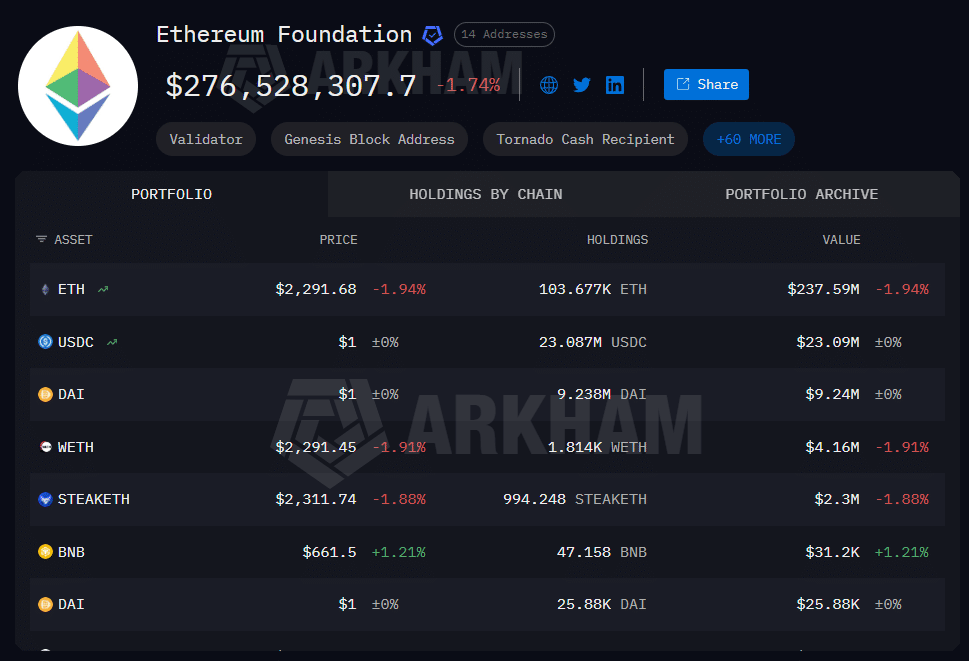
At the time of publishing, Ethereum Foundation’s total ETH holdings sits at 103.677K ETH—valued at approximately $237.60 million.
Divergent Signals, One Ethereum Future
The simultaneous moves create a fascinating tension. BitMine is effectively vacuuming up supply and removing it from circulation through staking, a deflationary force Lee loves to highlight.
The Foundation’s actions, by contrast, could add modest selling pressure once the ETH clears the queue—though analysts at Arkham downplay any immediate market impact given the OTC precedent and the Foundation’s history of measured treasury management.
For ordinary holders, the story is one of conviction versus caution. BitMine’s approach mirrors Strategy’s (Formerly MicroStrategy) Bitcoin playbook but tailored to Ethereum’s proof-of-stake economics: accumulate, stake for yield, and treat the asset as a long-term treasury reserve.
Lee’s public optimism—coupled with real skin in the game—has become a rallying point for bulls who see ETH as undervalued relative to its utility in tokenization and decentralized finance. The Foundation’s move, however modest, serves as a reminder that even insiders face trade-offs.
Operational needs don’t vanish in a bull market, and no one is immune to smart-contract risk after a string of nine-figure hacks. Yet the Foundation’s parallel shift toward self-custody validators suggests it is not abandoning Ethereum—merely rethinking how it participates in staking. Broader market watchers are split on the net effect.
Some see BitMine’s buying as a floor under prices, especially with more than 4% of supply now effectively sidelined. Others worry that repeated Foundation sales could cap upside if they become routine.
ETH itself has been range-bound near $2,300–$2,400 (currently trading at $2,284) waiting for a catalyst—perhaps clearer U.S. regulatory progress or fresh institutional inflows.
What is clear is that Ethereum’s largest corporate accumulator and its nonprofit guardian are operating on different timetables.
Apparently, BitMine is playing the long game, staking hundreds of millions and projecting triple-digit returns. The Foundation is managing a lean treasury, balancing development costs against protocol risks. Their paths may cross again—after all, BitMine has already bought directly from the Foundation—but for now they embody the push and pull that defines crypto’s maturation.
As Lee put it in a recent update, the supply dynamics are turning disinflationary. Whether that math holds against the Foundation’s periodic sales will help decide if Ethereum’s next leg is a sprint or a grind. For now, the nemeses are locked in a high-stakes dance—one stacking, one unstaking—on the same battlefield.
Also read: Bitcoin Faces Fourth Showdown at Short-Term Holder Cost Basis