
As Strategy Inc. (formerly MicroStrategy) continues its aggressive Bitcoin accumulation strategy, critics like veteran investor Peter Schiff have zeroed in on the company’s newly issued preferred stock, STRC.
Earlier this week, Schiff has labeled the 11.5% perpetual preferred shares a “classic centralized Ponzi” scheme run by the company. His comments come as STRC trading volume remains elevated ahead of a key dividend date and as investors await the next weekly Bitcoin purchase announcement.
“Saylor dodged my argument that $STRC is a Ponzi by saying, “Peter thinks Bitcoin’s a Ponzi scheme. Peter is not really a lover of anything in this space.” But I’ve called Bitcoin a new variant of decentralized Ponzi,” Schiff said in an X post.
He asserted that ‘STRC is a classic centralized Ponzi’ run by $MSTR (Strategy).
Strategy, under Chairman Michael Saylor, has built one of the largest corporate Bitcoin treasuries, currently holding 818,869 BTC. The company funds much of its buying through equity sales, including common stock MSTR and the STRC preferred shares.
But the preferred stock STRC’s structure and marketing have drawn sharp rebukes from Schiff, who has long viewed Bitcoin itself as a form of decentralized Ponzi scheme.
Read: STRC — The $100 “Stable Stock” Fueling Strategy’s BTC Treasury
Schiff Targets Saylor’s Comments on Retiree Suitability
In a subsequent X post on the same day, Schiff directly challenged Saylor’s public statements about STRC’s target audience.
In an interview at the Consensus conference in Miami, Saylor described the preferred shares as fitting for retirees seeking low-risk wealth preservation, steady income and protection of principal.
Schiff called the remarks misleading and potentially violative of Securities and Exchange Commission (SEC) anti-fraud and marketing rules.
“STRC is actually high-risk,” Schiff wrote on X. He noted that retirees are among the buyers but argued Saylor’s admissions could strengthen future lawsuits if investors suffer losses. Schiff also highlighted Saylor’s apparent walk-back regarding Bitcoin sales to fund dividends.
Saylor had indicated the company might sell BTC to cover STRC payments but later clarified such sales would occur only while remaining a net buyer overall. Schiff described that condition as requiring the firm to consistently sell high and buy low—an improbable feat in volatile markets.
The critique fits Schiff’s broader skepticism. He has contrasted STRC with Bitcoin, calling the former a centralized vehicle that depends on an ever-growing pool of new buyers to sustain its yield. Saylor, in response, dismissed the attack by noting Schiff’s long-standing bearish view on Bitcoin.
Strategy’s BTC Purchases Slow to Smallest Weekly Total
Strategy announced its latest Bitcoin acquisition on May 11, covering the period from May 5 to May 11. The company purchased 535 BTC for approximately $43 million, at an average price of about $80,340 per coin. That marked the smallest weekly buy of the year and a sharp slowdown from earlier 2026 hauls that sometimes exceeded 30,000 coins in a single week.
The company’s total holdings now stand at 818,869 BTC, with a blended cost basis of roughly $75,540 per coin. Its year-to-date (YTD) Bitcoin yield stands at 9.4%—as per official data.
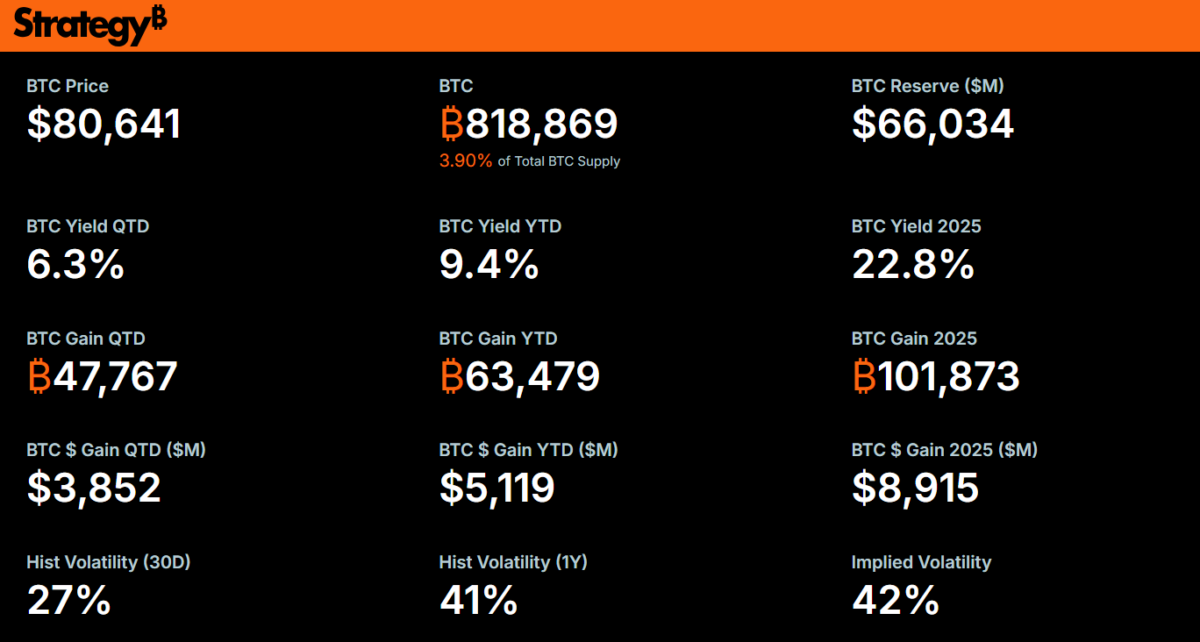
The funding for Strategy’s Bitcoin purchases came mostly from at-the-market sales of common stock, with a smaller contribution from STRC proceeds.
Saylor has repeatedly stressed the company’s commitment to net accumulation, even as he has acknowledged the possibility of selective Bitcoin sales tied to the preferred stock dividend obligations.
While no announcement has yet emerged for purchases covering May 12 through May 18, various post on X suggest—taking STRC volume in count—that this week’s Bitcoin buys will exceed 5,000 as the firm already acquired 2,543.3 BTC on May 11 and 2,982 BTC on May 12—as shown on Bitcoin Treasury’s STRC data.
If this pace continues, Strategy’s current week’s BTC purchases could surpass 10,000—primarily on the STRC issuance and sales.
STRC Volume Remains Robust Heading Into Ex-Dividend Date
Trading in STRC has stayed active as the May 15 ex-dividend date approaches. On May 12, daily dollar volume reached $370.77 millions, with shares hovering near the $100 par value. Data from Strategy’s own investor site showed recent trading volume at $363.4 million for the most recent session, above the 30-day average.
Market observers have noted improved quality of flow, with a higher percentage of trades executing above par compared to earlier sessions. STRC now routinely accounts for a larger share of combined MSTR and STRC activity than it did earlier in the year.
Some analysts view the preferred stock as a form of “digital credit” that helps fuel the broader Bitcoin acquisition flywheel by providing steady capital inflows.
While its volume has not hit the record $1.1 billion single-day peak seen in April, participants continue to watch the instrument closely for signs of sustained demand.
The upcoming semi-monthly dividend payout, set for May 31, is expected to remain a focal point. Strategy has structured STRC to pay a variable rate tied to market conditions, currently set at 11.5%—as of official data.
Polymarket Bettors Price In Near-Certain Bitcoin Announcement
While all the data is public, traders on prediction markets reflect strong confidence that Strategy will maintain its weekly cadence.
On Polymarket, the contract asking whether the company will announce any Bitcoin purchase for the May 12-18 period trades at a 98% probability for “yes,” with thousands of dollars in volume as of May 12 data.
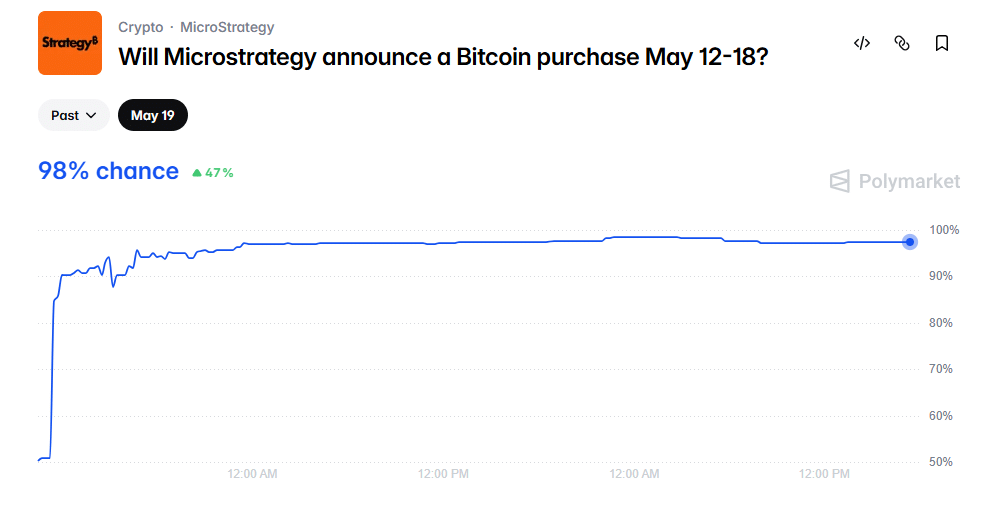
A companion market for an announcement exceeding 1,000 BTC sits at 97% “yes,” with about $29,000 wagered. Both markets resolve on May 19 based on official announcements from Strategy or Saylor, regardless of the actual purchase timing.
With resolution draws from the company’s Bitcoin purchases page, bettors appear to be pricing in continuity rather than disruption, even amid the recent slowdown in purchase size.
Tensions Highlight Broader Questions About Funding Model
The back-and-forth between Schiff and Saylor underscores ongoing debate over Strategy’s capital structure. The company has shifted emphasis toward preferred shares like STRC to diversify beyond common stock sales.
These proponents argue the instrument offers yield-seeking investors exposure to Bitcoin’s upside while providing the firm with lower-cost, longer-term capital. Critics, including Schiff, warn that the high dividend obligation creates dependency on continuous issuance and rising Bitcoin prices.
Strategy’s stock (MSTR) and STRC have both shown volatility this month. MSTR shares traded in the $180-$190 range recently, while STRC has held steady near par. The preferred shares carry no maturity date and rank senior to common equity, features that appeal to income-focused buyers but also introduce leverage tied directly to the Bitcoin treasury.
Saylor has defended the approach by pointing to the company’s track record of net Bitcoin accumulation and transparent disclosures. He has framed STRC as an innovative tool for corporate Bitcoin strategy rather than a risky gimmick.
Yet Schiff’s warnings about potential regulatory scrutiny and investor lawsuits add a layer of caution for those considering the securities.
As of May 13, the market awaits the next weekly Bitcoin update. If Strategy announces another purchase—as Polymarket odds strongly suggest—it would mark the 100-plus consecutive week of additions and reinforce the company’s role as one of Bitcoin’s most consistent corporate buyers. Whether volume in STRC sustains or fades will likely influence the scale of future buys.
The episode illustrates the high-stakes nature of Strategy’s experiment. With more than $61 billion in Bitcoin on the balance sheet, the company’s fortunes remain tightly linked to cryptocurrency prices, issuance capacity and investor appetite for its hybrid equity products.
Schiff’s pointed criticism may not derail the strategy in the short term, but it keeps a spotlight on the risks embedded in the preferred stock structure.