Key Highlights
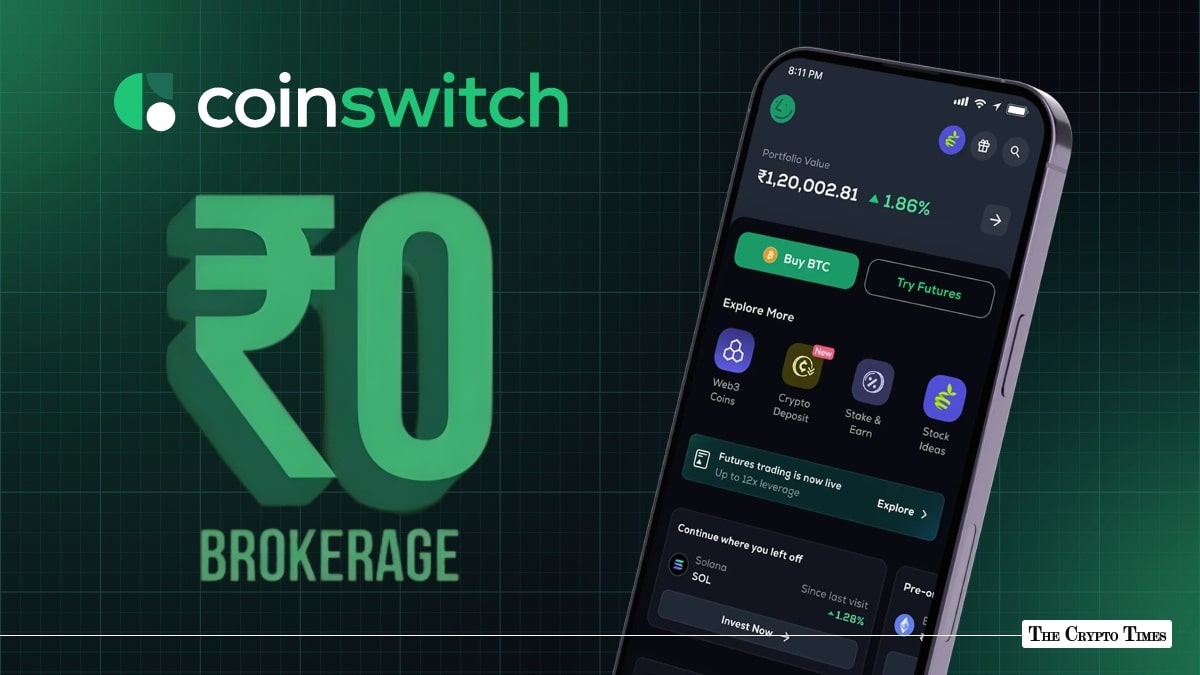
- CoinSwitch has posted on X, indicating a move toward zero or heavily reduced trading fees on its platform.
- This makes it the third major Indian exchange to signal fee elimination, after WazirX launched its ₹99/month ZERO subscription in December 2025 and CoinDCX teased a similar play on March 10.
- Indian traders already pay a flat 30% tax on crypto gains plus 1% TDS per transaction, making platform fees one of the few costs that exchanges can actually control.
CoinSwitch, India’s largest crypto app by registered users (over 20 million), posted a pair of updates on X that strongly suggest the exchange is preparing to drop trading fees. While the posts stop short of confirming a permanent zero-fee model, the timing and tone leave little room for interpretation.
The exchange currently operates a tiered fee structure. Spot trading fees range from 0.04% to 0.4% based on monthly volume. Futures trading on CoinSwitch PRO charges a maker fee of 0.02% and a taker fee of 0.05%. The platform also offers options trading starting at 0.015%, and has previously run limited-time zero-fee windows for specific pairs like XRP/USDT and ETH/USDT.
A broader, permanent fee reduction would be a significant shift for the Bengaluru-based exchange, which is backed by a16z, Tiger Global, and Sequoia Capital India, and was last valued at $1.9 billion.
No official pricing details, launch date, or product structure have been confirmed yet.
This didn’t start with CoinSwitch
The fee war traces back to October 2025, when WazirX resumed trading after a 16-month shutdown. The platform had been offline since July 2024, when a $230 million security breach linked to North Korea’s Lazarus Group wiped out nearly half its reserves and froze all withdrawals.
When WazirX came back online on October 24, 2025, it opened with zero trading fees across all markets for the first 30 days. That wasn’t charity. It was survival. The exchange needed to rebuild trust and pull back users who had migrated to CoinDCX, CoinSwitch, and international platforms during the downtime.
By late November, WazirX formalized the approach into WazirX ZERO, a subscription-based model where users pay ₹99 per month (roughly $1) and trade unlimited crypto with no per-trade fees across 300+ tokens. Founder Nischal Shetty described it as a reset that eliminates “fee pressure on every order.”
The messaging was direct: Indian crypto traders collectively spend thousands of crores annually on trading fees, and WazirX was the first domestic exchange willing to take that number to zero.
Then CoinDCX joined in
On March 10, CoinDCX co-founder Sumit Gupta posted a teaser video on X featuring animated “0” symbols against a blue background. His caption read: “@CoinDCX is launching something very interesting for Indian traders.”
The community’s reading was instant and near-unanimous: CoinDCX, India’s first crypto unicorn valued above $1 billion since 2021, is gearing up to slash fees.
CoinDCX currently charges a base spot trading fee of 0.2% for both makers and takers. For context, the global average taker fee across major exchanges sits at approximately 0.194%, which means CoinDCX is competitive domestically but increasingly exposed as WazirX undercuts on price and international platforms like Bitget offer rates as low as 0.08%.
The exchange has not confirmed whether its announcement involves trading fees specifically. But the “0” imagery, combined with the timing, has made the speculation almost irrelevant. The market has already priced in the expectation.
The part that matters more than fees
Here’s what none of the announcements address: where does the money come from once fees disappear?
Running a compliant Indian crypto exchange is expensive. All three platforms operate under FIU-IND registration, with mandatory KYC/AML frameworks, ISO certifications, institutional-grade custody, and regular audits. CoinDCX absorbed a $44 million hack on an internal account in July 2025 from its own reserves. CoinSwitch holds SOC 2 Type II certification and maintains Proof of Reserves. These are not cheap operations to run.
Trading fees have historically been the primary revenue source for all three exchanges. WazirX’s ₹99/month model works only if users subscribe at scale. Even assuming a fraction of its 16 million registered users convert, the revenue gap compared to percentage-based fees is significant. CoinSwitch and CoinDCX face the same math.
The playbook isn’t unfamiliar. Robinhood popularized commission-free stock trading in the U.S. and changed the brokerage industry permanently. It also quietly built a business around payment for order flow, selling its users’ trade data to market makers. That model came with its own set of controversies and regulatory scrutiny.
Indian exchanges will need to find their own version. Wider spreads, premium subscription tiers, futures-heavy revenue models, options trading margins, or cross-selling into adjacent financial products like CoinSwitch’s Lemonn (a stock investment platform under parent company PeepalCo) are all possibilities. But none of them have been articulated publicly yet.
What it means for the Indian trader, right now
For a retail trader executing ₹10,000 worth of daily spot trades on a platform charging 0.2%, the monthly fee cost comes to roughly ₹600. Under WazirX ZERO, that drops to ₹99. If CoinSwitch and CoinDCX match or beat that number, the savings are real and immediate.
That matters because Indian crypto traders already operate under one of the most punishing tax regimes in the world. A flat 30% tax on crypto gains with no loss set-off, no carry-forward, and 1% TDS deducted at source on every transaction means the effective cost of trading in India is already significantly higher than in most global markets. When exchanges layer their own 0.2% to 0.5% trading fees on top of that, the friction adds up fast.
Eliminating platform fees is one of the few levers exchanges can actually pull to reduce this burden. It doesn’t change the tax math. But it gives active traders more room to operate, and it gives casual investors less reason to hesitate.
The bigger picture
Six months ago, no major Indian crypto exchange offered zero-fee trading as a permanent feature. Today, all three are either offering it, teasing it, or signaling it.
The speed of this shift says something important about where the Indian market is headed. With over 30 million combined registered users across these three platforms, the fight for market share is real.
And in a market where product differentiation is limited (most exchanges list similar tokens, offer similar leverage, and run similar compliance frameworks), pricing becomes the primary battleground.
The question that remains unanswered is simple: can all three sustain this at the same time? Or will the fee war eventually force consolidation, acquisitions, or a quiet return to the old pricing model once the dust settles?
For now, the Indian crypto trader is the clear short-term winner. Whether that lasts depends on what these exchanges build to replace the revenue they’re giving up.
Also Read: India’s Rajya Sabha MP Raghav Chadha Introduces Tokenisation Bill