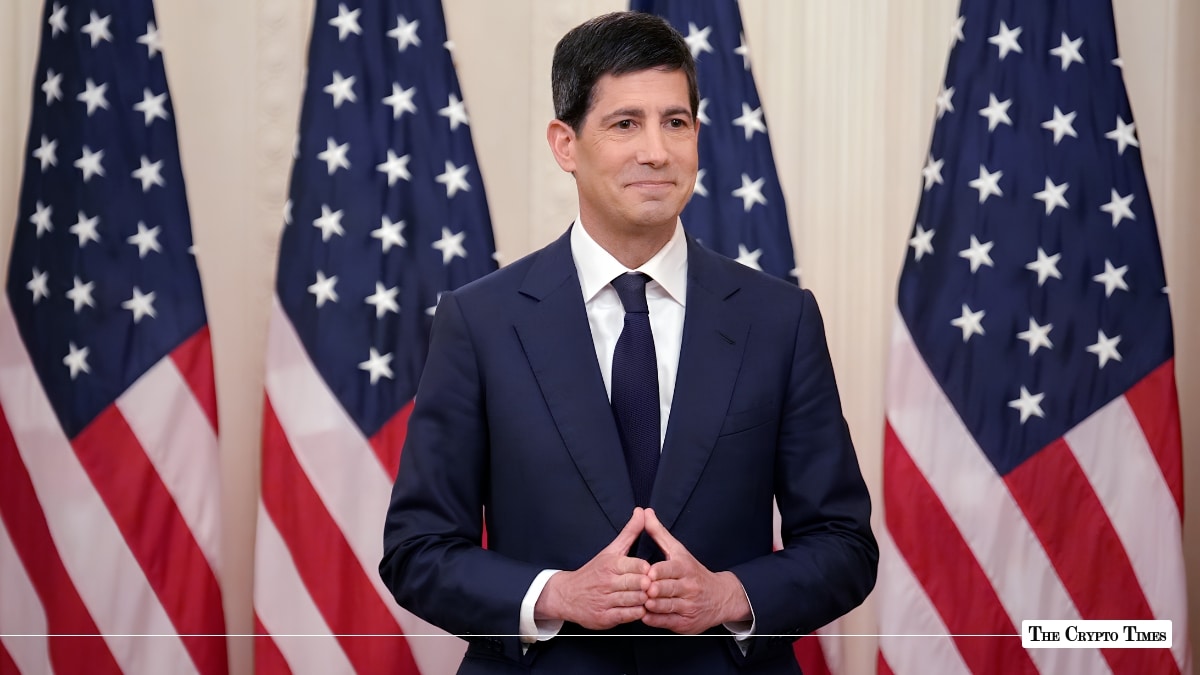
U.S. President Donald Trump today swore in Kevin Warsh as the new chair of the Federal Reserve, marking a leadership change that is drawing attention across cryptocurrency markets.
Warsh officially replaced Jerome Powell after Powell’s term ended on May 15. The White House ceremony was notable because it marked the first time in nearly four decades that a Federal Reserve chair was sworn in at the White House, a practice last seen during Alan Greenspan’s appointment in 1987.
The leadership transition comes as investors assess how Warsh’s views on digital assets, monetary policy, and financial regulation could influence Bitcoin and the broader crypto market.
Warsh has taken a more open view on crypto
Warsh, a former Federal Reserve governor, has previously described Bitcoin as “the new gold” for younger investors and said digital assets are already integrated into modern financial services.
During his Senate confirmation hearings, Warsh argued that policymakers should recognize the growing role of blockchain-based finance rather than treat the sector as a fringe market. His financial disclosures also showed exposure to several crypto-related ventures, including investments connected to blockchain infrastructure firms and prediction market platforms. Under Federal Reserve ethics rules, those holdings are expected to be divested.
Although the Fed does not directly regulate cryptocurrencies, its policies influence liquidity conditions, banking access, and risk appetite across financial markets. That has led many market participants to interpret Warsh’s appointment as potentially more favorable for digital assets than previous Fed leadership.
Bitcoin traders watching policy signals
Bitcoin traded around the mid-$70,000 range following Warsh’s appointment, showing a muted reaction to the leadership transition. At the time of this writing, Bitcoin is trading around $76,772, down 0.55% over the past 24 hours, according to CoinMarketCap.
The 1-week chart shows ongoing consolidation, with BTC maintaining support above the $76,000 level while facing resistance near $78,000. 24-hour trading volume stood at $26.22 billion, indicating relatively cautious participation, while Bitcoin’s market capitalization held at approximately $1.53 trillion.
Traders are now focused on Warsh’s early public comments and the upcoming Federal Open Market Committee meeting for clues on how aggressively the central bank may respond to slowing inflation and economic growth. This balance matters for crypto markets because Bitcoin has increasingly traded in line with broader liquidity conditions rather than as a standalone hedge against economic uncertainty.
Crypto industry sees shift in tone
Warsh’s appointment has also intensified discussion around how the Federal Reserve could approach banking relationships with crypto firms.
Industry executives and investors have argued for clearer rules around digital asset custody, tokenized deposits, and blockchain-based financial products. Warsh has generally supported more defined regulatory frameworks and has criticized what some viewed as overly restrictive enforcement approaches toward the sector.
His arrival comes during a period of rising institutional participation in crypto markets, including the expansion of spot Bitcoin exchange-traded funds and tokenized real-world asset platforms.
At the same time, some economists warn that Federal Reserve leadership changes alone are unlikely to alter the structural risks facing digital assets, particularly if inflation remains elevated or broader financial conditions tighten.
Fed transition adds new variable for Bitcoin
Warsh returns to the Federal Reserve after serving as a governor between 2006 and 2011, including during the global financial crisis. Since leaving the central bank, he has remained active in finance and investment circles, with ties to traditional Wall Street funds as well as emerging technology ventures.
For crypto markets, his appointment adds another variable at a time when investors are already weighing interest rate expectations, geopolitical risks, and institutional adoption trends.
Whether Warsh ultimately delivers a more crypto-friendly policy environment may depend less on rhetoric and more on how the Federal Reserve handles inflation, liquidity, and banking supervision over the coming months.
Also Read: Congress Investigates Insider Trading Risks on Kalshi, Polymarket