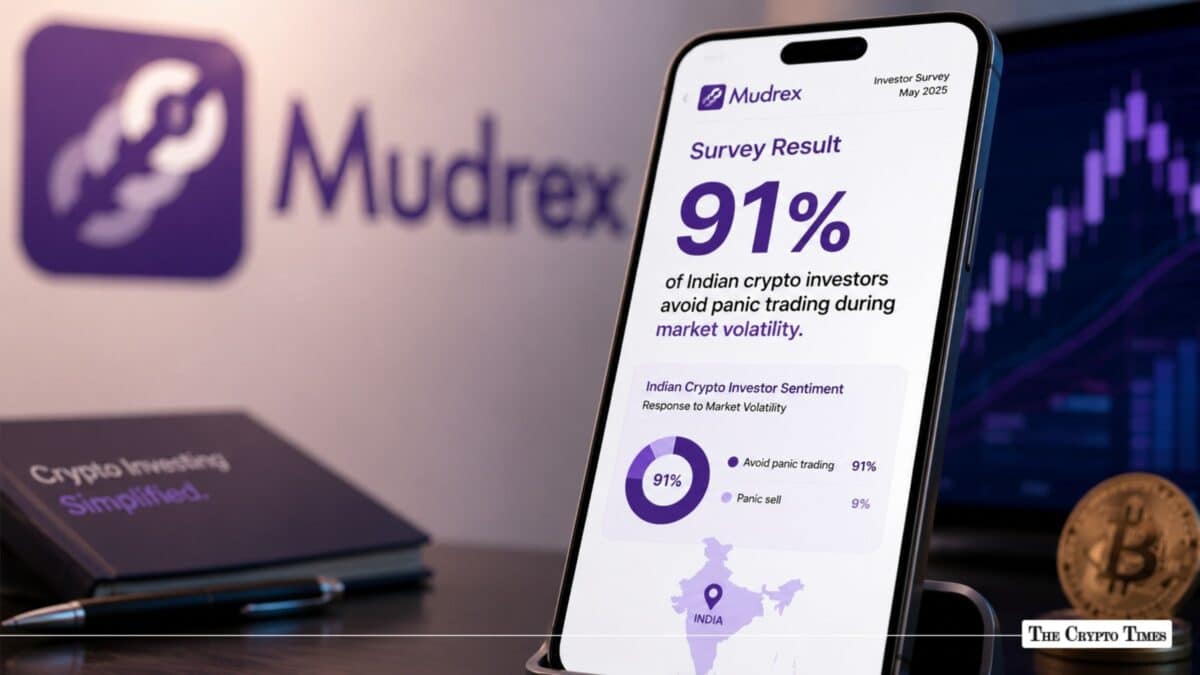
A new pan-India behavioural survey of over 6,000 active crypto traders and investors has found that 91% of them avoid panic trading during sharp market movements. The finding, published in Mudrex’s How India Trades Crypto 2026 report, challenges the long-standing narrative that retail crypto participation in India is driven primarily by speculation and impulse.
The survey, which covered respondents across 22 states, found that only 9% of Indian crypto investors panic-sell or chase hype when prices swing wildly. The remaining 91% respond to volatility with calibrated portfolio adjustments, patient observation, or deliberate inaction.
The numbers point to a significant shift in how Indian retail participants approach digital assets, one that is rooted in strategy and market understanding rather than emotion.
This discipline is not spread evenly across the country. In Maharashtra, Telangana, and Tamil Nadu, only 3 to 4% of traders reported reactive behaviour during sharp price moves. That is less than half the national average, with roughly just 1 in 29 traders in these states describing their response as panic-driven. Maharashtra and Telangana recorded the lowest reactive trading at 3.2% each, while Tamil Nadu recorded 4%.
Conservative allocation, not concentrated bets
The report also paints a picture of conservative portfolio construction. Nearly half of all respondents, at 48.4%, allocate less than 10% of their total portfolio to crypto. Over 70% keep their crypto allocation under 25%. This is not the behaviour of a speculative crowd making concentrated bets. Indian crypto traders and investors are treating digital assets as a satellite allocation within a broader portfolio.
The state of Madhya Pradesh stood out in particular. There, 72.7% of crypto traders, nearly three in four, keep their crypto exposure below 10% of their total portfolio.
Crypto SIPs grow over 220%
The shift toward discipline is not just showing up in survey responses. Platform-level data backs it up. According to Mudrex, crypto SIP (Systematic Investment Plan) openings grew over 220% in 2025, with average monthly contributions climbing to Rs 4,000 to Rs 6,000 by December.
“There’s a dated perception that India’s crypto users are speculative traders chasing the next price move. This survey shows that most Indian crypto traders and investors are systematic, patient, and measured under pressure,” said Edul Patel, Founder and CEO of Mudrex.
Prateek Gupta, Head of Business at Mudrex, added: “Investors are not just claiming they think long-term; they are putting money in, month after month.”
Buy-and-hold is now the dominant strategy
When respondents were asked to describe their primary approach to crypto, 41.2% identified themselves as long-term buy-and-hold investors. That was the single largest cohort in the survey, ahead of short-term traders at 25.8%.
The buy-and-hold approach is not limited to metros. In West Bengal, 60% of respondents identified as long-term holders. Rajasthan followed at 52%, Karnataka at 51%, and Bihar at 48%, all above the national average.
The 35-44 age Group Leads on Conviction
Among all age cohorts, investors aged 35 to 44 showed the highest long-term conviction. In this group, 45.2% identified as long-term holders, the highest rate of any demographic. The finding suggests that experience in traditional financial markets is translating into greater discipline within crypto.
Women show stronger long-term orientation than Men
One of the more striking findings in the report is the gender split on investment approach. Among women crypto investors, 46.4% identified as long-term holders. That is nearly six percentage points higher than the rate among men and also exceeds the overall survey average.
The data indicates that women who participate in crypto are doing so with a more patient and conviction-driven approach.
India’s 120 million-strong crypto market is growing up
India is already the world’s largest crypto market by user count, with approximately 120 million active participants, according to a Chainalysis report. The country has ranked first on the Chainalysis Global Crypto Adoption Index for three consecutive years, leading across all sub-indices, including retail, centralised services, DeFi, and institutional activity.
The behavioural data in the Mudrex survey suggests that this massive user base is not just large but increasingly mature.
“India’s crypto investors have already done the hard work of building sound habits. What the market now needs is the policy clarity and institutional infrastructure to match that maturity. The frameworks around this asset class need to catch up with the investors who are already in it,” Patel said.
The report arrives at a time when India’s crypto policy remains caught between tightening compliance infrastructure and delayed regulatory clarity. The 30% capital gains tax and 1% TDS continue to shape investor behaviour, while a formal regulatory framework for digital assets remains pending.
Whether the discipline documented in this survey eventually translates into broader institutional recognition of crypto as an asset class in India will depend largely on how quickly policy catches up with the market’s own evolution.
Also Read: Indians Get a Regulated Route to US Crypto Stocks via GIFT City, Leaves Bitcoin ETFs Out