Uniswap has emerged as one of the biggest gainers in the crypto market this week. The native governance token of the world’s largest decentralized exchange posted a sharp rally over the past 48 hours, catching the attention of both retail and institutional traders.
The move comes at a time when the broader crypto market has been relatively flat, with Bitcoin still consolidating below the $66,000 mark.
The rally was triggered by a research report published on June 15 by Standard Chartered Bank, in which the bank’s digital assets team initiated coverage on UNI with a long-term price target of $100 by the end of 2030.
The report was authored by Geoffrey Kendrick, Standard Chartered’s Global Head of Digital Assets Research, who argued that Uniswap should be viewed as core financial infrastructure rather than just another trading platform.
What did the Standard Chartered report say?
According to the report, Kendrick sees UNI as one of the strongest plays on the growth of tokenized real-world assets migrating into decentralized finance. The bank estimates that on-chain tokenized assets will grow from approximately $340 billion today to $4 trillion by the end of 2028.
Furthermore, the share of those assets active within DeFi is expected to climb from 3.5% to 30% by the end of 2030, which would push total DeFi assets to roughly $2.7 trillion, a 37-fold increase from current levels.
The projected price path outlined in the report places UNI at $6.50 by the end of 2026, followed by $20 in 2027, $40 in 2028, $65 in 2029, and ultimately $100 by the close of 2030. Kendrick also noted that UNI could outperform both Bitcoin and Ethereum over this period, making it one of the bank’s highest conviction long-term digital asset calls.
Standard Chartered pointed to the protocol’s automated market maker model, its deep liquidity, and its established brand in the DeFi space as key competitive advantages. The bank also highlighted recent integrations, including institutional products like BlackRock’s BUIDL fund appearing on Uniswap’s extended protocols, as evidence of growing Wall Street interest in decentralized venues.
UNI token burn adds fundamental support
Beyond the Standard Chartered catalyst, UNI’s rally also has a fundamental story backing it. In December 2025, the Uniswap community overwhelmingly approved the “UNIfication” governance proposal with 99.9% support, activating the long-awaited protocol fee switch. The proposal passed with over 125 million UNI voting in favor and just 742 tokens against.
Following the vote, Uniswap Labs executed a one-time burn of 100 million UNI from the protocol treasury on December 28, 2025, permanently destroying roughly 10% of the total supply. At the time, those tokens were valued at approximately $596 million.
Since the fee switch went live, a portion of protocol trading fees is now being redirected to buy and burn UNI tokens on an ongoing basis. Data shows that the protocol has burned an additional 5 million UNI since the upgrade went live, bringing total supply down from 1 billion to approximately 895 million tokens. The protocol generated over $1.05 billion in fees during 2025 alone, and the annualized fee run rate continues to grow.
This burn mechanism has effectively turned UNI from a purely speculative governance token into a deflationary asset with direct ties to protocol activity.
At the time of writing, UNI is trading around $3.63, up over 23% in the last 24 hours and has surged more than 50% in a week. The 24-hour trading volume has spiked to approximately $679 million, nearly doubling from the previous day. The market capitalization now stands at $2.26 billion, and the token has climbed to rank #35 on CoinMarketCap.
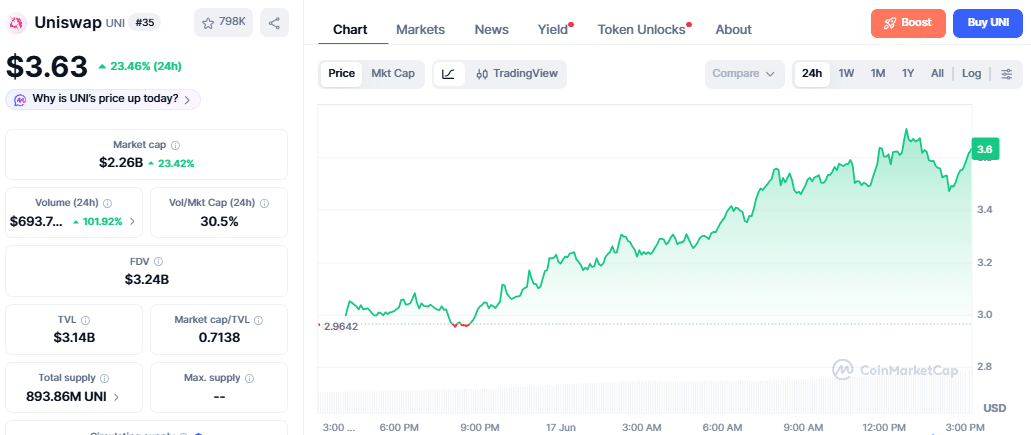
The volume-to-market-cap ratio of 30.5% signals extremely high trading activity relative to UNI’s size, which typically indicates strong momentum but also raises the possibility of short-term profit-taking.
What to watch next
While the rally has been impressive, traders should keep a few things in mind. The move has been largely sentiment-driven, fueled by a forward-looking institutional price target rather than a sudden change in current protocol metrics. Standard Chartered’s $100 target is based on projections about tokenized asset growth that are still years away from materializing.
From a technical standpoint, the price has broken above a resistance zone that had capped UNI for several months. If buying pressure continues and the token holds above the $3.20 level, a push toward $4.00 and beyond becomes more likely. However, a failure to hold current levels could see a pullback toward the $2.80 support area.
The broader market context also matters. Bitcoin remains range-bound, and the Federal Reserve’s upcoming policy decision this week could shift risk appetite across all asset classes, including crypto.
For now, Uniswap has put itself back in the spotlight. The combination of a major institutional endorsement and a working deflationary token model has given UNI one of its strongest days in months. Whether this momentum sustains will depend on whether real volume and adoption follow the narrative.
Also Read: Strategy’s “Bitcoin Machine” STRC Stock Slides 8% Below Par: What it Means and How Could it Recover?