
Key Highlights
- Bittensor (TAO) jumped over 17% on March 20, 2026, hitting intraday highs above $300—its highest level since January.
- The catalyst is a 72-billion-parameter large language model fully trained on Bittensor’s decentralized Subnet 3 by over 70 contributors using commodity internet hardware.
Bittensor’s TAO token surged over 17% on March 20, 2026, breaking above $300 for the first time since January as endorsements from Nvidia CEO Jensen Huang and investor Chamath Palihapitiya sent the decentralized AI narrative into overdrive.
The move was triggered by a segment on the All-In Podcast in which Palihapitiya raised the topic of decentralized AI training directly with Huang. Palihapitiya described the training of a large language model via a distributed network as a “pretty crazy technical accomplishment.”
Huang’s response was significant. The Nvidia CEO endorsed both proprietary and open-source AI models as complementary, framing foundational AI technology as benefiting from decentralized innovation to achieve broader adoption. His comments aligned directly with Bittensor’s core model—a peer-to-peer compute-sharing network that rewards participants with TAO tokens for contributing computing power and AI model training.
The Opentensor Foundation and Bittensor’s subnet team Templar subsequently clarified an inaccuracy from the podcast: the model in question is Covenant-72B, a 72-billion-parameter LLM — not the 4-billion-parameter figure Palihapitiya cited during the broadcast. Covenant-72B was pre-trained permissionlessly across 70+ global contributors using standard internet hardware and achieved a 67.1 MMLU score, confirmed in a March 2026 arXiv paper as the largest decentralized LLM pre-training run on record.
From $143 to $300: The V-Shaped Recovery
TAO’s surge on March 20 is the latest leg in a dramatic V-shaped recovery that began from lows of $143 on February 11, 2026. The token had been in a prolonged downtrend since its all-time high of $767.68 in April 2024, falling over 80% before the current reversal.
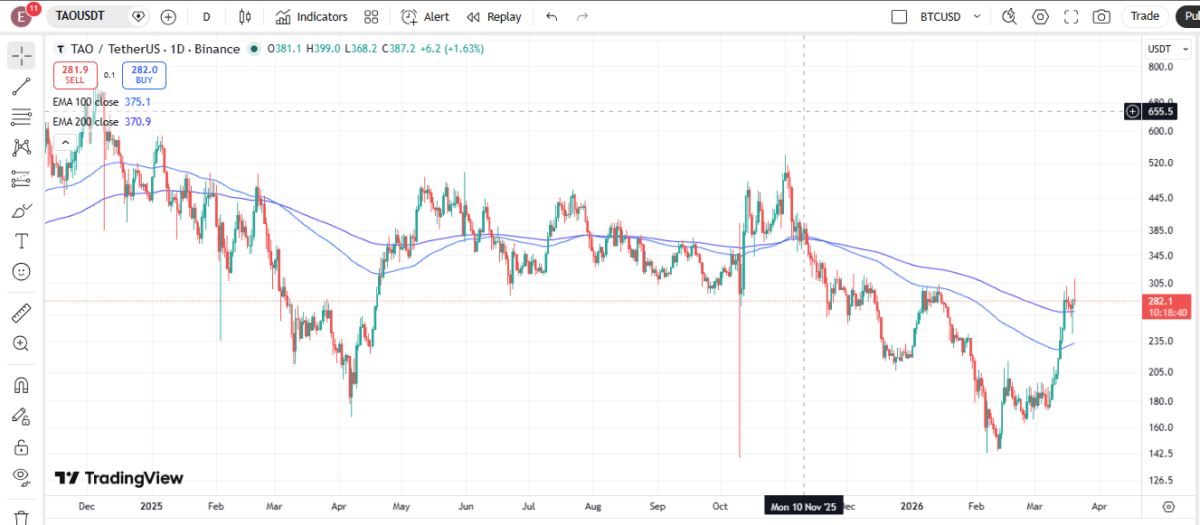
The breakout from an ascending triangle pattern brought TAO above both the 100-day and 200-day exponential moving averages on the daily chart. The token crossed $300 for the first time since January, with the intraday range spanning $243 to $307.
However, technical signals are mixed. The daily RSI is in overbought territory around 76–77, which historically has preceded short-term pullbacks. The MACD remains above its signal line but shows shrinking green histograms, suggesting momentum could be fading.
From a derivatives perspective, the rally appears structurally supported. CoinGlass data shows futures open interest in TAO surged from $131.9 million on March 4 to $361.1 million by March 17—nearly tripling in two weeks.
The Decentralized AI Narrative Gains Institutional Traction
The rally extends beyond Bittensor. Data from CoinMarketCap shows the market cap of the AI and Big Data crypto category increased 4% in the past 24 hours to $17.2 billion, with other tokens in the sector—including Render, Internet Computer, and Kite—posting notable gains alongside TAO.
The institutional backdrop has shifted meaningfully since late 2025. In December 2025, Grayscale filed an S-1 with the SEC to convert its Bittensor Trust into a spot TAO ETF that would trade under the ticker GTAO on NYSE Arca. The filing, which includes plans to stake the fund’s TAO holdings, remains pending and represents a major potential catalyst for regulated institutional access.
Earlier, Grayscale had classified AI as an official sixth sector in its cryptocurrency taxonomy, encompassing 20 tokens, including Bittensor. A separate staked TAO ETP launched on the SIX Swiss Exchange in October 2025 by Deutsche Digital Assets and Safello had already provided European institutional access.
The sector-wide momentum was further amplified by a Wired report on March 9 revealing Nvidia’s plans for NemoClaw, an open-source enterprise AI agent platform—news that triggered the initial wave of buying in AI tokens before Huang’s direct Bittensor comments on the podcast cemented the narrative.
Can TAO Reach $500?
Analysts are divided. The bull case rests on sustained institutional interest (Grayscale ETF approval), continued technical milestones (Covenant-72B and successor models), and the broader convergence of AI and crypto narratives. If TAO confirms a daily close above $302 and clears resistance at $365, the technical path to $450–$500 opens up.
The bear case centers on overbought conditions, the token’s history of sharp corrections after rapid rallies, and the fact that TAO remains down 61% from its all-time high despite the recovery. The fully diluted valuation of approximately $2.7–$3 billion also faces questions about whether decentralized AI infrastructure can capture meaningful revenue at scale.
What is clear is that Bittensor has moved from a niche AI-crypto project to one with endorsements from the CEO of the world’s most valuable semiconductor company and a pending ETF application from the largest crypto asset manager. Whether the price follows the narrative or the fundamentals will determine what comes next.
Also Read: Bitcoin Falls to $70K Max Pain Ahead of $1.72B Deribit Expiry