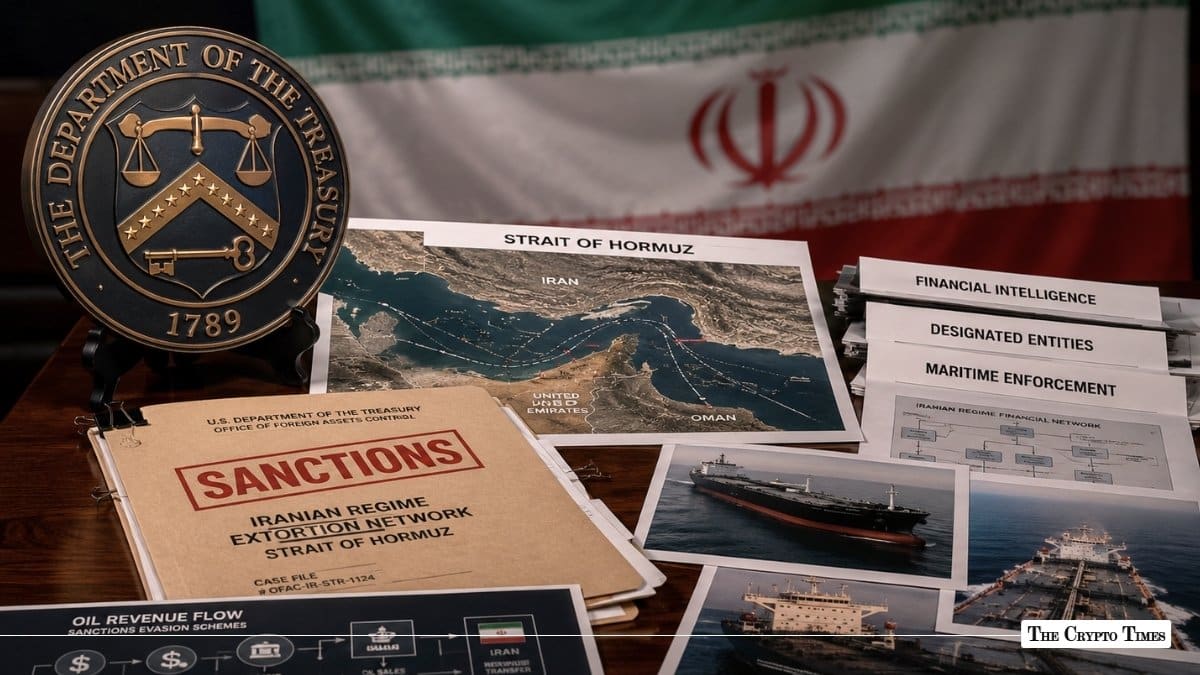
The US Treasury on July 29 sanctioned two Iranian firms behind what it described as a scheme that forces commercial ships to buy mandatory “insurance” to cross the Strait of Hormuz, one of which, Hormuz Safe, collects those payments in Bitcoin and other digital assets. The designations, announced by Treasury’s Office of Foreign Assets Control (OFAC), are the latest US move against Iran’s use of cryptocurrency to bypass Western sanctions and, according to OFAC, channel funds to the Islamic Revolutionary Guard Corps (IRGC).
OFAC also sanctioned eight shadow-fleet tankers and eight companies tied to Iranian oil shipments in the same action. The characterizations of the scheme as “extortion” are OFAC’s; the designations themselves are the operative facts, while the conduct OFAC attributes to the firms is its own allegation and has not been independently adjudicated.
A “digital insurance” firm paid in Bitcoin
The two designated entities are the Persian Gulf Marine Insurance Company (PGMIC) and the HormuzSafe Marine Services Authority, known as Hormuz Safe. Both were listed under Executive Order 13902, which targets entities operating in the financial and petroleum sectors of Iran’s economy. A designation adds a party to OFAC’s Specially Designated Nationals (SDN) list, blocking any US-held assets and generally barring US persons from dealing with them.
Hormuz Safe is the crypto-relevant piece. OFAC describes it as an Iranian digital insurance firm, developed by Iran’s Ministry of Economy, that advertises maritime services including insurance, traffic control, security, and emergency response for vessels transiting the Strait. According to the Treasury, it “accepts payment in Bitcoin and other digital assets as part of the regime’s attempts to bypass Western sanctions” and generates revenue on behalf of the IRGC. OFAC also alleges that a sanctioned Iranian financier, Babak Morteza Zanjani, promoted Hormuz Safe to his social-media followers.
The second firm, PGMIC, was established by the Central Insurance of the Islamic Republic of Iran, the country’s primary insurance regulator, and brokers policies approved by the IRGC-backed Persian Gulf Strait Authority (PGSA), an entity OFAC separately designated on May 27, 2026.
What OFAC alleges
According to OFAC, the scheme forces vessels to buy mandatory maritime “insurance” to pass through the Strait, covering risks such as seizures that, in the Treasury’s words, are “overwhelmingly created by Iran itself.”
Treasury Secretary Scott Bessent said the Iranian government is “desperate for cash” as its economy contracts, and said the US “will not allow Iran to hold global commerce hostage” or use international shipping to finance the IRGC. OFAC framed the action as part of the maximum-pressure campaign directed by National Security Presidential Memorandum 2 (NSPM-2), and referenced a US effort it called Operation Epic Fury.
Shadow fleet: 8 tankers and 8 firms
Alongside the insurance designations, OFAC sanctioned eight vessels it identified as part of Iran’s “shadow fleet,” a covert network of tankers the Treasury says keeps Iranian oil revenue flowing despite sanctions.
Among them are the chemical/products tanker WELL SAIL (IMO 9321938), which OFAC says moved Iranian petroleum products to the UAE, and the crude tankers LILY (IMO 9294331) and AL SALMI (IMO 9298296), which it says carried Iranian oil to China. Eight companies based in China, Hong Kong, and the Marshall Islands were designated as their owners or operators. OFAC said that since the start of the year it has sanctioned more than 100 vessels linked to the shadow fleet.
Part of a widening crypto-sanctions campaign
The action extends a run of 2026 US measures aimed at Iran’s cryptocurrency infrastructure. As The Crypto Times reported in April, OFAC expanded its Central Bank of Iran designation with additional crypto wallet addresses, and stablecoin issuer Tether froze hundreds of millions of dollars in associated USDT; reporting at the time put the April freeze at about $344 million. In June, OFAC designated Iran’s largest crypto exchanges, including Nobitex, for what it said was sanctions evasion and IRGC-linked activity.
The idea of a crypto “toll” on Hormuz shipping had surfaced during earlier US–Iran tensions; this designation targets firms OFAC says are now operating such a scheme.
What the designation means in practice
All property and interests of the designated parties within US jurisdiction are blocked and must be reported to OFAC, and any entity owned 50% or more by blocked persons is also blocked. OFAC warned that foreign firms and financial institutions face secondary-sanctions exposure, the risk of being cut off from the US financial system, for dealing with the designated entities, and noted that civil penalties can apply on a strict-liability basis. Treasury also pointed to FinCEN’s whistleblower program, which can award tipsters whose information leads to penalties exceeding $1 million.
The designated firms have not publicly responded, and Iran has historically rejected US sanctions as unlawful. OFAC noted that parties can petition for removal from the SDN list, and says the goal of sanctions is behavioral change rather than punishment.
Also Read: US Graham Russia Sanctions Bill Advances 86-12, Targets Crypto Evasion